
WE RELATE FROM the Sunans of Abū Dāwūd, at-Tirmidhī, al-Bayhaqī and others from Ibn ‘Umar  , who reported that when the Prophet
  laid the dead in the grave he said: “In the name of Allah and according to the Sunnah of the Messenger of Allah .” [1].At-Tirmidhī describes this as a ḥasan hadith. Ash-Shāfi‘ī and his colleagues, may Allah have mercy on them, hold that it is mustaḥabb to make du‘ā’ for the deceased with these words.
, who reported that when the Prophet laid the dead in the grave he said: “In the name of Allah and according to the Sunnah of the Messenger of Allah .” [1].At-Tirmidhī describes this as a ḥasan hadith. Ash-Shāfi‘ī and his colleagues, may Allah have mercy on them, hold that it is mustaḥabb to make du‘ā’ for the deceased with these words.
Bismi-llāhi wa ‘alā sunnati Rasūli-llāh ṣalla-llāhu ‘alayhi wa sallam.
One of the best du‘ā’s is what ash-Shāfi‘ī says in the Mukhtaṣar of al-Muzanī, that those who put the deceased in the grave should say: O Allah, the reluctant members of his family, children, relatives and brothers have surrendered him to You. He has parted from those who loved to be close to him, and left the spaciousness of the world and life for the darkness and constriction of the grave. He has come as a guest to You and You are the Best Host. If You punish him it is because of his sins and if You forgive him [it is because] You are Forgiving. You are not in need of punishing him, but he is in need of Your Mercy. Allah, show thankfulness for his good deeds and forgive his bad deeds. Protect him from punishment in the grave; and combine this, by Your mercy, with safety from Your punishment; and be his sufficiency in every horror along the way to Paradise. O Allah, take care of those whom he leaves behind, elevate him to be among those who are in the highest Heavens, and return to him with the immense favour of Your Mercy, O Most Merciful of the merciful.
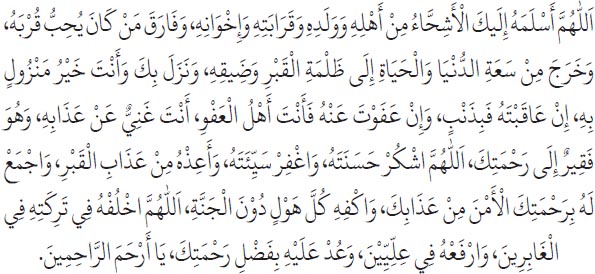
Allāhumma aslamahu ilayka-l-ashiḥḥā’u min ahlihi wa waladihi wa qarābatihi wa ikhwānih, wa fāraqa man kāna yuḥibbu qurbah, wa kharaja min sa‘ati-d-dunyā wa-l-ḥayāti ilā ẓalmati-l-qabri wa ḍīqih, wa nazala bika wa Anta khayru manzūlin bih, in ‘āqabtahu fa-bi-dhanb, wa in ‘afawta ‘anhu fa-Anta ahlu-l-‘afw, Anta Ghaniyyun ‘an ‘adhābih, wa huwa faqīrun ilā raḥmatik. Allāhumma-shkur ḥasanatah, wa-ghfir sayyi’atah, wa a‘idhhu min ‘adhābi-l-qabr, wa-jma‘ lahu bi raḥmatik-l-amna min ‘adhābik, wa-kfihi kulla hawlin dūna-l-Jannah. Allāhumma-khlufhu fī tarikatihi fi-l-ghābirīn, wa-rfa‘hu fī ‘Illiyyīn, wa ‘ud ‘alayhi bi-faḍli raḥmatika yā Arḥama-r-rāḥimīn.
References
[1] Abū Dāwūd (3213), at-Tirmidhī (1046), and al-Bayhaqī (4/55). This hadith is graded as ṣaḥīḥ by Ibn Ḥibbān, al-Ḥākim and adh-Dhahabī.