
IT IS MUSTAḤABB to be assiduous in reciting Qur’ān, doing dhikr, saying du‘ā’ and invoking blessings upon the Messenger of Allah  on Fridays, during the day and night. It is also mustaḥabb to recite the Chapter of the Cave (Sūrat al-Kahf) during the day. According to ash-Shāfi‘ī, it is also mustaḥabb to recite it at night on Friday, i.e. on Thursday night.
on Fridays, during the day and night. It is also mustaḥabb to recite the Chapter of the Cave (Sūrat al-Kahf) during the day. According to ash-Shāfi‘ī, it is also mustaḥabb to recite it at night on Friday, i.e. on Thursday night.We relate in the Ṣaḥīḥs of al-Bukhārī and Muslim from Abū Hurayrah  who reported that the Messenger of Allah spoke about Friday, and said: “During it there is a moment in which no Muslim servant stands performing ṣalāh and asking Allah
  for anything without Allah granting it to him;” [1].and he indicated with his hand that it was not very long.
who reported that the Messenger of Allah spoke about Friday, and said: “During it there is a moment in which no Muslim servant stands performing ṣalāh and asking Allah for anything without Allah granting it to him;” [1].and he indicated with his hand that it was not very long.I say that the ‘ulamā’ of the salaf and khalaf disagree about this hour. I have collected all the opinions on the subject in the Sharḥ al-Muhadhdhab, and have explained it there. Many of the Companions of the Messenger of Allah said that it is after ‘Aṣr. The meaning of standing in ṣalāh is waiting for ṣalāh, for anyone who is waiting for ṣalāh is [regarded as being engaged] in ṣalāh. The most authentic position in this regard is the following.
said that it is after ‘Aṣr. The meaning of standing in ṣalāh is waiting for ṣalāh, for anyone who is waiting for ṣalāh is [regarded as being engaged] in ṣalāh. The most authentic position in this regard is the following.We relate from the Ṣaḥīḥ of Muslim that Abū Mūsā al-Ash‘arī related: “I heard the Messenger of Allah say: ‘It is between the time when the Imam sits and the time when he completes the ṣalāh’” [2].—meaning when he sits on the minbar.
related: “I heard the Messenger of Allah say: ‘It is between the time when the Imam sits and the time when he completes the ṣalāh’” [2].—meaning when he sits on the minbar.There are many well-known hadiths on the subject of the recitation of Sūrat al-Kahf and praying for blessings upon the Messenger of Allah . I have not quoted them here because of the length of the book. Something has been said on this subject earlier in the section.
. I have not quoted them here because of the length of the book. Something has been said on this subject earlier in the section.We relate in the book of Ibn as-Sunnī from Anas who reported that the Messenger of Allah observed: “Whoever says thrice on Friday morning before the early morning ṣalāh: I ask for forgiveness from Allah, but Whom there is no god, the Living, the Self-Subsisting and I repent to Him, Allah will forgive his sins even if they be as abundant as the foam of the sea.” [3].
who reported that the Messenger of Allah observed: “Whoever says thrice on Friday morning before the early morning ṣalāh: I ask for forgiveness from Allah, but Whom there is no god, the Living, the Self-Subsisting and I repent to Him, Allah will forgive his sins even if they be as abundant as the foam of the sea.” [3].
Astaghfiru-llāhu-lladhī lā ilāha illā Huwa-l-Ḥayyu-l-Qayyūmu wa atūbu ilayh.
We relate in it from Abū Hurayrah who related that when the Messenger of Allah entered the mosque on Friday he held the door-jamb and said: “O Allah, make me the most eminent of those who turn towards You, the closest of those who come close to You, and the best of those who ask and request of You.” [4].
who related that when the Messenger of Allah entered the mosque on Friday he held the door-jamb and said: “O Allah, make me the most eminent of those who turn towards You, the closest of those who come close to You, and the best of those who ask and request of You.” [4].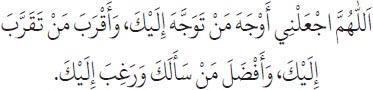
Allāhumma-j‘alnī awjaha man tawajjaha ilayk, wa aqraba man taqarraba ilayk, wa afḍala man sa’alaka wa raghiba ilayk.
In my view, we should add before man the word min, meaning ‘among’. We have stated what is mustaḥabb to recite in the Ṣubḥ ṣalāh and the Friday ṣalāh in the chapter on adhkār in ṣalāh.
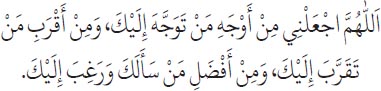
Allāhumma-j‘alnī min awjahi man tawajjaha ilayk, wa min aqrabi man taqarraba ilayk, wa min afḍali man sa’alaka wa raghiba ilayk.
We relate in the book of Ibn as-Sunnī from ‘Ā’ishah  who reported that the Messenger of Allah said: “Whoever recites after the Jumu‘ah prayer: ‘Say: He is Allah, One’, [5].‘Say: I seek refuge in the Lord of the daybreak’ [6].and ‘Say: I seek protection in the Lord of men’ seven times, Allah will give him refuge from evil up until the next Jumu‘ah.” [7].
who reported that the Messenger of Allah said: “Whoever recites after the Jumu‘ah prayer: ‘Say: He is Allah, One’, [5].‘Say: I seek refuge in the Lord of the daybreak’ [6].and ‘Say: I seek protection in the Lord of men’ seven times, Allah will give him refuge from evil up until the next Jumu‘ah.” [7].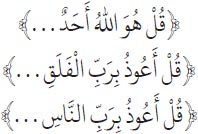
Qul Huwa-llāhu Aḥad. . .
Qul a‘ūdhu bi-Rabbi-l-falaq. . .
Qul a‘ūdhu bi-Rabbi-n-nās. . .
Qul a‘ūdhu bi-Rabbi-l-falaq. . .
Qul a‘ūdhu bi-Rabbi-n-nās. . .
IT IS RECOMMENDED TO DO MUCH DHIKR OF ALLAH MOST HIGH AFTER THE PRAYER OF JUMU‘AH
It is mustaḥabb to continue doing much dhikr after the Friday ṣalāh. Allah says: “And when the prayer is finished, disperse through the land and seek of the bounty of Allah; and remember Allah frequently, so that perhaps you may prosper.” [8].
says: “And when the prayer is finished, disperse through the land and seek of the bounty of Allah; and remember Allah frequently, so that perhaps you may prosper.” [8].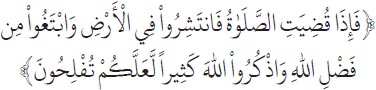
References
[1] Al-Bukhārī (935), Muslim (852), al-Muwaṭṭa’ (1/108), and an-Nasā’ī (3/115) in al-Mujtabā.
[2] Muslim (853) and Abū Dāwūd (1049), with a similar wording.
[3] Ibn as-Sunnī (82).
[4] Ibn as-Sunnī (276).
[5] Qur’ān 112.
[6] Qur’ān 113.
[7] Ibn as-Sunnī (377) and al-Futūḥāt (4/232). Ibn Ḥajar states that this hadith’s chain is weak.
[8] Qur’ān 62:10.