
ALLAH  SAYS: “. . .and that they may celebrate the name of Allah, on the days appointed, over the cattle which He has provided for them (for sacrifice). Then eat thereof, and feed the distressed ones in need.” [1].
SAYS: “. . .and that they may celebrate the name of Allah, on the days appointed, over the cattle which He has provided for them (for sacrifice). Then eat thereof, and feed the distressed ones in need.” [1].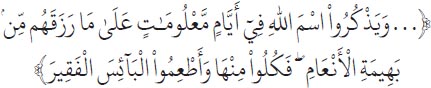
Ibn ‘Abbās  , ash-Shāfi‘ī and the majority of ‘ulamā’ hold that this refers to the [first] ten days [of Dhū al-Ḥijjah].
, ash-Shāfi‘ī and the majority of ‘ulamā’ hold that this refers to the [first] ten days [of Dhū al-Ḥijjah].Know that it is mustaḥabb to perform more dhikr on these ten days than on the others. Likewise, this is mustaḥabb on the Day of ‘Arafāt more than the rest of the [first] ten days.
WE RELATE FROM the Ṣaḥīḥ of al-Bukhārī from Ibn ‘Abbās who reported that the Messenger of Allah  said: “There is no deed better than [one done] during these days.” [The Companions] asked: “Not even doing battle for the Cause of Allah?” He replied: “Not even doing battle, except if a man goes out risking his life and his wealth and does not return with anything.” The wording is from al-Bukhārī’s version, which is ṣaḥīḥ. A version of at-Tirmidhī has: ‘There are no days on which pious deeds are more beloved to Allah than these ten days.” [2].Abū Dāwūd has the same version except that he said “. . .these days,” meaning the ten days. And we relate from the Musnad of Imam Abū Muḥammad ‘Abdullāh ibn ‘Abd ar-Raḥmān ad-Dārimī, with an isnād [equivalent to that] in the two Ṣaḥīḥs, in which he said: “No deed is better than the deeds in the ten days of Dhū al-Ḥijjah.” He was asked: “Not even jihād?” Then he mentioned all of the narration. [3].Another version states “the ten days of al-Aḍḥā”.
who reported that the Messenger of Allah said: “There is no deed better than [one done] during these days.” [The Companions] asked: “Not even doing battle for the Cause of Allah?” He replied: “Not even doing battle, except if a man goes out risking his life and his wealth and does not return with anything.” The wording is from al-Bukhārī’s version, which is ṣaḥīḥ. A version of at-Tirmidhī has: ‘There are no days on which pious deeds are more beloved to Allah than these ten days.” [2].Abū Dāwūd has the same version except that he said “. . .these days,” meaning the ten days. And we relate from the Musnad of Imam Abū Muḥammad ‘Abdullāh ibn ‘Abd ar-Raḥmān ad-Dārimī, with an isnād [equivalent to that] in the two Ṣaḥīḥs, in which he said: “No deed is better than the deeds in the ten days of Dhū al-Ḥijjah.” He was asked: “Not even jihād?” Then he mentioned all of the narration. [3].Another version states “the ten days of al-Aḍḥā”.We relate in the book of at-Tirmidhī from ‘Amr ibn Shu‘ayb, who reported from his father who reported from his grandfather that the Prophet said: “The best du‘ā’ is du‘ā’ on the Day of ‘Arafāt, and the best thing that I and the Prophets before me have said is: There is no god but Allah, One without partners. His is the kingdom and His is the praise, and He has power over all things.” [4].At-Tirmidhī considers this isnād weak.
said: “The best du‘ā’ is du‘ā’ on the Day of ‘Arafāt, and the best thing that I and the Prophets before me have said is: There is no god but Allah, One without partners. His is the kingdom and His is the praise, and He has power over all things.” [4].At-Tirmidhī considers this isnād weak.
Lā ilāha illa-llāhu waḥdahu lā sharīka lah, lahu-l-mulk, wa lahu-l-ḥamd, wa Huwa ‘alā kulli shay’in qadīr.
And we relate from the Muwaṭṭa’ of Imam Mālik, with a mursal isnād with incompleteness in its wording, which is: “The best du‘ā’ is du‘ā’ on the Day of ‘Arafāt, and the best thing that I and the Prophets before me have said is: There is no god but Allah, One without partner.” [5].

Lā ilāha illa-llāhu waḥdahu lā sharīka lah.
It has been reported to us that Sālim [6].ibn ‘Abdullāh ibn ‘Amr saw a beggar begging on the Day of ‘Arafāt and said to him: “O you weak person, [even] today do you ask of others besides Allah ?”
?”Al-Bukhārī [7].related in his Ṣaḥīḥ that ‘Umar said takbīr in his tent in Minā; the people in the mosque heard him and they said takbīr; and the people of the market said takbīr until Minā trembled with takbīr. Al-Bukhārī said that Ibn ‘Umar and Abū Hurayrah used to go out into the market during those ten days and say takbīr, and it would induce the people [in the market] to say the takbīr along with their takbīr.
said takbīr in his tent in Minā; the people in the mosque heard him and they said takbīr; and the people of the market said takbīr until Minā trembled with takbīr. Al-Bukhārī said that Ibn ‘Umar and Abū Hurayrah used to go out into the market during those ten days and say takbīr, and it would induce the people [in the market] to say the takbīr along with their takbīr.References
[1] Qur’ān 22:28.
[2] Al-Bukhārī (969) and at-Tirmidhī (757).
[3] Sunan ad-Dārimī (2/25–26).
[4] At-Tirmidhī (3579). Ibn Ḥajar states that this hadith is gharīb. It was reported by at-Tirmidhī, who states that it is gharīb in this form (wajh). The hadith from al-Muwaṭṭa’ following it is a supporting narration.
[5] Al-Muwaṭṭa’ (246). Ibn ‘Abd al-Barr states that Mālik does not disagree about it being mursal.
[6] Al-Futūḥāt (4/249). Ibn Ḥajar states that this hadith is narrated by Abū Nu‘aym in al-Ḥilyah, in an abridged form, in the biography of Sālim.
[7] Al-Bukhārī (2/461).