
WE RELATE FROM the Sunans of Abū Dāwūd and an-Nasā’ī from Ibn ‘Umar  who related that when the Messenger of Allah
  broke his fast he said: “Thirst is gone, veins have been moistened, and the reward has been secured, if Allah Most High wills.” [1].
who related that when the Messenger of Allah broke his fast he said: “Thirst is gone, veins have been moistened, and the reward has been secured, if Allah Most High wills.” [1].
Dhahaba-ẓ-ẓama’, wa-btallati-l-‘urūq, wa thabata-l-ajru in shā’a-llāh.
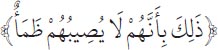
I say: the word aẓ-ẓama’ with the shortened hamzah at the end means ‘thirst’ (al-‘aṭash). Allah (Most High) says: “that is because they are not afflicted by thirst”. [2].I mention this, even though it is obvious, because I have seen those for whom it is ambivalent so that their state of illusion is prolonged.
And we relate from the Sunan of Abū Dāwūd from Mu‘ādh ibn Zahrah, who reported that he had been informed that when the Prophet broke the fast he said: “Allah, for You have I fasted and with Your sustenance I break my fast.” [3].Thus he narrated it as a mursal.
broke the fast he said: “Allah, for You have I fasted and with Your sustenance I break my fast.” [3].Thus he narrated it as a mursal.
Allāhumma laka ṣumt, wa ‘alā rizqika afṭart.
We relate in the book of Ibn as-Sunnī from Mu‘ādh ibn Zahrah who narrated that when the Prophet broke the fast he said: “Praise be to Allah, Who helped me to fast and has given me sustenance so that I could break my fast.” [4].This is related in mursal form.
broke the fast he said: “Praise be to Allah, Who helped me to fast and has given me sustenance so that I could break my fast.” [4].This is related in mursal form.
Al-ḥamdu li-llāhi-lladhī a‘ānanī fa-ṣumt, wa razaqanī fa-afṭart.
We relate in the book of Ibn as-Sunnī from Ibn ‘Abbās  , who related that when the Prophet broke his fast he said: “Allah, for You we have fasted and with Your sustenance we break our fast, so accept it from us. You are the All-Hearing, the All-Knowing.” [5].
, who related that when the Prophet broke his fast he said: “Allah, for You we have fasted and with Your sustenance we break our fast, so accept it from us. You are the All-Hearing, the All-Knowing.” [5].
Allāhumma laka ṣumnā, wa ‘alā rizqika afṭarnā, fa-taqabbal minnā, innaka Anta-s-Samī‘u-l-‘Alīm.
We relate in the books of Ibn Mājah and Ibn as-Sunnī from ‘Abdullāh ibn Abī Mulaykah, who reported that ‘Abdullāh ibn ‘Amr ibn al-‘Āṣ narrated: “I heard the Messenger of Allah say: ‘When a fasting person breaks his fast, he has one du‘ā’ that is not denied.’ Ibn Abī Mulaykah reported that he heard ‘Abdullāh ibn ‘Amr ibn al-‘Āṣ say, when he broke his fast: “O Allah, I ask You by Your Mercy that encompasses everything to forgive me.” [6].
narrated: “I heard the Messenger of Allah say: ‘When a fasting person breaks his fast, he has one du‘ā’ that is not denied.’ Ibn Abī Mulaykah reported that he heard ‘Abdullāh ibn ‘Amr ibn al-‘Āṣ say, when he broke his fast: “O Allah, I ask You by Your Mercy that encompasses everything to forgive me.” [6].
Allāhumma innī as’aluka bi-raḥmatika-llatī wasi‘at kulla shay’in an taghfira lī.
References
[1] Abū Dāwūd (2357).
[2] Qur’ān 9:120.
[3] Abū Dāwūd (2358).
[4] Ibn as-Sunnī (480).
[5] Ibn as-Sunnī (481) and al-Futūḥāt (4/341). Ibn Ḥajar states that this hadith is gharīb and that its chain is seriously weak.
[6] Ibn Mājah (1753) and Ibn as-Sunnī (482).