
IT IS MUSTAḤABB to say In the name of Allah, the Beneficent, the Merciful at the beginning. It is sufficient to say In the name of Allah. Our [Shāfi‘ī] colleagues hold that if one leaves out the name of Allah at the beginning of wuḍū’ one should say it during it, and if one has still not said it when one has finished then one should not say it, because one has neglected the proper place for it; but the wuḍū’ will be valid. This applies whether one leaves it out intentionally or out of forgetfulness. That is our view, and that of the majority of scholars. Weak hadiths have been reported about saying the name of Allah in wuḍū’. Aḥmad ibn Ḥanbal said: “I do not know of any established hadith about mentioning the name of Allah in wuḍū’.” Among those weak hadiths is the following.
Abū Hurayrah  reported that the Messenger of Allah
  said: “There is no wuḍū’ for anyone who has not mentioned the name of Allah over it.” [1].Abū Dāwūd and others narrated it. We relate this from the narration of Sa‘īd ibn Zayd, Abū Sa‘īd, ‘Ā’ishah, Anas ibn Malik and Sahl ibn Sa‘d . We relate them all from the Sunan of al-Bayhaqī as well as others. Al-Bayhaqī and others consider them all to be ḍa‘īf.
reported that the Messenger of Allah said: “There is no wuḍū’ for anyone who has not mentioned the name of Allah over it.” [1].Abū Dāwūd and others narrated it. We relate this from the narration of Sa‘īd ibn Zayd, Abū Sa‘īd, ‘Ā’ishah, Anas ibn Malik and Sahl ibn Sa‘d . We relate them all from the Sunan of al-Bayhaqī as well as others. Al-Bayhaqī and others consider them all to be ḍa‘īf.One of our colleagues, Shaykh Abū al-Fatḥ al-Maqādisī the zāhid (abstinent), said: “It is mustaḥabb for someone making wuḍū’ to say at the beginning, after [saying] the name of Allah, I bear witness that there is no god but Allah, the One Who has no partner, and I bear witness that Muḥammad is His slave and Messenger.” There is no problem with what he said, except that this has not been established from the perspective of the Sunnah and we do not know any of our other colleagues or anyone else who have said this. But Allah knows best.
After completing wuḍū’ one should say: I bear witness that there is no god but Allah, One without partner, and I bear witness that Muḥammad is His slave and Messenger. O Allah, make me one of those who repent and make me one of those who purify themselves. Glory be to You, Allah, and to You belongs all praise. I bear witness that there is no god but You. I ask Your forgiveness and I repent to You.
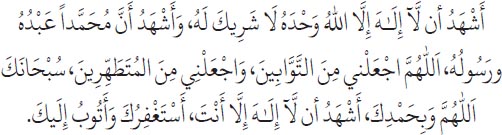
Ashhadu an lā ilāha illa-llāhu waḥdahu lā sharīka lah, wa ashhadu anna Muḥammadan ‘abduhu wa rasūluh, Allāhumma-j‘alnī mina-t-tawwābīn, wa-j‘alnī mina-l-mutaṭahhirīn, subḥānaka-llāhumma wa bi-ḥamdik, ashhadu an lā ilāha illā Ant, astaghfiruka wa atūbu ilayk.
And we relate from ‘Umar ibn al-Khaṭṭāb that the Messenger of Allah said: “Whoever makes ablution and then says I bear witness that there is no god but Allah alone without partner, and I bear witness that Muḥammad is His slave and Messenger, the eight doors of Paradise will be opened for him, and he may enter by any of them that he wishes.” [2].
that the Messenger of Allah said: “Whoever makes ablution and then says I bear witness that there is no god but Allah alone without partner, and I bear witness that Muḥammad is His slave and Messenger, the eight doors of Paradise will be opened for him, and he may enter by any of them that he wishes.” [2].
Ashhadu al-lā ilāha illa-llāhu waḥdahu lā sharīka lah, wa ashhadu anna Muḥammadan ‘abduhu wa rasūluh.
Muslim narrated this in his Ṣaḥīḥ. At-Tirmidhī narrated it and added: O Allah make me one of the repentant and make me one of those who purify themselves.

Allāhumma-j‘alnī mina-t-tawwābīn, wa-j‘alnī mina-l-mutaṭahhirīn.
He also narrated: Glory be to You, Allah! Praise belongs to You. . . to the end. An-Nasā’ī in al-Yawm wa al-laylah, and others, reported this with a weak isnād.
We relate in the Sunan of ad-Dāraquṭnī from Ibn ‘Umar  that the Messenger said: “Whoever performs wuḍū’ and says I bear witness that there is no god but Allah and I bear witness that Muḥammad is His slave and Messenger before he speaks will be forgiven for whatever happens between the two ablutions.” [3].Its isnād is weak.
that the Messenger said: “Whoever performs wuḍū’ and says I bear witness that there is no god but Allah and I bear witness that Muḥammad is His slave and Messenger before he speaks will be forgiven for whatever happens between the two ablutions.” [3].Its isnād is weak.We relate in the Musnad of Aḥmad ibn Ḥanbal, the Sunan of Ibn Mājah and the book of Ibn as-Sunnī that Anas reported that the Messenger said: “Whoever performs wuḍū’ and does so faultlessly, and then says thrice I bear witness that there is no god but Allah, One without partner, and I bear witness that Muḥammad is His slave and Messenger will have the eight doors of Paradise opened for him, and may enter by any of them that he wishes.” [4].The isnād of this hadith is weak.
reported that the Messenger said: “Whoever performs wuḍū’ and does so faultlessly, and then says thrice I bear witness that there is no god but Allah, One without partner, and I bear witness that Muḥammad is His slave and Messenger will have the eight doors of Paradise opened for him, and may enter by any of them that he wishes.” [4].The isnād of this hadith is weak.
Ashhadu an lā ilāha illa-llāhu waḥdahu lā sharīka lah, wa ashhadu anna Muḥammadan ‘abduhu wa rasūluh.
We relate also the repetition of the declaration There is no god but Allah thrice in the book of Ibn aṣ-Ṣunnī on the authority of ‘Uthmān ibn ‘Affān. Its isnād is weak. .
.According to Shaykh Naṣr al-Maqdisī one should say along with these dhikrs: O Allah, send blessings and salutations upon Muḥammad and upon the family of Muḥammad, and add to them and grant peace.

Allāhumma ṣalli ‘alā Muḥammadin wa ‘alā āli Muḥammadin wa sallim.
Our [Shāfi‘ī] colleagues hold that one should say these adhkār facing the qiblah after the completion of wuḍū’.
As for the du‘ā’ to be said while washing the hands, arms and feet during wuḍū’, there is nothing that has been conveyed from the Messenger . The jurists say that the supplications that have been conveyed from early Muslims are mustaḥabb, to which they added some things and from which they removed some. The upshot of what they said is that after saying the name of Allah one should say: Praise be to Allah, Who has made water pure and purifying.
. The jurists say that the supplications that have been conveyed from early Muslims are mustaḥabb, to which they added some things and from which they removed some. The upshot of what they said is that after saying the name of Allah one should say: Praise be to Allah, Who has made water pure and purifying.
Al-ḥamdu li-llāhi-lladhī ja‘ala-l-mā’a ṭahūrā.
After rinsing the mouth one should say: O Allah, give me a cup to drink from the pool of Your Prophet after which I will never thirst again.

Allāhumma asqinī min ḥawḍi Nabiyyika ṣalla-llāhu ‘alayhi wa sallama ka’san lā aẓma’u ba‘dahu abadā.
After cleaning the nose one should say: O Allah, do not deprive me of the fragrance of Your bounty and Your Gardens.

Allāhumma lā taḥrimnī rā’iḥata na‘īmika wa jinānik.
After washing the face one should say: O Allah, make my face white on the day when some faces will be whitened and some will be blackened.

Allāhumma bayyiḍ wajhī yawma tabyaḍḍu wujūhun wa taswaddu wujūh.
After washing the hands one should say: O Allah, give me my book in my right hand. O Allah, do not give me my book in my left hand.

Allāhumma a‘ṭinī kitābī bi-yamīnī. Allāhumma lā tu‘ṭinī kitābī bi-shimālī.
After wiping the head one should say: O Allah, forbid my hair and skin to Hell-Fire, and grant me shade beneath Your Throne on the day when there will be no shade except the shade You grant.

Allāhumma ḥarrim sha‘rī wa basharī ‘alā-n-nār, wa aẓillanī taḥta ‘arshika yawma lā ẓilla illā ẓilluk.
After wiping the ears one should say: O Allah, make me one of those who listen to the Word and follow the best of it.

Allāhumma-j‘alnī mina-lladhīna yastami‘ūna-l-qawla fa-yattabi‘ūna aḥsanah.
After washing the feet one should say: O Allah, make my feet firm on the Bridge. And Allah knows best.
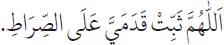
Allāhumma thabbit qadamayya ‘alā-ṣ-ṣirāṭ.
An-Nasā’ī and his colleague Ibn as-Sunnī in their books Kitāb ‘Amal al-yawm wa al-laylah relate with ṣaḥīḥ isnāds that Abū Mūsā al-Ash‘arī said: “I brought the Messenger of Allah water for wuḍū’ and he performed wuḍū’. I heard him say: ‘O Allah, forgive me my sins, give me expansion in my home, and bless me in my sustenance.’ I said: ‘O Messenger of Allah, I heard you supplicate saying such-and-such.’ He replied: ‘Have these words left anything out?’” [5].Ibn as-Sunnī comments on this hadith in the section on what to say in wuḍū’, and an-Nasā’ī includes it in the section on what to say when completing wuḍū’ ; and both are acceptable.
said: “I brought the Messenger of Allah water for wuḍū’ and he performed wuḍū’. I heard him say: ‘O Allah, forgive me my sins, give me expansion in my home, and bless me in my sustenance.’ I said: ‘O Messenger of Allah, I heard you supplicate saying such-and-such.’ He replied: ‘Have these words left anything out?’” [5].Ibn as-Sunnī comments on this hadith in the section on what to say in wuḍū’, and an-Nasā’ī includes it in the section on what to say when completing wuḍū’ ; and both are acceptable.
Allāhumma-ghfir lī dhanbī, wa wassi‘ lī fī dārī, wa bārik lī fī rizqī.
References
[1] Abū Dāwūd (101). According to al-Mundhirī, none of the chains of narration for the hadiths on this topic are above criticism; collectively however, they strengthen each other. See at-Targhīb wa-t-tarhīb (1/164).
[2] Muslim (234), at-Tirmidhī (55), Ibn Mājah (470), and an-Nasā’ī in ‘Amal al-yawm wa al-laylah (84).
[3] Sunan ad-Dāraquṭnī (1/93). Ibn Ḥajar describes this hadith as gharīb.
[4] Aḥmad (3/265), Ibn Mājah (469), Ibn as-Sunnī (32), and al-Futūḥāt (2/21–22). Ibn Ḥajar said that this is a gharīb hadith reported by Aḥmad, Ibn Mājah, Abū Ya‘lā, Ibn as-Sunnī and aṭ-Ṭabarānī. Its chain of narrators includes Umar ibn ‘Abdullāh ibn Wahb, who is exceedingly truthful (ṣadūq), who narrated from Zayd al-Ummī, who came from Basra and whose narration is weak according to the majority.
[5] An-Nasā’ī in ‘Amal al-yawm wa al-laylah (80), Ibn as-Sunnī (28), and al-Futūḥāt (2/33). Ibn Ḥajar said that all of the narrators in the chain for this hadith are narrators of ṣaḥīḥ hadiths , except for Ubad ibn Ubad.