
WE RELATE FROM the Ṣaḥīḥ of Muslim that Miqdād  , in a long and well-known hadith, narrated that the Messenger of Allah
  lifted his head to the heavens and said: “O Allah, feed the one who has fed me and give to drink the one who has given me to drink.” [1].
, in a long and well-known hadith, narrated that the Messenger of Allah lifted his head to the heavens and said: “O Allah, feed the one who has fed me and give to drink the one who has given me to drink.” [1].
Allāhumma aṭ‘im man aṭ‘amanī, wa-sqi man saqānī.
We relate in the book of Ibn as-Sunnī that ‘Amr ibn al-Ḥamiq narrated that he gave the Messenger of Allah milk to drink and he said: “O Allah, grant that he continue to enjoy his youth.” He [‘Amr] lived for eighty years without seeing any white hairs. [2].
narrated that he gave the Messenger of Allah milk to drink and he said: “O Allah, grant that he continue to enjoy his youth.” He [‘Amr] lived for eighty years without seeing any white hairs. [2].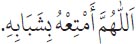
Allāhumma amti‘hu bi-shabābih.
I say that al-Ḥamiq has a fatḥah on the ḥā’ and a kasrah on the mīm.
We relate in the same source that ‘Amr ibn al-Akhṭab —with a khā’ and a fatḥah on the ṭā’—reported: “The Messenger of Allah asked for water and I brought him a wooden vessel in which was a hair, which I took out. The Messenger of Allah said: ‘O Allah, make him handsome.’” The narrator said: “I saw him at the age of ninety-three, and his hair and beard were black.” [3].
—with a khā’ and a fatḥah on the ṭā’—reported: “The Messenger of Allah asked for water and I brought him a wooden vessel in which was a hair, which I took out. The Messenger of Allah said: ‘O Allah, make him handsome.’” The narrator said: “I saw him at the age of ninety-three, and his hair and beard were black.” [3].
Allāhumma jammilh.
I say that jumjumah, with two jīms both with ḍammah and in between them a mīm with a sukūn, is a wooden vessel. Its plural is jamājim, after which Dayr al-Jamājim is named—that being the place in Iraq where the battle between Ibn al-Ash‘ath and al-Ḥajjāj took place—because they used to make wooden vessels there. Some have said it was named thus because it was built from the wooden vessels of the slain because of the great number of those killed.
References
[1] Muslim (2055).
[2] Ibn as-Sunnī (476) and al-Futūḥāt (5/255). Ibn Ḥajar states that the chain for this hadith is weak; however, it has two supporting narrations which are reported by aṭ-Ṭabarānī and Ibn as-Sunnī.
[3] Ibn as-Sunnī (478). This hadith is ḥasan. See al-Futūḥāt (5/255).