
ALLAH  SAYS: “So do not think highly of yourselves.”
SAYS: “So do not think highly of yourselves.”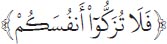
Know that to speak of one’s own good qualities can either be blameworthy or approved of. What is blameworthy is to mention them with pride and a display of superiority and importance over one’s peers. What is approved of is that in which there is some religious benefit. This [may arise from the speaker] enjoining good and discouraging evil, advising, guiding people to what is advantageous, teaching, training, admonishing, reminding or making peace between two people, or warding off evil. A person may mention his own good qualities intending thereby to make it easier to accept his word and believe what he is saying, or that “This thing that I am telling you, you will not find it with anyone other than me, so learn it from me,” and so on. There are innumerable texts in this regard. The Prophet  said: “I am the Prophet, and that is no lie,” “I am the leader of the progeny of Adam,” “I shall be the first for whom the earth will split,” “I am the most knowledgeable of you about Allah and I fear Him the most,” and “I spend the night with my Lord.” There are many similar sayings.
said: “I am the Prophet, and that is no lie,” “I am the leader of the progeny of Adam,” “I shall be the first for whom the earth will split,” “I am the most knowledgeable of you about Allah and I fear Him the most,” and “I spend the night with my Lord.” There are many similar sayings.Yūsuf  said: “Set me over the storehouses of the land. I shall be a knowledgeable guardian.” [1].
said: “Set me over the storehouses of the land. I shall be a knowledgeable guardian.” [1].
Shu‘ayb said: “Truly you will find me, if Allah wills, one of the righteous.” [2].
said: “Truly you will find me, if Allah wills, one of the righteous.” [2].
We relate in the Ṣaḥīḥ of al-Bukhārī that when ‘Uthmān  was besieged, he said: “Do you not know that the Messenger of Allah said: ‘Whoever equips the troubled army will have Paradise’? I equipped them. Do you not know that the Messenger of Allah said: ‘Whoever digs the well of Rūmah will have Paradise’? I dug it’”. Those present confirmed what he said. [3].
was besieged, he said: “Do you not know that the Messenger of Allah said: ‘Whoever equips the troubled army will have Paradise’? I equipped them. Do you not know that the Messenger of Allah said: ‘Whoever digs the well of Rūmah will have Paradise’? I dug it’”. Those present confirmed what he said. [3].We relate in the Ṣaḥīḥs about Sa‘d ibn Abī Waqqāṣ that the people of Kūfah complained to ‘Umar ibn al-Khaṭṭāb about Sa‘d ibn Abī Waqqāṣ , saying: “He does not perform the ṣalāh properly.” Sa‘d said: “By Allah, I was the first of the Arabs to shoot an arrow for the Cause of Allah. We went out for the Cause of Allah with the Messenger of Allah .” He then cited the rest of the hadith. [4].
about Sa‘d ibn Abī Waqqāṣ , saying: “He does not perform the ṣalāh properly.” Sa‘d said: “By Allah, I was the first of the Arabs to shoot an arrow for the Cause of Allah. We went out for the Cause of Allah with the Messenger of Allah .” He then cited the rest of the hadith. [4].We relate in the Ṣaḥīḥ of Muslim that ‘Alī said: “By Him Who splits the seed and created the soul, the Prophet made a vow to me that no one loves me but a believer and no one hates me but a hypocrite.” [5].
said: “By Him Who splits the seed and created the soul, the Prophet made a vow to me that no one loves me but a believer and no one hates me but a hypocrite.” [5].I say that bara’a (‘created’) is written with a hamzah, and it means the same as khalaqa. Nasamah (‘soul’) means the same as nafs (‘self’ or ‘soul’).
We relate in both Ṣaḥīḥs that Abū Wā’il narrated that Ibn Mas‘ūd addressed [the Tābi‘īn], saying: “By Allah, I have learned from the mouth of the Messenger of Allah some seventy Sūrahs. The Companions of the Messenger of Allah knew that I was one of the most learned among them about the Book of Allah, although I was not the best of them. If I knew of anyone more learned than me I would travel to him.” [6].
addressed [the Tābi‘īn], saying: “By Allah, I have learned from the mouth of the Messenger of Allah some seventy Sūrahs. The Companions of the Messenger of Allah knew that I was one of the most learned among them about the Book of Allah, although I was not the best of them. If I knew of anyone more learned than me I would travel to him.” [6].There are innumerable hadiths similar to these which are all interpretable in the way we have mentioned. And it is Allah Who grants success.
References
[1] Qur’ān 12:55.
[2] Qur’ān 28:27.
[3] Al-Bukhārī (2778).
[4] Al-Bukhārī (3728), Muslim (2966), and at-Tirmidhī (2366).
[5] Muslim (78).
[6] Al-Bukhārī (5002), Muslim (2462), and an-Nasā’ī (8/134).