
it is sunnah to say: ‘May Allah bless you, or ‘may He send blessings upon you and may He unite you in goodness.’
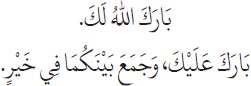
Bāraka-llāhu lak.
Bāraka ‘alayk, wa jama‘a baynakumā fī khayr.
Bāraka ‘alayk, wa jama‘a baynakumā fī khayr.
It is mustaḥabb to say to the bride and groom: ‘May Allah bless each of you in your partner and unite you in goodness.’

Bāraka-llāhu li-kulli wāḥidin minkumā fī ṣāḥibih, wa jama‘a baynakumā fī khayr.
We relate in the Ṣaḥīḥs of al-Bukhārī and Muslim that Anas  related that the Prophet
  said to ‘Abd ar-Raḥmān ibn ‘Awf , when he informed him that he had got married, “May Allah bless you.” [1].
related that the Prophet said to ‘Abd ar-Raḥmān ibn ‘Awf , when he informed him that he had got married, “May Allah bless you.” [1].
Bāraka-llāhu lak.
We relate, again from the Ṣaḥīḥ, that he said to Jābir , when he informed him that he had got married, “May Allah bless you.” [2].
said to Jābir , when he informed him that he had got married, “May Allah bless you.” [2].
Bāraka-llāhu ‘alayk.
We relate with ṣaḥīḥ isnāds from the Sunans of Abū Dāwūd, at-Tirmidhī, Ibn Mājah and others, that Abū Hurayrah reported that when the Prophet congratulated a man when he had married he said: “May Allah bless you, shower blessings on you, and unite you in goodness.” [3].According to at-Tirmidhī, this is a ḥasan ṣaḥīḥ hadith.
reported that when the Prophet congratulated a man when he had married he said: “May Allah bless you, shower blessings on you, and unite you in goodness.” [3].According to at-Tirmidhī, this is a ḥasan ṣaḥīḥ hadith.
Bāraka-llāhu lak, wa bāraka ‘alayk, wa jama‘a baynakumā fī khayr.
THE DISAPPROVAL OF ADDING ‘WITH CLOSE UNION AND CHILDREN’
It is makrūh to say to [a newly wedded man]: ‘with close union and children.’ We will discuss the evidence for the disapproval of this in the chapter on guarding the tongue at the end of this book.
Rifā’, with a kasrah on the rā’ and with a maddah [on the fā’], means ‘union’.
References
[1] Al-Bukhārī (5155), Muslim (1427), al-Muwaṭṭa’ (2/545), Abū Dāwūd (2109), at-Tirmidhī (1094), and an-Nasā’ī (6/137).
[2] Al-Bukhārī (6387), Muslim (715), Abū Dāwūd (2048), at-Tirmidhī (1086), and an-Nasā’ī (6/69).
[3] Abū Dāwūd (2130, at-Tirmidhī (1091), Ibn Mājah (1905), and al-Futūḥāt (6/79). Ibn Ḥajar mentions that Abū al-Fatḥ al-Qushayrī, in his book al-Iqtirāḥ, grades it as ṣaḥīḥ according to the criteria of Imam Muslim.