
ALLAH  SAYS: “Perish the hands of Abū Lahab, and perish he!” [1].
SAYS: “Perish the hands of Abū Lahab, and perish he!” [1].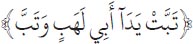
His name was ‘Abd al-‘Uzzā. It is said that his kunyah was mentioned here because he was [generally] known by it. It is also said that this was because his name was abhorrent, because it made him the slave of an idol.
We relate in the Ṣaḥīḥs of al-Bukhārī and Muslim that Usāmah ibn Zayd  reported that the Messenger of Allah
  rode on a donkey to visit Sa‘d ibn ‘Ubādah while he was sick. He recounted the rest of the hadith and that the Prophet passed by ‘Abdullāh ibn Ubayy ibn Salūl, a hypocrite. He continued: “The Prophet travelled until he reached Sa‘d ibn ‘Ubādah. The Prophet asked: ‘Sa‘d, did you not hear what Abū Ḥubāb (meaning ‘Abdullāh ibn Ubayy) was saying? He said such-and-such.’” [2].I say: “The hadiths repeatedly mention Abū Ṭālib, whose name was ‘Abd Manāf. The Ṣaḥīḥ reads: ‘This is the grave of Abū Righāl.’ [3].There are many similar instances. All this applies only when the condition that we mentioned earlier is fulfilled. If it is not fulfilled, only their names are mentioned. The Messenger of Allah wrote: ‘From Muḥammad, the servant and Messenger of Allah, to Hiraql [Heraclius].’ [4].He called him by his name and did not include any title or nickname. His title was the Emperor of Rome, the Caesar. There are many [similar examples]. We have been commanded to be harsh with such people. It is not befitting that we should give them a kunyah or be gentle in speech with them and thereby show love and affection towards them.”
reported that the Messenger of Allah rode on a donkey to visit Sa‘d ibn ‘Ubādah while he was sick. He recounted the rest of the hadith and that the Prophet passed by ‘Abdullāh ibn Ubayy ibn Salūl, a hypocrite. He continued: “The Prophet travelled until he reached Sa‘d ibn ‘Ubādah. The Prophet asked: ‘Sa‘d, did you not hear what Abū Ḥubāb (meaning ‘Abdullāh ibn Ubayy) was saying? He said such-and-such.’” [2].I say: “The hadiths repeatedly mention Abū Ṭālib, whose name was ‘Abd Manāf. The Ṣaḥīḥ reads: ‘This is the grave of Abū Righāl.’ [3].There are many similar instances. All this applies only when the condition that we mentioned earlier is fulfilled. If it is not fulfilled, only their names are mentioned. The Messenger of Allah wrote: ‘From Muḥammad, the servant and Messenger of Allah, to Hiraql [Heraclius].’ [4].He called him by his name and did not include any title or nickname. His title was the Emperor of Rome, the Caesar. There are many [similar examples]. We have been commanded to be harsh with such people. It is not befitting that we should give them a kunyah or be gentle in speech with them and thereby show love and affection towards them.”References
[1] Qur’ān 111:1.
[2] Al-Bukhārī (4566) and Muslim (1798).
[3] Abū Dāwūd (3088) and al-Futūḥāt (4/214). Ibn Ḥajar states that this hadith is ḥasan gharīb.
[4] Al-Bukhārī (2940) and Muslim (1773).