
IF SOMEONE TELLS you ‘Between me and you is the Book of Allah’, or ‘the Sunnah of Allah’s Messenger  ’, or ‘the rulings of the ‘ulamā’ of the Muslims’, or ‘Let us go to the ruler of the Muslims’, or ‘to the Muftī to decide the dispute between us’, and suchlike, he ought to reply: ‘We hear and we obey’, or ‘Hearing and obedience’, or ‘Yes, and nobly’, or suchlike.
’, or ‘the rulings of the ‘ulamā’ of the Muslims’, or ‘Let us go to the ruler of the Muslims’, or ‘to the Muftī to decide the dispute between us’, and suchlike, he ought to reply: ‘We hear and we obey’, or ‘Hearing and obedience’, or ‘Yes, and nobly’, or suchlike.Allah  says: “The answer of the believers, when summoned to Allah and His Messenger, that He may judge between them, is no other than to say, ‘We hear and obey’. It is those who shall attain felicity.” [1].
says: “The answer of the believers, when summoned to Allah and His Messenger, that He may judge between them, is no other than to say, ‘We hear and obey’. It is those who shall attain felicity.” [1].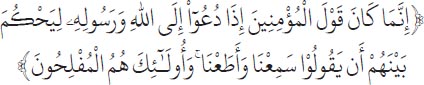
BEING COURTEOUS IN LITIGATION AND DISPUTE AND KEEPING FAR AWAY FROM INAPPROPRIATE SPEECH
If a person with whom one has a dispute or who argues with one about something says ‘Have taqwā of Allah ’, or ‘Fear Allah ’, or ‘Be vigilantly aware of Allah ’, or ‘Know that Allah watches over you’, or ‘Know that what you are saying is written down against you and you will be taken to account for it’; or if he tells you, ‘Allah says: “On the Day when every soul shall be confronted with all the good it has done, and all the evil it has done, it will wish there were a great distance between itself and [its evil]”’; [2].
’, or ‘Fear Allah ’, or ‘Be vigilantly aware of Allah ’, or ‘Know that Allah watches over you’, or ‘Know that what you are saying is written down against you and you will be taken to account for it’; or if he tells you, ‘Allah says: “On the Day when every soul shall be confronted with all the good it has done, and all the evil it has done, it will wish there were a great distance between itself and [its evil]”’; [2].
or ‘“And fear the Day when you shall be brought back to Allah. Then shall every soul be paid what it earned, and none shall be wronged”’; [3].

or any such āyāt or similar words—one ought to act respectfully and say: ‘Hearing and obedience,’ or ‘I ask Allah for success in that,’ or ‘I ask Allah, the Noble, for His grace.’ Then one should be gracious and kind in addressing the person who said it to one. And one should beware completely of being careless at that point of his expression since so many people at such a time speak inappropriately, sometimes expressing themselves [in words] that can be kufr.
Similarly, if a companion tells one, “This thing you have done is contrary to the hadith of the Messenger of Allah ” or something, [beware] of saying, “I do not adhere to the hadith” or “I do not act by the hadith” or any such repugnant expressions—even if the hadith is not accepted outwardly because of some particularisation of interpretation or suchlike. Rather, one should then say, “This hadith has a particular meaning”, or “It has an interpretation”, or “Its literal sense is not accepted, by the consensus”, or something similar.
” or something, [beware] of saying, “I do not adhere to the hadith” or “I do not act by the hadith” or any such repugnant expressions—even if the hadith is not accepted outwardly because of some particularisation of interpretation or suchlike. Rather, one should then say, “This hadith has a particular meaning”, or “It has an interpretation”, or “Its literal sense is not accepted, by the consensus”, or something similar.References
[1] Qur’ān 24:51.
[2] Qur’ān 3:30.
[3] Qur’ān 2:281.