
THIS IS THE most important chapter, or one of the most important, because of the many texts that bear on it and because of its prominence, its extreme importance and the fact that it is frequently neglected by most people. It is not possible to examine all the details, so I will mention some of the principles here. The learned have compiled various books on the subject. I collected some of [what they wrote] in the beginning of [my] commentary on the Ṣaḥīḥ of Muslim and drew attention in it to important matters which it is essential to know.
Allah  says: “Let there be a group of you who summon [others] to [all that is] good, enjoin what is right, and forbid what is reprehensible: it is those who are the successful.” [1].
says: “Let there be a group of you who summon [others] to [all that is] good, enjoin what is right, and forbid what is reprehensible: it is those who are the successful.” [1].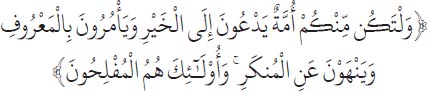
Allah says: “Hold on to forgiveness and enjoin what is right.” [2].
says: “Hold on to forgiveness and enjoin what is right.” [2].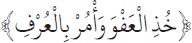
Allah says: “The believers, men and women, are protectors of one another: they enjoin what is right and forbid what is reprehensible.” [3].
says: “The believers, men and women, are protectors of one another: they enjoin what is right and forbid what is reprehensible.” [3].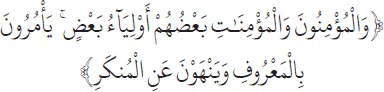
Allah says: “They did not forbid one another any iniquities that they committed. Evil indeed is that which they used to do!” [4].
says: “They did not forbid one another any iniquities that they committed. Evil indeed is that which they used to do!” [4].
The verses in this regard are very well-known.
We relate in the Ṣaḥīḥ of Muslim that Abū Sa‘īd al-Khudrī  narrated: “I heard the Messenger of Allah
  say: ‘Whoever of you sees something reprehensible should change it with his hand; and if he is unable to do so then with his tongue; and if he is unable to do so then with his heart; and that is the weakest form of faith.’” [5].
narrated: “I heard the Messenger of Allah say: ‘Whoever of you sees something reprehensible should change it with his hand; and if he is unable to do so then with his tongue; and if he is unable to do so then with his heart; and that is the weakest form of faith.’” [5].We relate in the book of at-Tirmidhī that Ḥudhayfah related that the Prophet said: “I swear by Him Who has my life in His hands, without a doubt you must enjoin what is beneficial and forbid what is reprehensible, or Allah will surely send down upon you a punishment from Him. Then you will pray to Him but He will not answer your prayers.” [6].At-Tirmidhī says that this is a ḥasan hadith.
related that the Prophet said: “I swear by Him Who has my life in His hands, without a doubt you must enjoin what is beneficial and forbid what is reprehensible, or Allah will surely send down upon you a punishment from Him. Then you will pray to Him but He will not answer your prayers.” [6].At-Tirmidhī says that this is a ḥasan hadith.We relate in the Sunans of Abū Dāwūd, at-Tirmidhī, an-Nasā’ī, and Ibn Mājah that Abū Bakr said: “O people, you recite this verse: ‘You who believe, guard your own souls; no harm can come to you from those who go astray if you follow guidance.’ [7].I heard the Messenger of Allah say: ‘If people see a wrongdoer but do not restrain his hands, Allah will soon send down on them a punishment that will affect all of them.’” [8].
said: “O people, you recite this verse: ‘You who believe, guard your own souls; no harm can come to you from those who go astray if you follow guidance.’ [7].I heard the Messenger of Allah say: ‘If people see a wrongdoer but do not restrain his hands, Allah will soon send down on them a punishment that will affect all of them.’” [8].
We relate in the Sunans of Abū Dāwūd, at-Tirmidhī and others from Abū Sa‘īd al-Khudrī that the Messenger of Allah said: “The best jihād is to speak a word of justice to a tyrannical ruler.” [9].At-Tirmidhī says that this is a ḥasan hadith.
that the Messenger of Allah said: “The best jihād is to speak a word of justice to a tyrannical ruler.” [9].At-Tirmidhī says that this is a ḥasan hadith.I say: “The hadiths in this chapter are too well-known to need mention. Many ignorant people are deceived by this noble verse and misinterpret it. The correct meaning is: ‘If you do what you have been ordered to do, the misguidance of those who go astray will not harm you.’ One of the things that they have been commanded to do is to enjoin what is right and to forbid what is reprehensible. The verse has a meaning close to His words : ‘And the Messenger’s duty is only to convey [the message].’” [10].
: ‘And the Messenger’s duty is only to convey [the message].’” [10].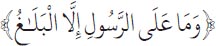
Know that enjoining what is right and forbidding what is reprehensible has conditions and modalities that are well-known; but this is not the place to discuss them. The best place to find [such a discussion] is in the Iḥyā’ ‘ulūm ad-dīn; I have also explained the most important aspects of it in my commentary on Muslim. And Allah it is Who grants success.
References
[1] Qur’ān 3:104.
[2] Qur’ān 7:199.
[3] Qur’ān 9:71.
[4] Qur’ān 5:79.
[5] Muslim (49), Abū Dāwūd (1140), Ibn Mājah (4013) and an-Nasā’ī (8/111).
[6] At-Tirmidhī (2169).
[7] Qur’ān 5:105.
[8] Abū Dāwūd (4338), at-Tirmidhī (2169), and Ibn Mājah (4011).
[9] Abū Dāwūd (4344), at-Tirmidhī (2175), and Ibn Mājah (4011).
[10] Qur’ān 29:18.