
IT IS MUSTAḤABB to say what was mentioned in the previous chapter.
And we relate that Abū Sa‘īd al-Khudrī  reported that whenever the Messenger of Allah
  put on new clothing he would mention its name—whether it was a turban, shirt or pair of trousers—and then say: “O Allah, to You belongs all praise. You have clothed me with this. I ask You for the good of it and the good for which it was created, and I seek Your protection from the evil of it and the evil of that for which it was created.” [1].The hadith is ṣaḥīḥ and was narrated by Abū Dāwūd Sulaymān ibn al-Ash‘ath as-Sijistānī, Abū ‘Īsā Muḥammad ibn ‘Īsā ibn Sawrah at-Tirmidhī, and Abū ‘Abd ar-Raḥmān Aḥmad ibn Shu‘ayb an-Nasā’ī in their Sunans. According to at-Tirmidhī this is a ḥasan hadith.
reported that whenever the Messenger of Allah put on new clothing he would mention its name—whether it was a turban, shirt or pair of trousers—and then say: “O Allah, to You belongs all praise. You have clothed me with this. I ask You for the good of it and the good for which it was created, and I seek Your protection from the evil of it and the evil of that for which it was created.” [1].The hadith is ṣaḥīḥ and was narrated by Abū Dāwūd Sulaymān ibn al-Ash‘ath as-Sijistānī, Abū ‘Īsā Muḥammad ibn ‘Īsā ibn Sawrah at-Tirmidhī, and Abū ‘Abd ar-Raḥmān Aḥmad ibn Shu‘ayb an-Nasā’ī in their Sunans. According to at-Tirmidhī this is a ḥasan hadith.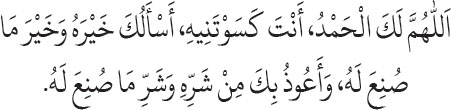
Allāhumma laka-l-ḥamd, Anta kasawtanīh, as’aluka khayrahu wa khayra mā ṣuni‘a lah, wa a‘ūdhu bika min sharrihi wa sharri mā ṣuni‘a lah.
And we relate from the book of at-Tirmidhī that ‘Umar reported: “I heard the Messenger of Allah say: ‘Whoever puts on new clothes and says ‘Praise be to Allah, Who has dressed me in something with which to conceal my private parts and adorn myself while alive,’ and then goes to the garment that he has worn out and gives it away in charity, will be under the protection, shelter and care of Allah in life and death.’” [2].
reported: “I heard the Messenger of Allah say: ‘Whoever puts on new clothes and says ‘Praise be to Allah, Who has dressed me in something with which to conceal my private parts and adorn myself while alive,’ and then goes to the garment that he has worn out and gives it away in charity, will be under the protection, shelter and care of Allah in life and death.’” [2].
Al-ḥamdu li-llāhi-lladhī kasānī mā uwārī bi-hi ‘awratī wa atajammalu bi-hi fī ḥayātī.
References
[1] Abū Dāwūd (4020), at-Tirmidhī (1767), and an-Nasā’ī (309) in ‘Amal al-yawm wa al-laylah. Ibn Ḥajar grades it as ḥasan. It is the same hadith , reported by Ibn as-Sunnī, that was cited above.
[2] At-Tirmidhī (3555), who states that this hadith is gharīb.