
KNOW THAT IF the ṣalāh has only two rak‘ahs, like the Ṣubḥ or supererogatory (nāfil), then there is only one tashahhud. If it has three or four rak‘ahs, then there are two tashahhuds: the first and the last.
A person who arrives late for ṣalāh may conceivably perform three tashahhuds. It is also conceivable that he may perform four tashahhuds in Maghrib. If he joins the Imam after rukū‘ in the second rak‘ah, he follows him in the first and second tashahhud but he has completed only one rak‘ah of the ṣalāh. When the Imam pronounces the salām, he should rise to complete the rak‘ahs that remain. He prays one rak‘ah and says tashahhud after it, for it is his second. Then he prays the third and says tashahhud after it. If he offers a nāfil ṣalāh and performs more than four rak‘ahs, even if he makes the intention to pray one hundred rak‘ahs, the preferred view is that he should restrict himself to two tashahhuds. He should perform all that he intended to perform except for two rak‘ahs, then say tashahhud, then perform the final two rak‘ahs and say tashahhud again and salām. A group of our colleagues say that it is not permissible to say more than two tashahhuds and it is not permissible that there be more than two rak‘ahs between the first and the second rak‘ah. It is permissible that there be only one rak‘ah. If a person prays more than two rak‘ahs or there are more than two rak‘ahs between them, his ṣalāh is invalid. Others say that it is permissible to say tashahhud in every rak‘ah. The correct view is that it is permissible after every two rak‘ahs, not every one. And Allah knows best.
The last tashahhud is wājib according to ash-Shāfi‘ī, Aḥmad and the majority of the ‘ulamā’. It is Sunnah according to Abū Ḥanīfah and Mālik. The first tashahhud is Sunnah according to ash-Shāfi‘ī, Mālik, Abū Ḥanīfah and many other ‘ulamā’. According to Aḥmad it is wājib. So, according to ash-Shāfi‘ī, if a person leaves it out his ṣalāh will be valid but he must prostrate for forgetfulness, whether he left it out intentionally or unintentionally. And Allah knows best.
As for the wording of the tashahhud, there are three tashahhuds that have been reported from the Messenger of Allah  .
.
.First is the report of Ibn Mas‘ūd  that the Messenger of Allah said: “Greetings (taḥiyyāt) belong to Allah, as do prayers (ṣalawāt) and good things (ṭayyibāt). Peace be upon you, O Prophet, and the mercy and blessings of Allah. Peace be upon us and upon the righteous servants of Allah. I bear witness that there is no god but Allah, and I bear witness that Muḥammad is His slave and Messenger.” [1].Al-Bukhārī and Muslim reported this in their Ṣaḥīḥs.
that the Messenger of Allah said: “Greetings (taḥiyyāt) belong to Allah, as do prayers (ṣalawāt) and good things (ṭayyibāt). Peace be upon you, O Prophet, and the mercy and blessings of Allah. Peace be upon us and upon the righteous servants of Allah. I bear witness that there is no god but Allah, and I bear witness that Muḥammad is His slave and Messenger.” [1].Al-Bukhārī and Muslim reported this in their Ṣaḥīḥs.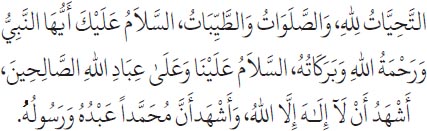
At-taḥiyyātu li-llāh, wa-ṣ-ṣalawātu wa-ṭ-ṭayyibāt, as-salāmu ‘alayka ayyuha-n-Nabiyyu wa rahmatu-llāhi wa barakātuh, as-salāmu ‘alaynā wa ‘alā ‘ibādi-llāhi-ṣ-ṣāliḥīn, ashhadu an lā ilāha illa-llāh, wa ashhadu anna Muḥammadan ‘abduhu wa Rasūluh.
The second is the report of Ibn ‘Abbās from the Messenger of Allah : “Blessed greetings and excellent prayers belong to Allah. Peace be upon you, O Prophet, and the mercy and blessings of Allah. Peace be upon us and upon the righteous servants of Allah. I bear witness that there is no god but Allah and I bear witness that Muḥammad is the Messenger of Allah.” [2].Muslim narrated this hadith in his Ṣaḥīḥ.
from the Messenger of Allah : “Blessed greetings and excellent prayers belong to Allah. Peace be upon you, O Prophet, and the mercy and blessings of Allah. Peace be upon us and upon the righteous servants of Allah. I bear witness that there is no god but Allah and I bear witness that Muḥammad is the Messenger of Allah.” [2].Muslim narrated this hadith in his Ṣaḥīḥ.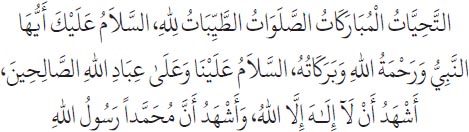
At-taḥiyyātu-l-mubārakātu-ṣ-ṣalawātu-ṭ-ṭayyibātu li-llāh, as-salāmu ‘alayka ayyuha-n-Nabiyyu wa rahmatu-llāhi wa barakātuh, as-salāmu ‘alaynā wa ‘alā ‘ibādi-llāhi-ṣ-ṣāliḥīn, ashhadu an lā ilāha illa-llāh, wa ashhadu anna Muḥammadan Rasūlu-llāh.
The third is the report of Abū Mūsā al-Ash‘arī from the Messenger of Allah : “Beautiful greetings and prayers belong to Allah. Peace be upon you, O Prophet, and the mercy and blessings of Allah. Peace be upon us and upon the righteous servants of Allah. I bear witness that there is no god but Allah and I bear witness that Muḥammad is His slave and Messenger.” Muslim narrated this in his Ṣaḥīḥ. [3].
from the Messenger of Allah : “Beautiful greetings and prayers belong to Allah. Peace be upon you, O Prophet, and the mercy and blessings of Allah. Peace be upon us and upon the righteous servants of Allah. I bear witness that there is no god but Allah and I bear witness that Muḥammad is His slave and Messenger.” Muslim narrated this in his Ṣaḥīḥ. [3].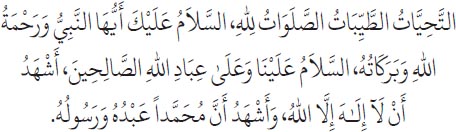
At-taḥiyyātu-ṭ-ṭayyibātu-ṣ-ṣalawātu li-llāh, as-salāmu ‘alayka ayyuha-n-Nabiyyu wa rahmatu-llāhi wa barakātuh, as-salāmu ‘alaynā wa ‘alā ‘ibādi-llāhi-ṣ-ṣāliḥīn, ashhadu an lā ilāha illa-llāh, wa ashhadu anna Muḥammadan ‘abduhu wa Rasūluh.
And we relate from the Sunan of al-Bayhaqī, with a good isnād from al-Qāsim who reported that ‘Ā’ishah  taught him: “This is the tashahhud of the Messenger of Allah : ‘Greetings belong to Allah, and the prayers and good things. Peace be upon you, O Prophet, and the mercy and blessings of Allah. Peace be upon us and upon the righteous servants of Allah. I bear witness that there is no god but Allah and I bear witness that Muḥammad is His slave and Messenger.’” [4].
taught him: “This is the tashahhud of the Messenger of Allah : ‘Greetings belong to Allah, and the prayers and good things. Peace be upon you, O Prophet, and the mercy and blessings of Allah. Peace be upon us and upon the righteous servants of Allah. I bear witness that there is no god but Allah and I bear witness that Muḥammad is His slave and Messenger.’” [4].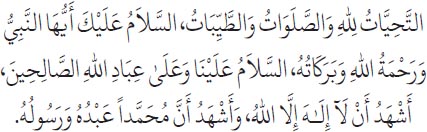
At-taḥiyyātu li-llāhi wa-ṣ-ṣalawātu wa-ṭ-ṭayyibāt. As-salāmu ‘alayka ayyuha-n-Nabiyyu wa raḥmatu-llāhi wa barakātuh, as-salāmu ‘alaynā wa ‘alā ‘ibādi-llāhi-ṣ-ṣāliḥīn, ashhadu an lā ilāha illa-llāh, wa ashhadu anna Muḥammadan ‘abduhu wa Rasūluh.
In this there is a great benefit, which is that his tashahhud is in the wording of our tashahhud. We relate in the Muwaṭṭa’ of Mālik, the Sunan of al-Bayhaqī, and others with a ṣaḥīḥ isnād from ‘Abd ar-Raḥmān ibn ‘Umar al-Qāriyy—with a doubled yā’—that he heard ‘Umar ibn al-Khaṭṭāb say, while he was on the minbar teaching the people the tashahhud: “Greetings belong to Allah. Pure actions belong to Allah. Good words and prayers belong to Allah. Peace be upon you, O Prophet, and the mercy and blessings of Allah. Peace be upon us and upon the righteous servants of Allah. I bear witness that there is no god but Allah and I bear witness that Muḥammad is His slave and Messenger.” [5].
is in the wording of our tashahhud. We relate in the Muwaṭṭa’ of Mālik, the Sunan of al-Bayhaqī, and others with a ṣaḥīḥ isnād from ‘Abd ar-Raḥmān ibn ‘Umar al-Qāriyy—with a doubled yā’—that he heard ‘Umar ibn al-Khaṭṭāb say, while he was on the minbar teaching the people the tashahhud: “Greetings belong to Allah. Pure actions belong to Allah. Good words and prayers belong to Allah. Peace be upon you, O Prophet, and the mercy and blessings of Allah. Peace be upon us and upon the righteous servants of Allah. I bear witness that there is no god but Allah and I bear witness that Muḥammad is His slave and Messenger.” [5].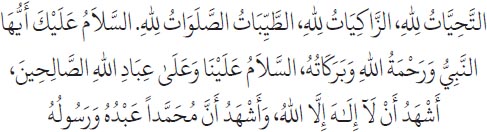
At-taḥiyyātu li-llāh, az-zākiyātu li-llāh, aṭ-ṭayyibātu-ṣ-ṣalawātu li-llāh. As-salāmu ‘alayka ayyuha-n-Nabiyyu wa raḥmatu-llāhi wa barakātuh, as-salāmu ‘alaynā wa ‘alā ‘ibādi-llāhi-ṣ-ṣāliḥīn, ashhadu an lā ilāha illa-llāh, wa ashhadu anna Muḥammadan ‘abduhu wa Rasūluh.
We relate, again in the Muwaṭṭa’ and the Sunan of al-Bayhaqī and others as well, with a ṣaḥīḥ isnād, from ‘Ā’ishah who used to say in her tashahhud: “Greetings, good words, prayers, pure actions belong to Allah. I bear witness that there is no god but Allah and that Muḥammad is His slave and Messenger. Peace be upon you, O Prophet, and the mercy and blessings of Allah. Peace be upon us and upon the righteous servants of Allah.” [6].
who used to say in her tashahhud: “Greetings, good words, prayers, pure actions belong to Allah. I bear witness that there is no god but Allah and that Muḥammad is His slave and Messenger. Peace be upon you, O Prophet, and the mercy and blessings of Allah. Peace be upon us and upon the righteous servants of Allah.” [6].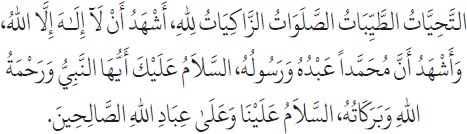
At-taḥiyyātu-ṭ-ṭayyibātu-ṣ-ṣalawātu-z-zākiyātu li-llāh, ashhadu an lā ilāha illa-llāh, wa ashhadu anna Muḥammadan ‘abduhu wa Rasūluh, as-salāmu ‘alayka ayyuha-n-Nabiyyu wa raḥmatu-llāhi wa barakātuh, as-salāmu ‘alaynā wa ‘alā ‘ibādi-llāhi-ṣ-ṣāliḥīn.
According to another account she said: “Greetings, good words, prayers, pure actions belong to Allah. I bear witness that there is no god but Allah, the One Who has no partner, and that Muḥammad is His slave and Messenger. Peace be upon you, O Prophet, and the mercy and blessings of Allah. Peace be upon us, and upon the righteous servants of Allah.”
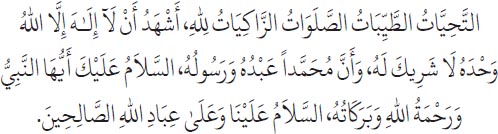
At-taḥiyyātu-ṭ-ṭayyibātu-ṣ-ṣalawātu-z-zākiyātu li-llāh, ashhadu an lā ilāha illa-llāh, wa ashhadu anna Muḥammadan ‘abduhu wa Rasūluh, as-salāmu ‘alayka ayyuha-n-Nabiyyu wa raḥmatu-llāhi wa barakātuh, as-salāmu ‘alaynā wa ‘alā ‘ibādi-llāhi-ṣ-ṣāliḥīn.
And we relate in the Muwaṭṭa’ and the Sunan of al-Bayhaqī with a ṣaḥīḥ isnād, from Mālik from Nāfi‘ that Ibn ‘Umar  used to say when he made tashahhud: “In the name of Allah. Greetings belong to Allah. Prayers belong to Allah. Pure actions belong to Allah. Peace be upon the Prophet, and the mercy and blessings of Allah. Peace be upon us and upon the righteous servants of Allah. I have borne witness that there is no god but Allah and I have borne witness that Muḥammad is the Messenger of Allah.” [7].
used to say when he made tashahhud: “In the name of Allah. Greetings belong to Allah. Prayers belong to Allah. Pure actions belong to Allah. Peace be upon the Prophet, and the mercy and blessings of Allah. Peace be upon us and upon the righteous servants of Allah. I have borne witness that there is no god but Allah and I have borne witness that Muḥammad is the Messenger of Allah.” [7].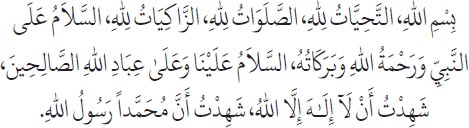
Bismi-llāh, at-taḥiyyātu li-llāh, aṣ-ṣalawātu li-llāhi, az-zākiyātu li-llāh, as-salāmu ‘ala-n-Nabiyyi wa raḥmatu-llāhi wa barakātuh, as-salāmu ‘alaynā wa ‘alā ‘ibādi-llāhi-ṣ-ṣāliḥīn, shahidtu an lā ilāha illa-llāh, shahidtu anna Muḥammadan Rasūlu-llāh.
And Allah knows best.
These are the different forms of the tashahhud. There are three hadiths which have been established to be from the Messenger of Allah : those of Ibn Mas‘ūd, Ibn ‘Abbās and Abū Mūsā  . That is the pronouncement of al-Bayhaqī. Others say that all three are authentic but the most rigorously authentic is the hadith of Ibn Mas‘ūd .
: those of Ibn Mas‘ūd, Ibn ‘Abbās and Abū Mūsā . That is the pronouncement of al-Bayhaqī. Others say that all three are authentic but the most rigorously authentic is the hadith of Ibn Mas‘ūd .It is permissible to make tashahhud with any of the above-mentioned forms of tashahhud that one wishes. This was stated by ash-Shāfi‘ī and other ‘ulamā’. The best, according to ash-Shāfi‘ī, is the hadith of Ibn ‘Abbās because of the addition of the word al-mubārakāt. Ash-Shāfi‘ī and other ‘ulamā’ say that the words of the narrators differ because the matter is one of scope and choice. And Allah knows best.
because of the addition of the word al-mubārakāt. Ash-Shāfi‘ī and other ‘ulamā’ say that the words of the narrators differ because the matter is one of scope and choice. And Allah knows best.The preferred view is that one should recite [one of] the first three tashahhuds completely. Would it suffice to leave out some of it? The position in detail is as follows. The words blessings, goodness and pious deeds are Sunnah and not a condition of tashahhud. If one leaves out all of it and says: Greetings are for Allah, peace be upon you, O Prophet to the end, that will suffice. There is no difference of opinion about this. As for the rest of the wording, such as ‘Peace be upon you, O Prophet. . .’, to the end, this is wājib and one is not permitted to omit anything of it except for the phrase ‘and Allah’s mercy and blessings. . .’ There are three views, according to our [Shāfi‘ī] colleagues. The first and most correct one is that it is not permitted to omit anything from it. This is what is necessitated by the evidence that is agreed upon. The second view is that it is permitted to omit, and the third view is that it is permitted to omit ‘His blessing’ but not ‘Allah’s mercy’.
Abū al-‘Abbās ibn Surayj, one of our colleagues, said that it is permitted to confine oneself to saying [in tashahhud]: ‘Greetings belong to Allah. Peace upon you, O Prophet, Peace upon the righteous servants of Allah. I bear witness that there is no god but Allah and that Muḥammad is His Messenger’.
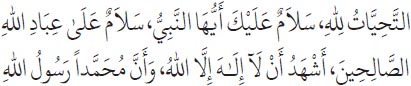
At-taḥiyyātu li-llāh, salāmun ‘alayka ayyuha-n-Nabī, salāmun ‘alā ‘ibādi-llāhi-ṣ-ṣāliḥīn, ashhadu an lā ilāha illa-llāh, wa anna Muḥammadan Rasūlu-llāh.
As for the wording ‘peace’, most of the versions have ‘peace upon you, O Prophet’, as well as ‘peace be upon us’ with the definite article. Some versions it have merely ‘peace’, both [letters of the definite article] being omitted.
According to our colleagues, both are permitted, although the better one is ‘peace’ with the definite article, owing to its preponderance [in the narrations] as additions.
As for the tasmiyah before the tashahhud, we have related a marfū‘ hadith from the Sunans of an-Nasā’ī, al-Bayhaqī and others, establishing its [veracity] in the narration of Ibn ‘Umar, as previously cited. However, al-Bukhārī and an-Nasā’ī as well as other scholars of hadith say that the addition of tasmiyah is not authenticated from the Prophet . Therefore, the majority of scholars hold that tasmiyah is not mustaḥabb. Others of our colleagues hold that it is mustaḥabb. The preferred view is that it should not be performed, because the majority of the Companions that narrated the tashahhud did not do so.
. Therefore, the majority of scholars hold that tasmiyah is not mustaḥabb. Others of our colleagues hold that it is mustaḥabb. The preferred view is that it should not be performed, because the majority of the Companions that narrated the tashahhud did not do so.The sequence in tashahhud is Sunnah and not wājib. It is permissible to say some things before others. This is the correct and preferred view of the majority, as ash-Shāfi‘ī states in al-Umm. Some hold that it is not permissible, as with the wording of al-Fātiḥah. Its permissibility is indicated because in some reports the words of greeting come before the bearing of witness and in others they come after. The words and their order in al-Fātiḥah are a divine miracle and it is not permissible to change them. It is not permissible to say the tashahhud in another language if one has the ability to recite Arabic. Anyone who is unable to should say the tashahhud in his own language and learn [the Arabic], as we have already explained about the takbīrat al-iḥrām.
It is Sunnah to say the tashahhud silently, according to the consensus of the Muslims, as is indicated by the hadith which we related in the Sunans of Abū Dāwūd, at-Tirmidhī and al-Bayhaqī from ‘Abdullāh ibn Mas‘ūd said: “It is Sunnah to say the tashahhud silently.” [8].At-Tirmidhī said the hadith is ḥasan and al-Ḥākim said it is ṣaḥīḥ. One [Shāfi‘ī] colleague says that this is Sunnah,” which is like saying: “The Messenger of Allah said such-and-such.” This is the preferred and correct view held by the majority of ‘ulamā’, jurists, and scholars of hadith (may Allah have mercy on them), experts in juristic principles (uṣūl) and scholars of theology (kalām). Reciting it aloud, although disliked, does not nullify the ṣalāh and one does not have to prostrate for forgetfulness.
said: “It is Sunnah to say the tashahhud silently.” [8].At-Tirmidhī said the hadith is ḥasan and al-Ḥākim said it is ṣaḥīḥ. One [Shāfi‘ī] colleague says that this is Sunnah,” which is like saying: “The Messenger of Allah said such-and-such.” This is the preferred and correct view held by the majority of ‘ulamā’, jurists, and scholars of hadith (may Allah have mercy on them), experts in juristic principles (uṣūl) and scholars of theology (kalām). Reciting it aloud, although disliked, does not nullify the ṣalāh and one does not have to prostrate for forgetfulness.References
[1] Al-Bukhārī (831), Muslim (402), Abū Dāwūd (968), at-Tirmidhī (289), and an-Nasā’ī (2/237).
[2] Muslim (403), Abū Dāwūd (974), at-Tirmidhī (290), and an-Nasā’ī (2/242–243).
[3] Muslim (404), Abū Dāwūd (972), and an-Nasā’ī (2/242).
[4] Sunan al-Bayhaqī (2/144) and al-Futūḥāt (2/327). Ibn Ḥajar states: “The chain for this hadith includes Muḥammad ibn Ṣāliḥ ibn Dīnār, about whom there is a difference of opinion. Aḥmad, Abū Dāwūd and others declare him to be trustworthy, while Abū Ḥātim ar-Rāzī states that his transmission is not strong. Likewise, ad-Dāraquṭnī casts doubts on his reputation, and I could find neither praise nor criticism for his son Ṣāliḥ, who therefore falls into the category of mastūr narrators. I do not know the basis for Imam an-Nawawī describing this chain as good, since al-Bayhaqī states after relating it: ‘ ṣaḥīḥ from ‘Ā’ishah in a mawqūf form’, indicating the irregularity (shudhūdh) of the additional wording. But Allah knows best.”
[5] Al-Muwaṭṭa’ (1/90), Sunan al-Bayhaqī (2/142).
[6] Al-Muwaṭṭa’ (1/91), Sunan al-Bayhaqī (2/142).
[7] Al-Muwaṭṭa’ (1/91) and Sunan al-Bayhaqī (2/142). Ibn Ḥajar classifies this hadith as mawqūf ṣaḥīḥ.
[8] Abū Dāwūd (986), at-Tirmidhī (291), al-Bayhaqī (2/146), and al-Ḥākim (1/230), who grades it as ṣaḥīḥ; and adh-Dhahabī agrees.