
THE ‘ULAMĀ’ AGREE unanimously that it is mustaḥabb to do dhikr after ṣalāh. There are many authentic hadiths on this subject, of which we will mention a few.
We relate in the book of at-Tirmidhī from Abū Umāmah  that the Messenger of Allah
  was asked: “Which du‘ā’ is most likely to be accepted?” He replied: “That which is made in the last part of the night or after a farḍ ṣalāh.” [1].at-Tirmidhī described this hadith as ḥasan.
that the Messenger of Allah was asked: “Which du‘ā’ is most likely to be accepted?” He replied: “That which is made in the last part of the night or after a farḍ ṣalāh.” [1].at-Tirmidhī described this hadith as ḥasan.And we relate from the Ṣaḥīḥs of al-Bukhārī and Muslim that Ibn ‘Abbās said: “I used to recognise when the Messenger of Allah had ended the ṣalāh because of his takbīr.” [2].In a narration of Muslim it reads, “We used. . .” According to another report in the same Ṣaḥīḥs he [Ibn ‘Abbās] said: “In the time of the Messenger of Allah , when people had finished the farḍ ṣalāh they would raise their voices in dhikr.” Ibn ‘Abbās said: “I knew they had finished it when I heard them doing that.”
said: “I used to recognise when the Messenger of Allah had ended the ṣalāh because of his takbīr.” [2].In a narration of Muslim it reads, “We used. . .” According to another report in the same Ṣaḥīḥs he [Ibn ‘Abbās] said: “In the time of the Messenger of Allah , when people had finished the farḍ ṣalāh they would raise their voices in dhikr.” Ibn ‘Abbās said: “I knew they had finished it when I heard them doing that.”We relate in the Ṣaḥīḥ of Muslim that Tawbān reported that when the Messenger of Allah ended his ṣalāh, he asked for forgiveness thrice and said: “O Allah, You are Peace and from You comes peace. Blessed are You, Lord of Majesty and Honour.” [3].
reported that when the Messenger of Allah ended his ṣalāh, he asked for forgiveness thrice and said: “O Allah, You are Peace and from You comes peace. Blessed are You, Lord of Majesty and Honour.” [3].
Allāhumma Anta-s-Salāmu wa minka-s-salām, tabārakta yā Dha-l-Jalāli wa-l-Ikrām.
Al-Awzā‘ī, one of the narrators of these hadiths, was asked: “How is the asking for forgiveness?” He replied: “‘I ask Allah for forgiveness, I ask Allah for forgiveness.’”

Astaghfiru-llāh, astaghfiru-llāh.
And we relate from the Ṣaḥīḥs of al-Bukhārī and Muslim, from al-Mughīrah ibn Shu‘bah , that when the Messenger of Allah had completed his ṣalāh and invoked salutations [upon himself] he would say: “There is no god but Allah. He is Alone and has no partner. To Him belongs sovereignty and to Him belongs all praise, and He has power over all things. O Allah, none can withhold what You have granted and none can grant what You withhold; and the riches of the rich do not avail him against You.” [4].
, that when the Messenger of Allah had completed his ṣalāh and invoked salutations [upon himself] he would say: “There is no god but Allah. He is Alone and has no partner. To Him belongs sovereignty and to Him belongs all praise, and He has power over all things. O Allah, none can withhold what You have granted and none can grant what You withhold; and the riches of the rich do not avail him against You.” [4].
Lā ilāha illa-llāhu waḥdahu lā sharīka lah, lahu-l-mulk, wa lahu-l-ḥamd, wa Huwa ‘alā kulli shay’in qadīr, Allāhumma lā māni‘a li-mā a‘ṭayt, wa lā mu‘ṭiya li-mā mana‘ta, wa lā yanfa‘u dha-l-jaddi minka-l-jadd.
We relate in the Ṣaḥīḥ of Muslim from ‘Abdullāh ibn az-Zubayr who used to say after every ṣalāh, after pronouncing the salām: “There is no god but Allah. He is Alone and has no partner. To Him belongs sovereignty and to Him belongs all praise, and He has power over all things. There is no power and no strength except with Allah. There is no god but Allah and we worship none but Him. To Him belongs grace and to Him belongs bounteousness and to Him belongs noble praise. There is no god but Allah. We shall fulfil our religion sincerely for Him, even if the disbelievers dislike it.” Ibn az-Zubayr reported that the Messenger of Allah used to glorify Allah with these words after the ṣalāh. [5].
who used to say after every ṣalāh, after pronouncing the salām: “There is no god but Allah. He is Alone and has no partner. To Him belongs sovereignty and to Him belongs all praise, and He has power over all things. There is no power and no strength except with Allah. There is no god but Allah and we worship none but Him. To Him belongs grace and to Him belongs bounteousness and to Him belongs noble praise. There is no god but Allah. We shall fulfil our religion sincerely for Him, even if the disbelievers dislike it.” Ibn az-Zubayr reported that the Messenger of Allah used to glorify Allah with these words after the ṣalāh. [5].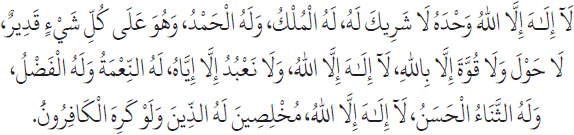
Lā ilāha illa-llāhu waḥdahu lā sharīka lah, lahu-l-mulk, wa lahu-l-ḥamd, wa Huwa ‘alā kulli shay’in qadīr, lā ḥawla wa lā quwwata illā bi-llāh, lā ilāha illa-llāh, wa lā na‘budu illā iyyāh, lahu-n-ni‘matu wa lahu-l-faḍl, wa lahu-th-thanā’u-l-ḥasan, lā ilāha illa-llāhu mukhliṣīna lahu-d-dīna wa law kariha-l-kāfirūn.
We relate in the Ṣaḥīḥs of al-Bukhārī and Muslim from Abū Hurayrah that the poor Muhājirūn came to the Messenger of Allah and said: “The men of wealth have taken the high ranks and the everlasting bounties. They pray as we pray, they fast as we fast, they have their excess wealth with which they perform Ḥajj and ‘Umrah, and they strive for the Cause of Allah and give charity.” He replied: “Should I not teach you something that will enable you to catch up with those who have surpassed you and make you surpass those who are behind you, so that no-one will be better than you except for those who do the same as you do?” They said: “Yes, Messenger of Allah.” He said: “Glorify Allah, praise Allah and magnify Allah thirty-three times after every ṣalāh.” Abū Ṣāliḥ, the narrator of the hadith, reported that when Abū Hurayrah was asked how this should be done he said: “Say: Glory be to Allah, Praise be to Allah, and Allah is Greatest, until each of them has been said thirty-three times.” [6].The word ad-duthur is the plural of dathr with fatḥah on the letter dāl and sukūn on the letter thā’, which means ‘abundance’.
that the poor Muhājirūn came to the Messenger of Allah and said: “The men of wealth have taken the high ranks and the everlasting bounties. They pray as we pray, they fast as we fast, they have their excess wealth with which they perform Ḥajj and ‘Umrah, and they strive for the Cause of Allah and give charity.” He replied: “Should I not teach you something that will enable you to catch up with those who have surpassed you and make you surpass those who are behind you, so that no-one will be better than you except for those who do the same as you do?” They said: “Yes, Messenger of Allah.” He said: “Glorify Allah, praise Allah and magnify Allah thirty-three times after every ṣalāh.” Abū Ṣāliḥ, the narrator of the hadith, reported that when Abū Hurayrah was asked how this should be done he said: “Say: Glory be to Allah, Praise be to Allah, and Allah is Greatest, until each of them has been said thirty-three times.” [6].The word ad-duthur is the plural of dathr with fatḥah on the letter dāl and sukūn on the letter thā’, which means ‘abundance’.
Subḥāna-llāhi wa-l-ḥamdu li-llāhi wa-llāhu akbar.
We relate in the Ṣaḥīḥ of Muslim that Ka‘b ibn ‘Ujrah related that the Messenger of Allah said: “The tasbīḥs said sequentially are such that no-one who says them after every farḍ ṣalāh will be disappointed: thirty-three times tasbīḥ, thirty three times taḥmīd and thirty-four times takbīr.” [7].
related that the Messenger of Allah said: “The tasbīḥs said sequentially are such that no-one who says them after every farḍ ṣalāh will be disappointed: thirty-three times tasbīḥ, thirty three times taḥmīd and thirty-four times takbīr.” [7].We relate in the Ṣaḥīḥ of Muslim that Abū Hurayrah reported that the Messenger of Allah said: “Whoever glorifies Allah thirty-three times after every ṣalāh, praises Allah thirty-three times and magnifies Allah thirty-three times and says, to finish, one hundred times There is no god but Allah. He is One and has no partner. To Him belongs sovereignty, to Him belongs all praise, and He has power over all things, his sins will be forgiven even if they be [as abundant] as the foam of the sea.” [8].
reported that the Messenger of Allah said: “Whoever glorifies Allah thirty-three times after every ṣalāh, praises Allah thirty-three times and magnifies Allah thirty-three times and says, to finish, one hundred times There is no god but Allah. He is One and has no partner. To Him belongs sovereignty, to Him belongs all praise, and He has power over all things, his sins will be forgiven even if they be [as abundant] as the foam of the sea.” [8].
Subḥāna-llāh. Al-ḥamdu li-llāh. Allāhu akbar. Lā ilāha illa-llāhu waḥdahu lā sharīka lah, lahu-l-mulk, wa lahu-l-ḥamd, wa Huwa ‘alā kulli shay’in qadīr.
We relate in the Ṣaḥīḥ of al-Bukhārī in the first part of the Book of Jihād from Sa‘d ibn Abī Waqqāṣ , that the Messenger of Allah used to seek protection after ṣalāh with these words: “O Allah, I seek Your protection from cowardice, I seek Your protection from being brought back to a miserable old age, I seek Your protection from the trials of the world, and I seek Your protection from punishment in the grave.” [9].
, that the Messenger of Allah used to seek protection after ṣalāh with these words: “O Allah, I seek Your protection from cowardice, I seek Your protection from being brought back to a miserable old age, I seek Your protection from the trials of the world, and I seek Your protection from punishment in the grave.” [9].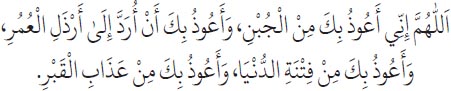
Allāhumma innī a‘ūdhu bika min al-jubn, wa a‘ūdhu bika an uradda ilā ardhali-l-‘umur, wa a‘ūdhu bika min fitnati-d-dunyā, wa a‘ūdhu bika min ‘adhābi-l-qabr.
We relate in the Sunans of Abū Dāwūd, at-Tirmidhī and an-Nasā’ī that ‘Abdullāh ibn ‘Amr ibn al-‘Āṣ  reported that the Messenger of Allah said: “There are two practices (khaṣlah)—or two habits (khallah)—which, if a Muslim slave keeps to them, he will enter Paradise. They are easy but those who perform them will be few. He should glorify Allah
  ten times, praise Him ten times and magnify Him ten times after every ṣalāh. That will be one hundred and fifty on the tongue and one thousand five hundred on the scales. He should magnify Allah thirty-four times and praise Allah thirty-three times and glorify Him thirty-three times when he goes to bed. That will be one hundred on the tongue and one thousand on the scales.” He said: “I saw the Messenger of Allah counting them with his hand.” Those present asked: “O Messenger of Allah, how is it that they are so easy yet so few people perform them?” He said: “He (that is, Shayṭān) comes to you before you go to sleep and he puts you to sleep before you can say them; and he comes to you in your ṣalāh and he reminds you of your needs before you can say them.” [10].The isnād of this hadith is ṣaḥīḥ except that ‘Atā’ ibn as-Sayyib is in it, and there is disagreement over him and his confusion in narrating (ikhtilāṭ). Ayyūb as-Sakhtiyānī has alluded to the authenticity of this narration.
reported that the Messenger of Allah said: “There are two practices (khaṣlah)—or two habits (khallah)—which, if a Muslim slave keeps to them, he will enter Paradise. They are easy but those who perform them will be few. He should glorify Allah ten times, praise Him ten times and magnify Him ten times after every ṣalāh. That will be one hundred and fifty on the tongue and one thousand five hundred on the scales. He should magnify Allah thirty-four times and praise Allah thirty-three times and glorify Him thirty-three times when he goes to bed. That will be one hundred on the tongue and one thousand on the scales.” He said: “I saw the Messenger of Allah counting them with his hand.” Those present asked: “O Messenger of Allah, how is it that they are so easy yet so few people perform them?” He said: “He (that is, Shayṭān) comes to you before you go to sleep and he puts you to sleep before you can say them; and he comes to you in your ṣalāh and he reminds you of your needs before you can say them.” [10].The isnād of this hadith is ṣaḥīḥ except that ‘Atā’ ibn as-Sayyib is in it, and there is disagreement over him and his confusion in narrating (ikhtilāṭ). Ayyūb as-Sakhtiyānī has alluded to the authenticity of this narration.We relate in the Sunans of Abū Dāwūd, at-Tirmidhī, an-Nasā’ī and others that ‘Uqbah ibn ‘Āmir reported: “The Messenger of Allah instructed me to recite the Mu‘awwidhatayn after every ṣalāh.” In the narration of Abū Dāwūd it is the Mu‘awwidhāt. So one ought to recite: “Say: He is Allah, One,” “Say: I seek refuge in the Lord of the dawn” and “Say: I seek protection in the Lord of men.” [11].
reported: “The Messenger of Allah instructed me to recite the Mu‘awwidhatayn after every ṣalāh.” In the narration of Abū Dāwūd it is the Mu‘awwidhāt. So one ought to recite: “Say: He is Allah, One,” “Say: I seek refuge in the Lord of the dawn” and “Say: I seek protection in the Lord of men.” [11].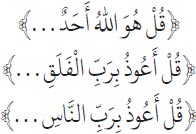
Qul Huwa-llāhu Aḥad. . .
Qul a‘ūdhu bi-Rabbi-l-falaq. . .
Qul a‘ūdhu bi-Rabbi-n-nās. . .
Qul a‘ūdhu bi-Rabbi-l-falaq. . .
Qul a‘ūdhu bi-Rabbi-n-nās. . .
We relate with a ṣaḥīḥ isnād from the Sunans of Abū Dāwūd and an-Nasā’ī from Mu‘ādh ibn Jabal that the Messenger of Allah took him by the hand and said: “Mu‘ādh, by Allah, I love you. So do not neglect to say after every ṣalāh: O Allah, assist me in remembering You and in thanking You and in goodly worship of You.” [12].
that the Messenger of Allah took him by the hand and said: “Mu‘ādh, by Allah, I love you. So do not neglect to say after every ṣalāh: O Allah, assist me in remembering You and in thanking You and in goodly worship of You.” [12].
Allāhumma a‘innī ‘alā dhikrika wa shukrika wa ḥusni ‘ibādatik.
And we relate from the Kitāb of Ibn as-Sunnī from Anas that when the Messenger of Allah completed the ṣalāh he wiped his face with his right hand and said: “I bear witness that there is no god beside Allah, the Beneficent, the Merciful. O Allah, remove worry and grief from me.” [13].
that when the Messenger of Allah completed the ṣalāh he wiped his face with his right hand and said: “I bear witness that there is no god beside Allah, the Beneficent, the Merciful. O Allah, remove worry and grief from me.” [13].
Ashhadu an lā ilāha illa-llāhu-r-Raḥmānu-r-Raḥīm, Allāhumma adhhab ‘anni-l-hamma wa-l-ḥuzn.
We relate from [Ibn as-Sunnī], from Abū Umāmah who said: “I never came near the Messenger of Allah after an obligatory or nāfil ṣalāh without hearing him say: ‘O Allah, forgive all my sins and transgressions. O Allah, invigorate me, restore me and guide me to virtuous deeds and character, for none guides to the virtue thereof and none wards off the evil thereof but You.’” [14].
who said: “I never came near the Messenger of Allah after an obligatory or nāfil ṣalāh without hearing him say: ‘O Allah, forgive all my sins and transgressions. O Allah, invigorate me, restore me and guide me to virtuous deeds and character, for none guides to the virtue thereof and none wards off the evil thereof but You.’” [14].
Allāhumma-ghfir lī dhunūbī wa khaṭāyāya kullahā, Allāhumma-n‘ashnī wa-jburnī wa-hdinī li-ṣāliḥi-l-a‘māli wa-l-akhlāq, innahu lā yahdī li-ṣāliḥihā wa lā yaṣrifu sayyi’ahā illā Ant.
We relate from Abū Sa‘īd al-Khudrī that he reported: “When the Messenger of Allah completed his ṣalāh—I do not know whether it was before or after the salām—he used to say: ‘Glorified is your Lord, the Lord of Sovereign Might, above what they ascribe to Him. And peace be on the Messengers. And praise be to Allah, Lord and Cherisher of the worlds.” [15].
that he reported: “When the Messenger of Allah completed his ṣalāh—I do not know whether it was before or after the salām—he used to say: ‘Glorified is your Lord, the Lord of Sovereign Might, above what they ascribe to Him. And peace be on the Messengers. And praise be to Allah, Lord and Cherisher of the worlds.” [15].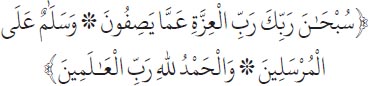
Subḥāna Rabbika Rabbi-l-‘izzati ‘ammā yaṣifūn, wa salāmun ‘ala-l-mursalīn, wa-l-ḥamdu li-llāh Rabbi-l-‘ālamīn.
We relate from Anas that he said: “After completing ṣalāh the Prophet used to say: ‘O Allah, make the best part of my lifespan the last of it, and the best of my deeds the last of them, and make the best of my days the day I meet You.’” [16].
that he said: “After completing ṣalāh the Prophet used to say: ‘O Allah, make the best part of my lifespan the last of it, and the best of my deeds the last of them, and make the best of my days the day I meet You.’” [16].
Allāhumma-j‘al khayra ‘umurī ākhirah, wa khayra ‘amalī khawātimah, wa-j‘al khayra ayyāmī yawma alqāk.
We relate from Abū Bakr who reported that the Messenger of Allah said when he had finished ṣalāh: “O Allah, I seek protection in You from unbelief, poverty and punishment in the grave.” [17].
who reported that the Messenger of Allah said when he had finished ṣalāh: “O Allah, I seek protection in You from unbelief, poverty and punishment in the grave.” [17].
Allāhumma innī a‘ūdhu bika mina-l-kufri wa-l-faqri wa ‘adhābi-l-qabr.
We relate with a weak isnād from Fuḍālah ibn ‘Ubayd who reported that the Messenger of Allah said: “When any one of you has performed ṣalāh, let him begin by praising Allah and then praying for blessings upon the Prophet , and then let him make du‘ā’ for whatever he wants.” [18].
who reported that the Messenger of Allah said: “When any one of you has performed ṣalāh, let him begin by praising Allah and then praying for blessings upon the Prophet , and then let him make du‘ā’ for whatever he wants.” [18].References
[1] At-Tirmidhī (3494), al-Futūḥāt (3/30), and an-Nasā’ī (108) in ‘Amal al-yawm wa al-laylah. At-Tirmidhī states that this is a ḥasan gharīb hadith. Ibn Ḥajar says that at-Tirmidhī’s statement needs looking into as the chain has some defects, among them the break between Ibn Thābit and Abū Umāmah, the ‘an‘anah of Ibn Jurayj from Ibn Thābit and its irregularity (shudhūdh). Ibn Ḥajar goes on to say that it is ṣaḥīḥ, with witnessed narrations for the first part of the hadith.
[2] Al-Bukhārī (841) and Muslim (583).
[3] Muslim (591), Abū Dāwūd (1513), at-Tirmidhī (300), and an-Nasā’ī (3/68).
[4] Al-Bukhārī (844), Muslim (593), Abū Dāwūd (1505), and an-Nasā’ī (3/70) in al-Mujtabā and (129) in ‘Amal al-yawm wa al-laylah.
[5] Muslim (594), Abū Dāwūd (1506), and an-Nasā’ī (3/75) in al-Mujtabā and (155) in ‘Amal al-yawm wa al-laylah.
[6] Al-Bukhārī (843), Muslim (595), al-Muwaṭṭa’ (1/209), and Abū Dāwūd (1504).
[7] Muslim (596), at-Tirmidhī (3409), and an-Nasā’ī—(3/75) in al-Mujtabā and (155) in ‘Amal al-yawm wa al-laylah.
[8] Muslim (595).
[9] Al-Bukhārī (6374), at-Tirmidhī (3562), and an-Nasā’ī—(8/266) in al-Mujtabā and (131) in ‘Amal al-yawm wa al-laylah. Al-Bukhārī’s version has a slight addition to the wording.
[10] Abū Dāwūd (5065), at-Tirmidhī (3407), an-Nasā’ī (3/74), and al-Futūḥāt (1/51). Ibn Ḥajar grades this hadith as ṣaḥīḥ.
[11] Abū Dāwūd (1532), at-Tirmidhī (2905), an-Nasā’ī (3/68), and al-Futūḥāt (3/53). Ibn Ḥajar grades this hadith as ṣaḥīḥ.
[12] Abū Dāwūd (1522), al-Futūḥāt (3/55), and an-Nasā’ī: (3/53) in al-Mujtabā and (109) in ‘Amal al-yawm wa al-laylah. Ibn Ḥajar grades this hadith as ṣaḥīḥ.
[13] Ibn as-Sunnī (110), with a slight change of wording.
[14] Ibn as-Sunnī (114).
[15] Qur’ān 37:180–182.
[16] Ibn as-Sunnī (119).
[17] Ibn as-Sunnī (109) and al-Futūḥāt (3/60–61). Ibn Ḥajar states that this is a ḥasan hadith reported by Aḥmad, an-Nasā’ī and Ibn Abī Shaybah. It was also reported by Ibn as-Sunnī from an-Nasā’ī with his chain. It is strange that an-Nawawī references only Ibn as-Sunnī when this hadith is present in one of the well-known Sunan compilations.
[18] Ibn as-Sunnī (111) and al-Futūḥāt (3/62). Ibn Ḥajar grades it as ṣaḥīḥ.