
WE RELATE FROM the book of Ibn as-Sunnī that Zayd ibn Thābit  narrated: “I complained to the Messenger of Allah
  about my sleeplessness and he said: ‘Say: O Allah, the stars have set and the eyes are resting, but You are Ever-Living, Self-Subsisting. You are not overcome by slumber or sleep. O Ever-Living, Self-Subsisting, make my night calm and my eyes sleep.’ I said this and Allah took away from me what I had been experiencing.” [1].
narrated: “I complained to the Messenger of Allah about my sleeplessness and he said: ‘Say: O Allah, the stars have set and the eyes are resting, but You are Ever-Living, Self-Subsisting. You are not overcome by slumber or sleep. O Ever-Living, Self-Subsisting, make my night calm and my eyes sleep.’ I said this and Allah took away from me what I had been experiencing.” [1].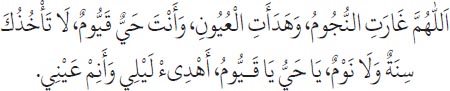
Allāhumma ghārati-n-nujūm, wa hada’ati-l-‘uyūn, wa Anta Ḥayyun Qayyūm, lā ta’khudhuka sinatun wa lā nawm. Yā Ḥayyu yā Qayyūm, ahdi’ laylī wa anim ‘aynī.
We relate in the same source that Muḥammad ibn Yaḥyā ibn Ḥabbān—with fatḥah on the letter hā’ and doubled letter bā’—related that Khālid ibn Wālid complained to the Messenger of Allah that he was afflicted by sleeplessness, so the Prophet instructed him, when he went to sleep, to seek protection in the perfect words of Allah from His wrath, from the evil of His servants, from the insinuations of Shayṭān, and from them approaching him. [2].This hadith is mursal, as Muḥammad ibn Yaḥyā was a Tābi‘ī. Linguists say that the word al-araq means ‘sleepnessness’ (as-sahar).
complained to the Messenger of Allah that he was afflicted by sleeplessness, so the Prophet instructed him, when he went to sleep, to seek protection in the perfect words of Allah from His wrath, from the evil of His servants, from the insinuations of Shayṭān, and from them approaching him. [2].This hadith is mursal, as Muḥammad ibn Yaḥyā was a Tābi‘ī. Linguists say that the word al-araq means ‘sleepnessness’ (as-sahar).We relate in the book of at-Tirmidhī with a weak isnād—at-Tirmidhī considered it weak—from Buraydah , who narrated that Khālid ibn Wālid complained to the Messenger of Allah , saying: “Messenger of Allah, I did not sleep last night because of insomnia.” So the Prophet told him: “When you retire to bed, say: O Allah, Lord of the Seven Heavens and all that they give shade to, Lord of the Earths and all that they support, Lord of the shayṭāns (demons) and all those whom they lead astray, be a Protector to me from all Your Creation, to prevent them from transgressing against me or oppressing me. Those whom You protect are mighty, glorious is Your praise, and there is no God other than You. There is no god but You.” [3].
, who narrated that Khālid ibn Wālid complained to the Messenger of Allah , saying: “Messenger of Allah, I did not sleep last night because of insomnia.” So the Prophet told him: “When you retire to bed, say: O Allah, Lord of the Seven Heavens and all that they give shade to, Lord of the Earths and all that they support, Lord of the shayṭāns (demons) and all those whom they lead astray, be a Protector to me from all Your Creation, to prevent them from transgressing against me or oppressing me. Those whom You protect are mighty, glorious is Your praise, and there is no God other than You. There is no god but You.” [3].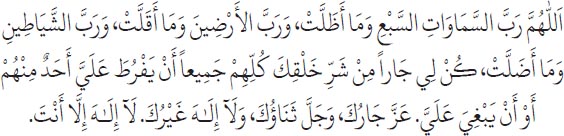
Allāhumma Rabba-s-samāwāti-s-sab‘i wa mā aẓallat, wa Rabba-l-arḍīna wa mā aqallat, wa Rabba-sh-shayāṭīni wa mā aḍallat, kun lī jāran min sharri khalqika kullihim jamī‘an an yafruṭa ‘alayya aḥadun minhum aw an yabghī ‘alayy, ‘Azza jāruk, wa jalla thanā‘uk, wa lā ilāha ghayruk, lā ilāha illā Ant.
References
[1] Ibn as-Sunnī (754) and al-Futūḥāt (3/177). Ibn Ḥajar states that this is a gharīb hadith, reported by Ibn as-Sunnī, Abū Aḥmad Ibn ‘Adī in al-Kāmil, and aṭ-Ṭabarānī in al-Kabīr. Ibn al-‘Adī states that ‘Amr ibn al-Ḥusayn al-Ḥarrānī is the only narrator of this hadith; his transmission is extremely weak, as he narrates reprehensible things (manākir) from trustworthy narrators which no-one else narrates.
[2] Ibn as-Sunnī (755). Ibn Ḥajar states that this is a mursal narration with a ṣaḥīḥ isnād.
[3] At-Tirmidhī (3518) and al-Futūḥāt (3/181). Its chain contains al-Ḥakam ibn Zuhayr, whose narration is disregarded (matrūk) by scholars of hadith.