
ALLAH  SAYS: “And the remembrance of Allah is greater.” [1].
SAYS: “And the remembrance of Allah is greater.” [1].
Allah also said: “So remember Me and I will remember you.” [2].
also said: “So remember Me and I will remember you.” [2].
Allah says: “Had it not been that he glorified Allah, he would certainly have remained inside its belly until the Day they are resurrected.” [3].
says: “Had it not been that he glorified Allah, he would certainly have remained inside its belly until the Day they are resurrected.” [3].
Allah also says: “They celebrate His praises night and day, and never do they slacken.” [4].
also says: “They celebrate His praises night and day, and never do they slacken.” [4].
We relate in the Ṣaḥīḥs of the Imams of hadith, Abū ‘Abdullāh Muḥammad ibn Ismā‘īl ibn Ibrāhīm ibn Mughīrah al-Bukhārī al-Ju‘fī, and Abū al-Ḥusayn Muslim ibn al-Ḥajjāj ibn Muslim al-Qushayrī an-Nīsābūrī, may Allah be pleased with them, with their isnāds from Abū Hurayrah  , whose name is ‘Abd ar-Raḥmān ibn Ṣakhr according to the soundest of almost thirty statements, and who narrated more hadiths than any other Companion, that the Messenger of Allah
  said: “Two phrases that are light on the tongue but heavy in the scale and beloved to the All Merciful are Glory be to Allah and with His praise, and Glory be to Allah the Tremendous.” [5].This hadith is the last thing in the Ṣaḥīḥ of al-Bukhārī.
, whose name is ‘Abd ar-Raḥmān ibn Ṣakhr according to the soundest of almost thirty statements, and who narrated more hadiths than any other Companion, that the Messenger of Allah said: “Two phrases that are light on the tongue but heavy in the scale and beloved to the All Merciful are Glory be to Allah and with His praise, and Glory be to Allah the Tremendous.” [5].This hadith is the last thing in the Ṣaḥīḥ of al-Bukhārī.
Subḥāna-llāhi wa bi-ḥamdihi, subḥāna-llāhi-l-‘Aẓīm.
We relate in the Ṣaḥīḥ of Muslim that Abū Dharr reported: “The Messenger of Allah asked me: ‘Shall I not inform you of the dearest words to Allah ? The dearest words to Allah are Glory be to Allah and with His praise.’” According to another report, he said that the Messenger of Allah was asked: “Which words are the best?” He replied: “Those which Allah has chosen for His angels and His slaves: Glory be to Allah and with His praise.” [6].
reported: “The Messenger of Allah asked me: ‘Shall I not inform you of the dearest words to Allah ? The dearest words to Allah are Glory be to Allah and with His praise.’” According to another report, he said that the Messenger of Allah was asked: “Which words are the best?” He replied: “Those which Allah has chosen for His angels and His slaves: Glory be to Allah and with His praise.” [6].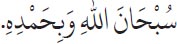
Subḥāna-llāhi wa bi-ḥamdihi.
We relate in the Ṣaḥīḥ of Muslim also that Samurah ibn Jundab reported: “The Messenger of Allah said: ‘The phrases most beloved to Allah are four: Glory be to Allah, Praise be to Allah, There is no god but Allah, and Allah is greater. No harm will befall you whichever of them you begin with.’” [7].
reported: “The Messenger of Allah said: ‘The phrases most beloved to Allah are four: Glory be to Allah, Praise be to Allah, There is no god but Allah, and Allah is greater. No harm will befall you whichever of them you begin with.’” [7].
Subḥāna-llāhi wa-l-ḥamdu li-llāhi wa lā ilāha illa-llāhu wa-llāhu akbar.
We relate in the Ṣaḥīḥ of Muslim that Abū Mālik al-Ash‘arī said: “The Messenger of Allah said: ‘Cleanliness is half of faith; Praise be to Allah fills up the scales; and Glory be to Allah and all praise is due to Allah fill up—or it fills up—what is between the heavens and the earth.’” [8].
said: “The Messenger of Allah said: ‘Cleanliness is half of faith; Praise be to Allah fills up the scales; and Glory be to Allah and all praise is due to Allah fill up—or it fills up—what is between the heavens and the earth.’” [8].
Al-ḥamdu li-llāh.

Subḥāna-llāhi wa-l-ḥamdu li-llāh.
We also relate from the Ṣaḥīḥ of Muslim from Juwayriyah  , the Mother of the Believers, that the Messenger of Allah once left her early, after performing the ṣalāh of Ṣubḥ, while she was in her place of prayer. Then he returned at mid-morning and she was still sitting there. He asked: “Have you been in that same position since I left you?” She replied: “Yes.” The Messenger of Allah said: “After I left you, I said four things, thrice each. If they were weighed against what you have said, they would outweigh it. They are: Glory be to Allah and with His praise, according to the number of His creations and to His pleasure and according to the weight of His throne and the ink of His words.” [9].
, the Mother of the Believers, that the Messenger of Allah once left her early, after performing the ṣalāh of Ṣubḥ, while she was in her place of prayer. Then he returned at mid-morning and she was still sitting there. He asked: “Have you been in that same position since I left you?” She replied: “Yes.” The Messenger of Allah said: “After I left you, I said four things, thrice each. If they were weighed against what you have said, they would outweigh it. They are: Glory be to Allah and with His praise, according to the number of His creations and to His pleasure and according to the weight of His throne and the ink of His words.” [9].
Subḥāna-llāhi wa bi-ḥamdihi, ‘adada khalqihi wa riḍā nafsihi wa zinata ‘arshihi wa midāda kalimātih.
According to another report he said: “Glory be to Allah, according to the number of His creations, and Glory be to Allah according to His own pleasure; and Glory be to Allah according to the weight of His throne; and Glory be to Allah according to the ink of His words.”
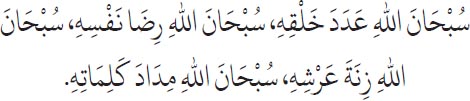
Subḥāna-llāhi ‘adada khalqihi, subḥāna-llāhi riḍā nafsihi, subḥāna-llāhi zinata ‘arshihi, subḥāna-llāhi midāda kalimātih.
And we have narrated it in the book of at-Tirmidhī, where the wording is: “Shall I not teach you some phrases for you to say? Glory be to Allah, according to the quantity of His Creation (3 times), Glory be to Allah, according to His own pleasure (3 times), Glory be to Allah, according to the weight of His Throne (3 times), Glory be to Allah, according to the ink of His Words (3 times).” [10].

Subḥāna-llāhi ‘adada khalqihi (x 3), subḥāna-llāhi riḍā nafsihi (x 3), subḥāna-llāhi zinata ‘arshihi (x 3), subḥāna-llāhi midāda kalimātih (x 3).
We relate in the Ṣaḥīḥ of Muslim that Abū Hurayrah reported that the Messenger of Allah said: “To say Glory be to Allah, all praise is due to Allah, there is no god but Allah and Allah is greater is dearer to me than all that the sun rises over.” [11].
said: “To say Glory be to Allah, all praise is due to Allah, there is no god but Allah and Allah is greater is dearer to me than all that the sun rises over.” [11].
Subḥāna-llāhi wa-l-ḥamdu li-llāhi wa lā ilāha illa-llāhu wa-llāhu akbar.
We relate in the Ṣaḥīḥs of Muslim and al-Bukhārī that Abū Ayyūb al-Anṣārī reported that the Messenger of Allah said: “Whoever says There is no god but Allah, One without partners. His is the kingdom and His is the praise, and He has power over all things ten times will receive the reward of freeing four of the descendants of Ismā‘īl.” [12].
said: “Whoever says There is no god but Allah, One without partners. His is the kingdom and His is the praise, and He has power over all things ten times will receive the reward of freeing four of the descendants of Ismā‘īl.” [12].
Lā ilāha illa-llāh, waḥdahu lā sharīka lah, lahu-l-mulku wa lahu-l-ḥamd, wa Huwa ‘alā kulli shay’in qadīr.
We relate in the Ṣaḥīḥs of Muslim and al-Bukhārī that Abū Hurayrah stated that the Messenger of Allah said: “Whoever says one hundred times a day There is no god but Allah, One without partners; His is the kingdom and His is the praise, and He has power over all things will be like someone who has set free ten slaves. One hundred good deeds will be written for him, one hundred of his sins will be forgiven, and it will be a shield for him against Shayṭān for that day until the evening. No one can produce anything better than it, except a man who does more than him. And whoever says Glory be to Allah and with His praise one hundred times a day will have his sins forgiven, even if they be [as abundant] as the foam of the sea.” [13].
stated that the Messenger of Allah said: “Whoever says one hundred times a day There is no god but Allah, One without partners; His is the kingdom and His is the praise, and He has power over all things will be like someone who has set free ten slaves. One hundred good deeds will be written for him, one hundred of his sins will be forgiven, and it will be a shield for him against Shayṭān for that day until the evening. No one can produce anything better than it, except a man who does more than him. And whoever says Glory be to Allah and with His praise one hundred times a day will have his sins forgiven, even if they be [as abundant] as the foam of the sea.” [13].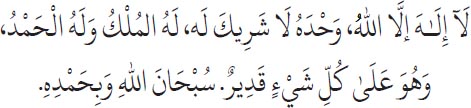
Lā ilāha illa-llāh, waḥdahu lā sharīka lah, lahu-l-mulku wa lahu-l-ḥamd, wa Huwa ‘alā kulli shay’in qadīr. Subḥāna-llāhi wa bi-ḥamdihi.
And we relate from the books of at-Tirmidhī and Ibn Mājah that Jābir ibn ‘Abdullāh reported that he heard the Messenger of Allah say: “The best dhikr is to say: There is no god but Allah.” [14].At-Tirmidhī described this hadith as ḥasan.
reported that he heard the Messenger of Allah say: “The best dhikr is to say: There is no god but Allah.” [14].At-Tirmidhī described this hadith as ḥasan.
Lā ilāha illa-llāh.
We relate in the Ṣaḥīḥ of al-Bukhārī that Abū Mūsā al-Ash‘arī reported that the Messenger of Allah said: “He who remembers his Lord, compared to him who does not remember Him, is like the living compared to the dead.” [15].
said: “He who remembers his Lord, compared to him who does not remember Him, is like the living compared to the dead.” [15].And we relate from the Ṣaḥīḥ of Muslim that Sa‘d ibn Abī Waqqāṣ reported that a Bedouin came to the Messenger of Allah and said: “Teach me something to say.” He replied: “Say: There is no god but Allah, One, without partners. Allah is vastly greater and abundant praise is due to Allah. Glory be to Allah, the Lord of the Worlds. There is no power and no strength except through Allah, the Mighty, the All-Wise.” The man said: “Those words are for my Lord. But what is for me?” He replied: “O Allah, forgive me, have mercy on me, guide me and sustain me.” [16].
reported that a Bedouin came to the Messenger of Allah and said: “Teach me something to say.” He replied: “Say: There is no god but Allah, One, without partners. Allah is vastly greater and abundant praise is due to Allah. Glory be to Allah, the Lord of the Worlds. There is no power and no strength except through Allah, the Mighty, the All-Wise.” The man said: “Those words are for my Lord. But what is for me?” He replied: “O Allah, forgive me, have mercy on me, guide me and sustain me.” [16].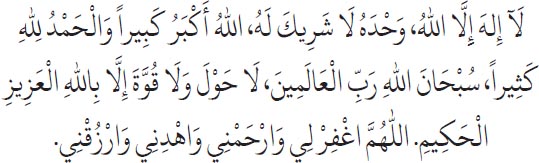
Lā ilāha illa-llāhu, waḥdahu lā sharīka lah, Allāhu akbaru kabīran wa-l-ḥamdu li-llāhi kathīrā, subḥāna-llāhi Rabbī-l-‘ālamīn, lā ḥawla wa lā quwwata illā bi-llāhi-l-‘Azīzi-l-Ḥakīm. Allāhumma-ghfir lī wa-rḥamnī wa-hdinī wa-rzuqnī.
Again, we relate from the Ṣaḥīḥ of Muslim that Sa‘d ibn Abī Waqqāṣ reported: “While we were with the Messenger of Allah he asked: ‘Are any of you unable to earn a thousand good deeds a day?’ Somebody in the gathering asked: ‘How can any one of us earn a thousand good deeds?’ He answered: ‘If he glorifies Allah one hundred times, a thousand good deeds will be written for him or one thousand wrong actions will be eliminated for him.’” [17].
reported: “While we were with the Messenger of Allah he asked: ‘Are any of you unable to earn a thousand good deeds a day?’ Somebody in the gathering asked: ‘How can any one of us earn a thousand good deeds?’ He answered: ‘If he glorifies Allah one hundred times, a thousand good deeds will be written for him or one thousand wrong actions will be eliminated for him.’” [17].The Imam and Ḥāfiẓ Abū ‘Abdullāh al-Ḥumaydī said: It is thus in the Ṣaḥīḥ of Muslim in all the narrations with the wording aw yuḥaṭṭu (or He reduces, erases or eliminates). Al-Burqānī said: Shu‘bah, Abū ‘Awānah and Yaḥyā al-Qaṭṭān narrated it from Mūsā, from whom Muslim narrated it with wa yuḥaṭṭu (and He reduces. . .) without the letter alif.
We relate in the Ṣaḥīḥ of Muslim that Abū Dharr reported that the Messenger of Allah said: “Every morning there is charity due on every joint of your bodies. Extolling the glory of Allah is charity, praising Allah is charity, declaring the oneness of Allah is charity and saying ‘Allah is greater’ is charity. To command good and forbid evil is charity. The equivalent of that is two rak‘ahs of ṣalāh performed in the forenoon.” [18].I say: the word as-sulāmā with a ḍammah on the letter sīn and no doubling of the letter lām means a member or limb (‘uḍw), and the plural is sulāmayāt with fatḥah on the letter mīm and no doubling on the letter yā’.
reported that the Messenger of Allah said: “Every morning there is charity due on every joint of your bodies. Extolling the glory of Allah is charity, praising Allah is charity, declaring the oneness of Allah is charity and saying ‘Allah is greater’ is charity. To command good and forbid evil is charity. The equivalent of that is two rak‘ahs of ṣalāh performed in the forenoon.” [18].I say: the word as-sulāmā with a ḍammah on the letter sīn and no doubling of the letter lām means a member or limb (‘uḍw), and the plural is sulāmayāt with fatḥah on the letter mīm and no doubling on the letter yā’.And we relate from the Ṣaḥīḥs of Muslim and al-Bukhārī that Abū Mūsā al-Ash‘arī reported that the Messenger of Allah said to him: “Shall I show you one of the treasures of Paradise?” He said: “Yes, Messenger of Allah.” He said: “Say: There is no power and no strength except by Allah.” [19].
said to him: “Shall I show you one of the treasures of Paradise?” He said: “Yes, Messenger of Allah.” He said: “Say: There is no power and no strength except by Allah.” [19].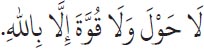
Lā ḥawla wa lā quwwata illā bi-llāh.
We relate in the Sunans of Abū Dāwūd and at-Tirmidhī that Sa‘d ibn Abī Waqqāṣ narrated that he went with the Messenger of Allah to a woman, and in front of her were date stones or pebbles which she was using to make tasbīḥ. He said: “Should I not show you something that is easier and better than this? Glory be to Allah, equal to what He has created in the heavens; Glory be to Allah, equal to what He has created on Earth; Glory be to Allah, equal to the amount of what is between them; Glory be to Allah, equal to what He will create. And Allah is greater, equal to that, and All praise is due to Allah, equal to that; and There is no god but Allah, equal to that; and There is no power and no strength [except by Allah], equal to that.” [20].At-Tirmidhī described this hadith as ḥasan.
narrated that he went with the Messenger of Allah to a woman, and in front of her were date stones or pebbles which she was using to make tasbīḥ. He said: “Should I not show you something that is easier and better than this? Glory be to Allah, equal to what He has created in the heavens; Glory be to Allah, equal to what He has created on Earth; Glory be to Allah, equal to the amount of what is between them; Glory be to Allah, equal to what He will create. And Allah is greater, equal to that, and All praise is due to Allah, equal to that; and There is no god but Allah, equal to that; and There is no power and no strength [except by Allah], equal to that.” [20].At-Tirmidhī described this hadith as ḥasan.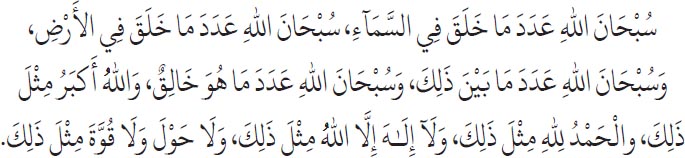
Subḥāna-llāhi ‘adada mā khalaqa fi-s-samā’, subḥāna-llāhi ‘adada mā khalaqa fi-l-arḍ, wa subḥāna-llāhi ‘adada mā bayna dhālik, wa subḥāna-llāhi ‘adada mā Huwa khāliq, wa-llāhu akbaru mithla dhālik, wa-l-ḥamdu li-llāhi mithla dhālik, wa lā ilāha illa-llāhu mithla dhālik, wa lā ḥawla wa lā quwwata mithla dhālik.
And we relate from both, [21].with an isnād that is ḥasan, that Yusayrah , a female Companion and Emigrant, reported that the Messenger of Allah commanded them (the women Companions) to pay attention to doing takbīr, taqdīs and tahlīl and to count them on their fingers, for [their fingers] will be questioned and examined about them. [22].
, a female Companion and Emigrant, reported that the Messenger of Allah commanded them (the women Companions) to pay attention to doing takbīr, taqdīs and tahlīl and to count them on their fingers, for [their fingers] will be questioned and examined about them. [22].And we relate from both and from the Sunan of an-Nasā’ī, with an isnād that is ḥasan, that ‘Abdullāh ibn ‘Amr said: “I saw the Messenger of Allah counting the tasbīḥ,” [23].and in another narration “with his right hand”.
said: “I saw the Messenger of Allah counting the tasbīḥ,” [23].and in another narration “with his right hand”.And we relate from the Sunan of Abū Dāwūd that Abū Sa‘īd al-Khudrī related that the Messenger of Allah said: “Whoever says: I am pleased with Allah as Lord, with Islam as religion, and with Muḥammad as Messenger, Paradise will be obligatory for him.” [24].
related that the Messenger of Allah said: “Whoever says: I am pleased with Allah as Lord, with Islam as religion, and with Muḥammad as Messenger, Paradise will be obligatory for him.” [24].
Raḍītu bi-llāhi Rabban, wa bi-l-Islāmi dīnan, wa bi-Muḥammadin Rasūlā.
We relate in the book of at-Tirmidhī that ‘Abdullāh ibn Busr—with a ḍammah on the bā’ and a sukūn on the sīn—the Companion , reported that a man said: “O Messenger of Allah, the decrees of Islam have become too numerous for me, so tell me something that I can adhere (atashabbathu) to.” He replied: “Let your tongue always be moist with dhikr of Allah .” [25].At-Tirmidhī said, described this as a ḥasan hadith.”
, reported that a man said: “O Messenger of Allah, the decrees of Islam have become too numerous for me, so tell me something that I can adhere (atashabbathu) to.” He replied: “Let your tongue always be moist with dhikr of Allah .” [25].At-Tirmidhī said, described this as a ḥasan hadith.”I say that the verb atashabbathu, with the letters tā’ and thā’ followed by bā’, all with fatḥah means ‘I adhere to’ as well as ‘I cling to’.
And we relate from it (the book of at-Tirmidhī) that Abū Sa‘īd al-Khudrī said: “The Messenger of Allah was asked: ‘Which form of worship will be the best in rank in the sight of Allah on the Day of Judgment?’ He said: ‘Men and women who engage in Allah’s remembrance abundantly’, I asked: ‘O Messenger of Allah, more than him who goes on military expeditions in the Way of Allah ?’ He said: ‘Even if he strikes the kāfirūn and the mushrikūn with his sword until it breaks and is stained with blood, the one who remembers Allah will still be superior to him in rank.’” [26].
said: “The Messenger of Allah was asked: ‘Which form of worship will be the best in rank in the sight of Allah on the Day of Judgment?’ He said: ‘Men and women who engage in Allah’s remembrance abundantly’, I asked: ‘O Messenger of Allah, more than him who goes on military expeditions in the Way of Allah ?’ He said: ‘Even if he strikes the kāfirūn and the mushrikūn with his sword until it breaks and is stained with blood, the one who remembers Allah will still be superior to him in rank.’” [26].And we relate from it and from the book of Ibn Mājah from Abū ad-Dardā’ who reported that the Messenger of Allah asked: “Shall I inform you of the best of your deeds, the purest in the sight of your King, the highest in your ranks, and better than spending gold and silver in charity, and better than you meeting the enemy and striking their necks and them striking yours?” [Those present] said: “Yes.” He replied: “The remembrance of Allah .” [27].Al-Ḥākim Abū ‘Abdullāh says in his book al-Mustadrak ‘alā aṣ-Ṣaḥīḥayn that this hadith has a saḥīḥ isnād.
who reported that the Messenger of Allah asked: “Shall I inform you of the best of your deeds, the purest in the sight of your King, the highest in your ranks, and better than spending gold and silver in charity, and better than you meeting the enemy and striking their necks and them striking yours?” [Those present] said: “Yes.” He replied: “The remembrance of Allah .” [27].Al-Ḥākim Abū ‘Abdullāh says in his book al-Mustadrak ‘alā aṣ-Ṣaḥīḥayn that this hadith has a saḥīḥ isnād.And we relate from the book of at-Tirmidhī that Ibn Mas‘ūd narrated that the Messenger of Allah said: “I met Ibrāhīm on the night I was taken to Heaven, and he said: ‘O Muḥammad, convey my greetings to your Ummah, and inform them that Paradise has fertile soil and sweet water, but it is barren. Its plantations are: Glory be to Allah, praise be to Allah, there is no god but Allah, and Allah is greater.’” [28].At-Tirmidhī described this hadith as ḥasan.
narrated that the Messenger of Allah said: “I met Ibrāhīm on the night I was taken to Heaven, and he said: ‘O Muḥammad, convey my greetings to your Ummah, and inform them that Paradise has fertile soil and sweet water, but it is barren. Its plantations are: Glory be to Allah, praise be to Allah, there is no god but Allah, and Allah is greater.’” [28].At-Tirmidhī described this hadith as ḥasan.
Subḥāna-llāhi wa-l-ḥamdu li-llāhi wa lā ilaha illa-llāhu wa-llāhu akbar.
We also relate from the book of at-Tirmidhī that Jābir stated that the Messenger said: “Whoever says Glory be to Allah the Great and to Him belongs all praise will have a date palm planted for him in Paradise.” [29].At-Tirmidhī described the hadith as ḥasan.
stated that the Messenger said: “Whoever says Glory be to Allah the Great and to Him belongs all praise will have a date palm planted for him in Paradise.” [29].At-Tirmidhī described the hadith as ḥasan.
Subḥāna-llāhi-l-‘Aẓīmi wa bi-ḥamdihi.
Again, we relate from the book of at-Tirmidhī that Abū Dharr said: “I asked: ‘O Messenger of Allah, which words are most beloved to Allah ?’ He replied: ‘What He has chosen for His angels: Glory be to my Lord and to Him belongs all praise. Glory be to my Lord and to Him belongs all praise.’” [30].According to at-Tirmidhī, this is ḥasan ṣaḥīḥ.
said: “I asked: ‘O Messenger of Allah, which words are most beloved to Allah ?’ He replied: ‘What He has chosen for His angels: Glory be to my Lord and to Him belongs all praise. Glory be to my Lord and to Him belongs all praise.’” [30].According to at-Tirmidhī, this is ḥasan ṣaḥīḥ.
Subḥāna Rabbī wa bi-ḥamdih, subḥāna Rabbī wa bi-ḥamdih.
I shall discuss the subject matter contained in this book in order. I will start with what one should say when he first gets up from sleep, and then move on sequentially until one goes to sleep at night, as well as when he wakes up at night. And from Allah comes all ability and success.
References
[1] Qur’ān 29:45.
[2] Qur’ān 2:152.
[3] Qur’ān 37:143–144.
[4] Qur’ān 21:20.
[5] Al-Bukhārī (7563), Muslim (2694), at-Tirmidhī (3463).
[6] Muslim (2731), at-Tirmidhī (3587).
[7] Muslim (2137), Abū Dāwūd (4958), at-Tirmidhī (2838).
[8] Muslim (223), at-Tirmidhī (3512), an-Nasā’ī (5/5–6), Ibn Mājah (270).
[9] Muslim (2726), Abū Dāwūd (1503), at-Tirmidhī (3550), an-Nasā’ī (4/77).
[10] At-Tirmidhī (3499) and al-Futūḥāt (1/200). The repetition of this dhikr three times, as mentioned in the hadith of Juwayriyah as well as in this transmission, is valid, since the additional narration of a trustworthy narrator is acceptable. Ibn Ḥajar states that this hadith has a supporting shahīd (witnessed) narration among the hadiths of Sa‘d ibn Abī Waqqāṣ which an-Nawawī mentions later.
[11] Muslim (2695), at-Tirmidhī (3591).
[12] Al-Bukhārī (6404), Muslim (2693), at-Tirmidhī (3584), and an-Nasā’ī in ‘Amal al-yawm wa al-laylah (24).
[13] Al-Bukhārī (6403), Muslim (2691), at-Tirmidhī (3464), al-Muwaṭṭa’ (1/209), and an-Nasā’ī in ‘Amal al-yawm wa al-laylah (26).
[14] At-Tirmidhī (3380), who states that this is a ḥasan gharīb hadith. We only know of it from the hadith of Mūsā. It is also reported by Ibn Mājah (3800).
[15] Al-Bukhārī (6407), Muslim (779), with a similar wording and meaning.
[16] Muslim (2696).
[17] Muslim (2698), an-Nasā’ī in ‘Amal al-yawm wa al-laylah (152), at-Tirmidhī (3459), and Aḥmad (1/174).
[18] Muslim (720).
[19] Al-Bukhārī (6484) and Muslim (2704).
[20] At-Tirmidhī (3564), Abū Dāwūd (1500), and al-Futūḥāt (1/244–245). Ibn Ḥajar said that the hadith is ṣaḥīḥ; its narrators are the narrators of ṣaḥīḥ hadiths, except for Khuzaymah, whose lineage and condition are unknown; and that no-one quotes his narration except Sa‘īd ibn Abī Hilāl, who is mentioned by Ibn Ḥibbān in ath-Thiqāt.
[21] The Sunans of Abū Dāwūd and at-Tirmidhī.
[22] Abū Dāwūd (1501) and at-Tirmidhī (3577).
[23] An-Nasā’ī (3/74–75), Abū Dāwūd (1502), and at-Tirmidhī (3482).
[24] Abū Dāwūd (1529), and an-Nasā’ī in ‘Amal al-yawm wa al-laylah (5). Ibn Ḥajar grades it as ḥasan. It is also mentioned in the Mustadrak of al-Ḥākim (1/518), who grades it as ṣaḥīḥ; and adh-Dhahabī agrees.
[25] At-Tirmidhī (3372) and al-Futūḥāt (1/257). Ibn Ḥajar grades it as ḥasan.
[26] At-Tirmidhī (3373); he also described this as a gharīb hadith.
[27] Ibn Mājah (3790), at-Tirmidhī (3374), and al-Ḥākim (1/496), who grades it as ṣaḥīḥ; and adh-Dhahabī agrees. It is also reported in al-Muwaṭṭa’ (1/211) in a mawqūf form from Abū ad-Dardā’.
[28] At-Tirmidhī (3458).
[29] At-Tirmidhī (3460), and al-Ḥākim in al-Mustadrak (1/501–502), who grades it as ṣaḥiḥ; and adh-Dhahabī agrees.
[30] At-Tirmidhī (3587).