
WE RELATE FROM the Ṣaḥīḥs of two Imams of hadith, Abū ‘Abdullāh Muḥammad ibn Ismā‘īl ibn Ibrāhīm ibn Mughīrah al-Bukhārī al-Ju‘fī and Abū ’l-Ḥusayn Muslim ibn al-Ḥajjāj ibn Muslim al-Qushayrī an-Naysābūrī, may Allah be pleased with them, with their isnāds from Abū Hurayrah  who reported that the Messenger of Allah
  said: “Shayṭān ties three knots on the nape of a person while he is sleeping, putting each knot in place. He says: ‘You have a long night, so sleep.’ When the person wakes up and remembers Allah
  , one knot is untied; when he performs wuḍū’ one knot is untied; and when he performs ṣalāh all three knots are untied. Then he gets up [feeling] energetic and in good spirits. If he does not do this, he gets up in bad spirits and lazy.” [1].That is the wording from al-Bukhārī’s narration, whereas Muslim has ‘qāfiyat ar-ra’s, ‘the end’ (i.e. the nape) ‘of the neck’.
who reported that the Messenger of Allah said: “Shayṭān ties three knots on the nape of a person while he is sleeping, putting each knot in place. He says: ‘You have a long night, so sleep.’ When the person wakes up and remembers Allah , one knot is untied; when he performs wuḍū’ one knot is untied; and when he performs ṣalāh all three knots are untied. Then he gets up [feeling] energetic and in good spirits. If he does not do this, he gets up in bad spirits and lazy.” [1].That is the wording from al-Bukhārī’s narration, whereas Muslim has ‘qāfiyat ar-ra’s, ‘the end’ (i.e. the nape) ‘of the neck’.And we relate from the Ṣaḥīḥ of al-Bukhārī that Ḥudhayfah ibn al-Yamān and Abū Dharr reported that the Messenger of Allah used to say when he went to his bed, “In Your name, O Allah, I live and I die.”
and Abū Dharr reported that the Messenger of Allah used to say when he went to his bed, “In Your name, O Allah, I live and I die.”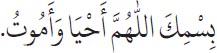
Bismika-llāhumma aḥyā wa amūt.
And when he awoke he said: “Praise be to Allah, Who has given us life after causing us to die, and to Him is the Resurrection.” [2].

Al-ḥamdu li-llāhi-lladhī aḥyānā ba‘da mā amātanā wa ilayhi-n-nushūr.
And we relate from the book of Ibn as-Sunnī with a ṣaḥīḥ isnād that Abū Hurayrah reported that the Messenger of Allah said: “When you wake up you should say: Praise be to Allah Who has returned my soul to me, given me good health in my body, and permitted me to remember Him.” [3].
reported that the Messenger of Allah said: “When you wake up you should say: Praise be to Allah Who has returned my soul to me, given me good health in my body, and permitted me to remember Him.” [3].
Al-ḥamdu li-llāhi-lladhī radda ‘alayya rūḥī wa ‘āfānī fī jasadī wa adhina lī bi-dhikrih.
We also relate from the book of Ibn as-Sunnī that ‘Ā’ishah  reported that the Messenger of Allah said: “There is no-one who, when Allah returns his soul to him [i.e. after sleep], says: There is no god but Allah alone without partner; His is the kingdom and His is the praise, and He has power over all things without Allah forgiving his sins, even if they are [as abundant] as the foam of the sea.” [4].
reported that the Messenger of Allah said: “There is no-one who, when Allah returns his soul to him [i.e. after sleep], says: There is no god but Allah alone without partner; His is the kingdom and His is the praise, and He has power over all things without Allah forgiving his sins, even if they are [as abundant] as the foam of the sea.” [4].
Lā ilāha illa-llāh, waḥdahu lā sharīka lah, lahu-l-mulk, wa lahu-l-ḥamd, wa Huwa ‘alā kulli shay’in qadīr.
And we relate from the book of Ibn as-Sunnī that Abū Hurayrah reported that the Messenger of Allah said: “No man says, when he wakes up, Praise be to Allah, Who created sleep and wakefulness; praise be to Allah, Who has resurrected me healthy and sound. I bear witness that Allah gives life to the dead and that He has power over all things without Allah saying: ‘My slave has spoken the truth.’” [5].
reported that the Messenger of Allah said: “No man says, when he wakes up, Praise be to Allah, Who created sleep and wakefulness; praise be to Allah, Who has resurrected me healthy and sound. I bear witness that Allah gives life to the dead and that He has power over all things without Allah saying: ‘My slave has spoken the truth.’” [5].
Al-ḥamdu li-llāhi-lladhī khalaqa-n-nawma wa-l-yaqaẓah, wa-l-ḥamdu li-llāhi-lladhī ba‘athanī sāliman sawiyyā. Ashhadu annā-llāha yuḥyi-l-mawtā wa Huwa ‘alā kulli shay’in qadīr.
We relate in the Sunan of Abū Dāwūd that ‘Ā’ishah reported that when the Messenger of Allah woke up in the night he would say “Allah is greater” ten times, “Praise be to Allah” ten times, “Glory be to Allah and with His praise” ten times, and “Glory be to the Holy King” ten times. Then he would ask for forgiveness ten times and say “There is no god but Allah” ten times and say “O Allah, I seek Your protection from anxiety in this world and anxiety on the Day of Judgment” ten times, and then he would begin the ṣalāh. [6].
reported that when the Messenger of Allah woke up in the night he would say “Allah is greater” ten times, “Praise be to Allah” ten times, “Glory be to Allah and with His praise” ten times, and “Glory be to the Holy King” ten times. Then he would ask for forgiveness ten times and say “There is no god but Allah” ten times and say “O Allah, I seek Your protection from anxiety in this world and anxiety on the Day of Judgment” ten times, and then he would begin the ṣalāh. [6].
Allāhu akbar. Al-ḥamdu li-llāh. Subḥāna-llāhi wa bi-ḥamdihi. Subḥāna-l-Maliki-l-Quddūs. Lā ilāha illa-llāh. Allāhumma innī a‘ūdhu bika min ḍīqi-d-dunyā wa ḍīqi Yawmi-l-Qiyāmah.
We relate from the Sunan of Abū Dāwūd that ‘Ā’ishah also reported that when the Messenger of Allah woke up at night he would say: “There is no god but You. Glory be to You, O Allah, and to You belongs all praise. I ask Your forgiveness for my sins and I ask You for Your Mercy. O Allah, increase me in knowledge, and do not lead my heart astray after You have guided me. Bestow on me Your Mercy, for You are the Ever-Bestowing One.” [7].
also reported that when the Messenger of Allah woke up at night he would say: “There is no god but You. Glory be to You, O Allah, and to You belongs all praise. I ask Your forgiveness for my sins and I ask You for Your Mercy. O Allah, increase me in knowledge, and do not lead my heart astray after You have guided me. Bestow on me Your Mercy, for You are the Ever-Bestowing One.” [7].
Lā ilāha illā Ant, subḥānaka-llāhumma wa bi-ḥamdik, astaghfiruka li-dhanbī wa as’aluka raḥmatak, Allāhumma zidnī ‘ilman wa lā tuzigh qalbī ba‘da idh hadaytanī, wa hab lī min ladunka raḥmah, innaka Anta-l-Wahhāb.
References
[1] Al-Bukhārī (1142) and Muslim (776).
[2] Al-Bukhārī (6312).
[3] Ibn as-Sunnī (9), an-Nasā’ī (791), at-Tirmidhī (3398), who narrates part of the hadith, and al-Futūḥāt (1/291). Ibn Ḥajar grades it as ḥasan.
[4] Ibn as-Sunnī (10) and al-Futūḥāt (1/292). Ibn Ḥajar states that this hadith is very weak.
[5] Ibn as-Sunnī (13).
[6] Abū Dāwūd (5080) and an-Nasā’ī (2/284); also in ‘Amal al-yawm wa al-laylah (871).
[7] Abū Dāwūd (5061), an-Nasā’ī (568) in ‘Amal al-yawm wa al-laylah, and al-Ḥākim (1/540), who grades it as ṣaḥīḥ; and adh-Dhahabī agrees.