
THE HADITHS IN the previous chapter apply [here also].
We relate in the Ṣaḥīḥs of al-Bukhārī and Muslim that al-Barā’ ibn ‘Āzib  reported that a man asked him: “Did you run away from the Messenger of Allah
  on the Day of Ḥunayn?” Al-Barā’ said: “But the Messenger of Allah did not run away. I saw him on his white mule with Sufyān ibn al-Ḥārith holding the reins. The Messenger of Allah was saying:
reported that a man asked him: “Did you run away from the Messenger of Allah on the Day of Ḥunayn?” Al-Barā’ said: “But the Messenger of Allah did not run away. I saw him on his white mule with Sufyān ibn al-Ḥārith holding the reins. The Messenger of Allah was saying:‘I am the Prophet and that is no lie;
and I am the son of ‘Abd al-Muṭṭalib.’” [1].
In one narration it is, “And he alighted, supplicated and sought help.”
We relate in both Ṣaḥīḥs that al-Barā’ also said: “I saw the Prophet moving sand on the Day of the Confederates. Dust had covered the skin of his abdomen. He was saying:
also said: “I saw the Prophet moving sand on the Day of the Confederates. Dust had covered the skin of his abdomen. He was saying:‘Had it not been for You, we would not have been guided,
we would not have given charity, or prayed.
Send down peace and tranquillity upon us,
and make our feet firm when we meet the foe.
They have transgressed against us;
when they wanted trouble we refused.’” [2].
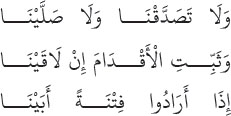
Law lā Anta ma-htadaynā
Fa-anzilan sakīnatan ‘alaynā
Inna-l-ulā qad baghaw ‘alaynā
Fa-anzilan sakīnatan ‘alaynā
Inna-l-ulā qad baghaw ‘alaynā
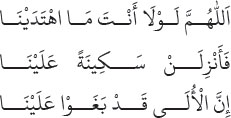
wa lā taṣaddaqnā wa lā ṣallaynā.
wa thabbiti-l-aqdāma in lāqaynā.
idhā arādū fitnatan abaynā.
wa thabbiti-l-aqdāma in lāqaynā.
idhā arādū fitnatan abaynā.
We relate in the Ṣaḥīḥ of al-Bukhārī that Anas reported: “The Muhājirūn and the Anṣār were digging the Trench and carrying the earth on their backs, saying: ‘We are the ones who made a pledge with Muḥammad [to stay true to] Islam . . ..’ [3].
reported: “The Muhājirūn and the Anṣār were digging the Trench and carrying the earth on their backs, saying: ‘We are the ones who made a pledge with Muḥammad [to stay true to] Islam . . ..’ [3].
Naḥnu-lladhīna bāya‘ū Muḥammadan

‘ala l-Islāmi . . .
Another narration has: ‘. . .[to wage] jihād as long as we live.’
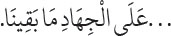
‘. . .alā-l-jihādi mā baqīnā.
“The Prophet replied:
replied:‘O Allah, there is no good but the good of the Hereafter,
so bless the Helpers and the Emigrants.’”

Allāhumma innahu lā khayra illā khayru-l-ākhirah,
fa-bārik fi-l-Anṣāri wa-l-Muhājirah.
fa-bārik fi-l-Anṣāri wa-l-Muhājirah.
References
[1] Al-Bukhārī (4317), Muslim (1776), and at-Tirmidhī (1688).
[2] Al-Bukhārī (4106) and Muslim (1803).
[3] Al-Bukhārī (4100), Muslim (1805), and at-Tirmidhī (3856).