
AND ALSO GIVING him glad tidings of what he will attain because of his wounds for the Cause of Allah, and where he will reach because of his martyrdom, and urging him to be happy with that; and showing that there is no harm to him in that, but rather it is our aim and our ultimate hope and quest.
Allah  says:
says:
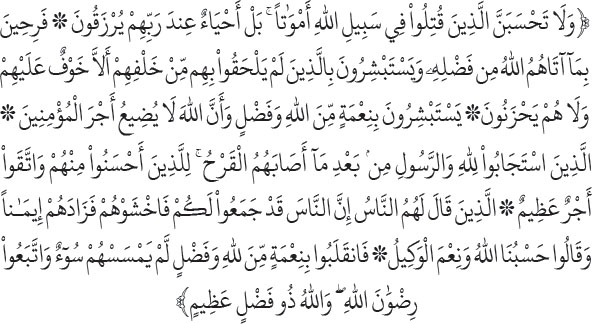
says:“Think not of those who are slain in Allah’s cause as dead. Rather, they live, finding their sustenance from their Lord. They rejoice in the bounty provided by Allah; and with regard to those left behind, who have not yet joined them [in their bliss], the [martyrs] glory in the fact that they have no fear, nor have they [cause to] grieve. They rejoice in the grace and the bounty from Allah, and in the fact that Allah suffers not the reward of the believers to be lost—those who answered the call of Allah and the Messenger even after being wounded. For those who do good and are Godfearing there shall be a great reward. Those to whom people said, ‘The people have gathered against you, so fear them.’ But that merely increased their faith and they said, ‘Allah is enough for us and the Best of Guardians.’ So they returned with blessings and bounty from Allah and no evil touched them. They pursued the pleasure of Allah. Allah’s favour is indeed immense.”
We relate in the Ṣaḥīḥs of al-Bukhārī and Muslim that Anas  narrated the hadith about the reciters of the Qur’ān of Bi’r Ma‘ūnah whom the disbelievers betrayed and killed. One of the kāfirūn stabbed the uncle of Anas, Ḥarām ibn Milḥān, and pierced him. Ḥarām said: “Allah is greater. I have triumphed by the Lord of the Ka‘bah.” [1].In Muslim’s version it states: “Allah is the Greatest!”. I say that Ḥarām has a fatḥah on the letters ḥā’ and rā’.
narrated the hadith about the reciters of the Qur’ān of Bi’r Ma‘ūnah whom the disbelievers betrayed and killed. One of the kāfirūn stabbed the uncle of Anas, Ḥarām ibn Milḥān, and pierced him. Ḥarām said: “Allah is greater. I have triumphed by the Lord of the Ka‘bah.” [1].In Muslim’s version it states: “Allah is the Greatest!”. I say that Ḥarām has a fatḥah on the letters ḥā’ and rā’.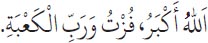
Allāhu akbar, fuztu wa Rabbi-l-Ka‘bah.
References
[1] Al-Bukhārī (4092) and Muslim (677).