
WE RELATE FROM the Ṣaḥīḥs of al-Bukhārī and Muslim that Abū Hurayrah  reported that the Messenger of Allah
  said: “One who is riding should greet one who is walking; one who is walking should greet those who are sitting; and the few should greet the many.” According to a report by al-Bukhārī he said: “The small should greet the big; the walking should greet the sitting; and the few should greet the many.” [1].
reported that the Messenger of Allah said: “One who is riding should greet one who is walking; one who is walking should greet those who are sitting; and the few should greet the many.” According to a report by al-Bukhārī he said: “The small should greet the big; the walking should greet the sitting; and the few should greet the many.” [1].According to our [Shāfi‘ī] colleagues and other ‘ulamā’, what has just been mentioned is the Sunnah. So if people were to go against that, with those walking greeting those who are riding or those who are sitting greeting them, it would not be makrūh. Imam Abū Sa‘d al-Mutawallī and others are explicit about this. According to this principle it is not makrūh for the many to greet the few, or for the big to greet the small. This will mean forgoing the greeting that one is entitled to. These rules of etiquette apply when two people meet on the street. When a person comes upon others who are sitting, the one arriving must greet those already present in all circumstances, whether they be younger or older, many or few.
ON THE DISAPPROVAL OF SINGLING OUT A PARTY FOR GREETING
Al-Mutawallī said: “If a man meets a group and he wants to specify some of them in the greeting, to the exclusion of others, it is makrūh, because the purpose of greeting is cordiality and sociability. Singling out some will cause the others to be uneasy and may sometimes lead to enmity.”
HOW ONE SHOULD GREET WHILE WALKING IN PLACES THAT ARE MUCH FREQUENTED, SUCH AS MARKETPLACES
According to the most judicious of Qāḍīs, al-Māwardī, if a person is walking in a marketplace, or on a road alongside many other people, or in any other place where many people meet, he should greet some and not others. If he greets everyone he meets, it will distract him from matters of importance. According to al-Māwardī, one only seeks one of two things from greetings: to gain love and affection or to repel hatred.
EXPLANATION THAT IF SOMEONE IS GREETED BY A GROUP AND REPLIES TO THEM INTENDING ALL OF THEM, THAT SUFFICES HIM
According to al-Mutawallī, if a group greets one man and he says ‘And on you be peace,’ intending thereby to reply to all of them, the obligation to respond to all of them is fulfilled. This is the same as performing one ṣalāh over many deceased persons, which fulfils the obligation for all.
HOW TO GREET A BODY OF PEOPLE WHO CAN BE INCLUDED IN A SINGLE GREETING AND THOSE NOT THUS INCLUDED, SUCH AS IN A JUMU‘AH MOSQUE
According to al-Māwardī, if one enters a small group of people, he may offer one greeting for them all; any greeting he adds specifically to each of them is good etiquette. One person [from the group] replying to the greeting is sufficient; but others adding is also good etiquette. If there is a gathering and one greeting is not extended to them, as in a mosque, meeting or crowd, then the way to greet is that the one who enters begins the greeting when he first enters and sees the people. All who hear [his greeting] ought to observe the way of greeting, and the farḍ kifāyah arises for them all when they hear him. If he intends to greet those of them who are sitting down, those who did not hear him are exempt from the obligation to return the greeting. If he intends to sit alongside those who did not initially hear his greeting, then there are two opinions on this point.
The first is that the means of greeting for them is achieved by the greeting being given to the first of them, because they are one group. If he responds to their greetings, this is good etiquette. Also, if anyone in the mosque responds to him, the farḍ kifāyah is discharged for the rest.
The second is that the obligation remains to greet for those who have not yet been offered the initial greeting; it is not waived for the first [of the group] by the reply of the second.
IT IS MUSTAḤABB TO GREET ON ENTERING A PLACE WHERE THERE IS NO ONE
It is mustaḥabb to give greetings when entering one’s home, even if there is no one there. One should say: Peace be upon us and upon the righteous servants of Allah. And we have previously explained in the beginning of the book what one says when one enters one’s house.

As-salāmu ‘alaynā wa ‘alā ‘ibādi-llāhi-ṣ-ṣāliḥīn.
Likewise, when entering a mosque or someone else’s house which is empty, one should give greetings by saying: Peace be upon us and upon the righteous servants of Allah. Peace be upon you, people of the house, and may the mercy and blessings of Allah be upon you.
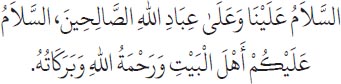
As-salāmu ‘alaynā wa ‘alā ‘ibādi-llāhi-ṣ-ṣāliḥīn. As-salāmu ‘alaykum ahla-l-bayti wa raḥmatu-llāhi wa barakātuh.
ON THE SUNNAH NATURE OF GREETING WHEN PARTING AND AN EXPLANATION OF THE RULING ON RESPONDING
If someone is sitting with a group of people and is about to get up and leave them, it is Sunnah to greet them.
We relate in the Sunans of Abū Dāwūd, at-Tirmidhī and others, with good isnāds, that Abū Hurayrah narrated that the Messenger of Allah said: “When any of you comes to a gathering, let him extend his greetings, and when about to get up let him extend his greetings, for the former is not more important than the latter.” [2].At-Tirmidhī says that this is a ḥasan hadith.
narrated that the Messenger of Allah said: “When any of you comes to a gathering, let him extend his greetings, and when about to get up let him extend his greetings, for the former is not more important than the latter.” [2].At-Tirmidhī says that this is a ḥasan hadith.I say: “The apparent meaning of this hadith is that it is wājib for a group to return the greeting of a person who is greeting them or departing from them. According to the two Imams, al-Qāḍī Ḥusayn and his colleague Imam Abū Sa‘d al-Mutawallī, it is customary to greet others when leaving them. That is a du‘ā’, and it is mustaḥabb to reply to it and not wājib, because greeting is something that is done upon meeting and not on parting. That is their opinion. Imam Abū Bakr, the later ash-Shāshī, [3].however, holds that this is incorrect, because greeting is Sunnah when departing, just as it is Sunnah when sitting down. The preceding hadith is proof of this. Ash-Shāshī’s view is the correct one.”
GREETING SOMEONE WHO ONE IS CONVINCED WILL NOT RETURN THE GREETING, AND THE RECOMMENDATION TO ABSOLVE WHOMEVER ONE GREETS IF THEY DO NOT RETURN THE GREETING
If one passes by one person or more and suspects that he will not reply to one’s greeting—either because of the pride of the person whom one passes, because of one’s disdain for the person passing or for the greeting, or for any other reason—one should greet him and not omit it on account of that suspicion. For we are ordered to greet, and the one who is ordered to greet is the one who is passing by. He is not, however, ordered to obtain a reply; moreover, it may be that the person he passes will prove his opinion wrong and return the greeting.
There are those who do not verify things carefully, and who say that the greeting of someone passing by will cause the person passed by to fall into wrongdoing. This is manifest ignorance and blatant stupidity, because Sharī‘ah commands are not lifted off the shoulders of those commanded because of such imaginings. If we were to look to these vain imaginings, we would give up reproving any wrong action done by someone who does it out of ignorance that it is a wrong action. We would also consider that he would not be reproved by our talking to him, because our reproving him and our acquainting him of his wrongdoing will be a cause of his guilt if he does not cease doing it. There is no doubt that we must not give up reproving [wrongdoing] for reasons like these, and the likes of this are numerous and well-known. And Allah knows best.
We relate in the book of Ibn as-Sunnī that ‘Abd ar-Raḥmān ibn Shibl, a Companion, reported that the Messenger of Allah said: “Whoever replies to a greeting, it will be to his own benefit; and anyone who does not reply is not one of us.” [4].
reported that the Messenger of Allah said: “Whoever replies to a greeting, it will be to his own benefit; and anyone who does not reply is not one of us.” [4].It is mustaḥabb for a person who has greeted someone who does not then reply to say to him kindly: “To respond to a greeting is wājib, so it is imperative for you to answer me, so that the obligation may be removed from you.” And Allah knows best.
References
[1] Al-Bukhārī (6231), Muslim (2160), Abū Dāwūd (5198), and at-Tirmidhī (2704).
[2] Abū Dāwūd (5208) and at-Tirmidhī (2707). According to Ibn Ḥajar this hadith is ḥasan.
[3] There were two well-known jurists of Tashkent called ash-Shāshī: Muḥammad ibn Aḥmad ibn al-Ḥusayn Abū Bakr ash-Shāshī (d. 507/1113–4) and Muḥammad ibn ‘Alī ibn Ḥāmid Abī Bakr ash-Shāshī (d. 485/1092–3), may Allah have mercy on them both.
[4] Ibn as-Sunnī (207) and al-Futūḥāt (5/367). This is part of a longer hadith, which is ṣaḥīḥ and is reported by al-Bukhārī in al-Adab al-mufrad, and by Aḥmad, aṭ-Ṭabarānī and al-Ḥākim.