
ALLAH  SAYS: “O you who believe, enter not houses other than your own, until you have asked permission and greeted those in them.” [1].
SAYS: “O you who believe, enter not houses other than your own, until you have asked permission and greeted those in them.” [1].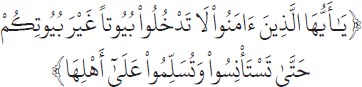
Allah says: “But when the children among you come of age, let them ask permission, as did those before them.” [2].
says: “But when the children among you come of age, let them ask permission, as did those before them.” [2].
We relate in the Ṣaḥīḥs of al-Bukhārī and Muslim that Abū Mūsā al-Ash‘arī  narrated that the Messenger of Allah
  said: “Permission must be sought thrice, and if you are not given permission you must turn back.” [3].
narrated that the Messenger of Allah said: “Permission must be sought thrice, and if you are not given permission you must turn back.” [3].We have related this in both their Ṣaḥīḥs from Abū Sa‘īd al-Khudrī and others from the Prophet .
and others from the Prophet .We relate in the same Ṣaḥīḥs that Sahl ibn Sa‘d reported that the Messenger of Allah said: “Seeking permission was instituted because of the gaze.” [4].
reported that the Messenger of Allah said: “Seeking permission was instituted because of the gaze.” [4].The reports about seeking permission thrice are numerous. The Sunnah is that one should greet and then seek permission standing at the door, so that one cannot see those who are in the house. Then one should say: ‘Peace be upon you. May I enter?’ If no one replies one should say it twice or thrice, and if still no-one replies one should go away.
We relate in the Sunan of Abū Dāwūd, with a ṣaḥīḥ isnād, that Rib‘ī ibn Ḥirāsh—with a kasrah on the ḥā’ and at the end a shīn—the eminent Tābi‘, said: “It has been reported to us that a man from Banū ‘Āmir sought permission to come to the Prophet while he was in his house. He asked: ‘May I come in?’ The Messenger of Allah told his servant: ‘Go out to this person and teach him how to seek permission. Tell him to say: “Peace be upon you. May I come in?”’ The man heard him and said: ‘Peace be upon you. May I come in?’ The Prophet gave him permission and he entered.” [5].
while he was in his house. He asked: ‘May I come in?’ The Messenger of Allah told his servant: ‘Go out to this person and teach him how to seek permission. Tell him to say: “Peace be upon you. May I come in?”’ The man heard him and said: ‘Peace be upon you. May I come in?’ The Prophet gave him permission and he entered.” [5].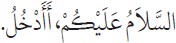
As-salāmu ‘alaykum, a-adkhul?
We relate in the Sunans of Abū Dāwūd and at-Tirmidhī that Kaladah ibn al-Ḥanbal , a Companion, reported that he came to the Prophet and went into [the house] without greeting him. He said: “Go back and say: ‘Peace be upon you. May I come in?’” [6].According to at-Tirmidhī, this hadith is ḥasan.
, a Companion, reported that he came to the Prophet and went into [the house] without greeting him. He said: “Go back and say: ‘Peace be upon you. May I come in?’” [6].According to at-Tirmidhī, this hadith is ḥasan.I say that Kaladah is written with a fatḥah on the kāf and the lām, and Ḥanbal with fatḥah on the ḥā’, followed by nūn with sukūn, then bā’ with fatḥah, then lām.
What we have stated about greeting before seeking permission is correct. Al-Māwardī mentions three views. The first is [the Sunnah, as described above]. The second is to seek permission before the greeting. The third is that one has a choice. If the gaze of the person seeking permission falls on the owner of the house before he enters he should greet first; if he does not see him, then he should seek permission first. If he has asked for permission thrice and thinks that he has not heard him, should he ask again? Abū Bakr Ibn al-‘Ārabī al-Mālikī mentions three views. The first is that he should ask again. The second is that he should not ask again. The third is that if he used the above-mentioned words he should not ask again, but if he used any other words he may ask again. The most correct view is that he should not ask again. This view, which he regarded as the soundest, is the one required by the Sunnah, and Allah knows best.
WHICH COMPLETE FORMS OF INTRODUCTION ONE OUGHT TO EMPLOY WHEN SEEKING ADMITTANCE, AND WHICH ARE DISAPPROVED OF
If someone seeks permission to enter by greeting or knocking on the door and is asked: ‘Who are you?’ he should reply ‘So-and-so, the son of So-and-so’, or ‘So-and-so al-Fulānī’, or ‘So-and-so, better known as Such-and-such’ in order that he may be identified. It is makrūh to say: ‘I,’ or ‘The servant’ or ‘one of the boys’ or ‘one of the lovers’ and suchlike.
We relate in the Ṣaḥīḥs of al-Bukhārī and Muslim that in a well-known hadith about the Prophet’s Night Journey, the Messenger of Allah said: “Then he ascended with me to the heaven closest to the earth and he asked for it to be opened.” It was said: “Who is this?” He replied: “Jibrīl.” It was said: “And who is with you?” He replied: “Muḥammad.” Then he ascended to the second, third and the rest of the heavens. It was said at the door of every heaven: “Who is this?” and he replied: “Jibrīl.” [7].
said: “Then he ascended with me to the heaven closest to the earth and he asked for it to be opened.” It was said: “Who is this?” He replied: “Jibrīl.” It was said: “And who is with you?” He replied: “Muḥammad.” Then he ascended to the second, third and the rest of the heavens. It was said at the door of every heaven: “Who is this?” and he replied: “Jibrīl.” [7].We relate in the same Ṣaḥīḥs that Abū Mūsā al-Ash‘arī reported that while the Prophet was sitting by a well in a garden Abū Bakr came and sought permission [to enter the garden]. [The Prophet ] asked: “Who is it?” He replied: “Abū Bakr.” Then ‘Umar came and sought permission and he asked: “Who?” He replied: “‘Umar.” Then ‘Uthmān came and did the same. [8].
reported that while the Prophet was sitting by a well in a garden Abū Bakr came and sought permission [to enter the garden]. [The Prophet ] asked: “Who is it?” He replied: “Abū Bakr.” Then ‘Umar came and sought permission and he asked: “Who?” He replied: “‘Umar.” Then ‘Uthmān came and did the same. [8].We relate again from the same Ṣaḥīḥs, that Jābir reported: “I came to the Prophet and knocked on the door. He asked: ‘Who is it?’ I replied: ‘Me.’ He said: ‘Me, me.’ It was as if he disliked it.” [9].
reported: “I came to the Prophet and knocked on the door. He asked: ‘Who is it?’ I replied: ‘Me.’ He said: ‘Me, me.’ It was as if he disliked it.” [9].EXPLANATION THAT THERE IS NO HARM IN THE PERSON SEEKING PERMISSION TO ENTER DESCRIBING HIMSELF IN SOME WAY TO WHICH THERE IS NO ALTERNATIVE, EVEN IF THERE IS SOME DEGREE OF SELF-GLORIFICATION IN IT
There is no objection to a man describing himself by a trait that he is known for, if the person who is addressed does not know him by any other name, even if there is some self-reverence in calling oneself by a title; or in saying ‘I am Muftī So-and-so,’ or ‘the Qāḍī,’ or ‘Shaykh So-and-so’ etc.
We relate in the Ṣaḥīḥs of al-Bukhārī and Muslim that Umm Hānī bint Abī Ṭālib  —whose name was Fākhitah, as is well-known, although some say that it was Fāṭimah and others that it was Hind—reported: “I came to the Prophet whilst he was having a bath and Fāṭimah was screening him. He asked: ‘Who is it?’ I replied: ‘I am Umm Hānī.’” [10].
—whose name was Fākhitah, as is well-known, although some say that it was Fāṭimah and others that it was Hind—reported: “I came to the Prophet whilst he was having a bath and Fāṭimah was screening him. He asked: ‘Who is it?’ I replied: ‘I am Umm Hānī.’” [10].We relate also from the same Ṣaḥīḥs that Abū Dharr —whose name was Jundub although some say it was Burayr with a ḍammah on the bā’, which is the diminutive of Barr—narrated: “I went out one night, and the Messenger of Allah was walking on his own. I started walking in the moonlight. He turned around and saw me. ‘Who is that?’ he asked. ‘Abū Dharr,’ I replied.” [11].
—whose name was Jundub although some say it was Burayr with a ḍammah on the bā’, which is the diminutive of Barr—narrated: “I went out one night, and the Messenger of Allah was walking on his own. I started walking in the moonlight. He turned around and saw me. ‘Who is that?’ he asked. ‘Abū Dharr,’ I replied.” [11].We relate in the Ṣaḥīḥ of Muslim that Abū Qatādah al-Ḥārith ibn Rib‘ī narrated a hadith about a wuḍū’ water container which mentions many of the miracles of the Messenger of Allah and many branches of knowledge. In it Abū Qatādah says: “The Messenger of Allah raised his head and asked: ‘Who is this?’ I said: ‘Abū Qatādah.’” [12].
narrated a hadith about a wuḍū’ water container which mentions many of the miracles of the Messenger of Allah and many branches of knowledge. In it Abū Qatādah says: “The Messenger of Allah raised his head and asked: ‘Who is this?’ I said: ‘Abū Qatādah.’” [12].I say that there are many similar hadiths. The reason [for saying so] is the need and not a desire to boast.
We relate in the Ṣaḥīḥ of Muslim that Abū Hurayrah —whose name was ‘Abd ar-Raḥmān ibn Sakhr, according to the most reliable accounts—reported that he said: “Messenger of Allah, pray to Allah to guide the mother of Abū Hurayrah.” Then he quoted the rest of the hadith as far as “Messenger of Allah, Allah has answered your prayer and guided the mother of Abū Hurayrah.” [13].
—whose name was ‘Abd ar-Raḥmān ibn Sakhr, according to the most reliable accounts—reported that he said: “Messenger of Allah, pray to Allah to guide the mother of Abū Hurayrah.” Then he quoted the rest of the hadith as far as “Messenger of Allah, Allah has answered your prayer and guided the mother of Abū Hurayrah.” [13].References
[1] Qur’ān 24:27.
[2] Qur’ān 24:59.
[3] Al-Bukhārī (6244), Muslim (2153), al-Muwaṭṭa’ (2/963–964), Abū Dāwūd (5180), and at-Tirmidhī (2691).
[4] Al-Bukhārī (6241), Muslim (2156), at-Tirmidhī (2710) and an-Nasā’ī (7/60–61). “Because of the gaze” means to prevent being seen by members of the opposite sex.
[5] Abū Dāwūd (5177).
[6] Abū Dāwūd (5176) and at-Tirmidhī (2711), who states that this hadith is ḥasan gharīb.
[7] Al-Bukhārī (2887) and Muslim (162).
[8] Al-Bukhārī (3674) and Muslim (2403).
[9] Al-Bukhārī (6250), Muslim (2155), Abū Dāwūd (5187), at-Tirmidhī (2712), and an-Nasā’ī in ‘Amal al-yawm wa al-laylah (328).
[10] Al-Bukhārī (280) and Muslim (336).
[11] Al-Bukhārī (6443) and Muslim (94).
[12] Muslim (681).
[13] Muslim (2491).