
WE RELATE IN the Ṣaḥīḥs of al-Bukhārī and Muslim that Sahl ibn Ḥunayf related that ‘Ā’ishah  reported that the Messenger of Allah
  said: “None of you should say ‘My soul is foul (khabuthat)’. Instead [they should say] ‘My soul heaved (laqisat).’” [1].
reported that the Messenger of Allah said: “None of you should say ‘My soul is foul (khabuthat)’. Instead [they should say] ‘My soul heaved (laqisat).’” [1].We relate in the Sunan of Abū Dāwūd, with a ṣaḥīḥ isnād, that ‘Ā’ishah reported that the Messenger of Allah said: “None of you should say ‘My soul is nauseous (jāshat)’. Instead [they should say]: ‘My soul heaved (laqisat).’” [2].
reported that the Messenger of Allah said: “None of you should say ‘My soul is nauseous (jāshat)’. Instead [they should say]: ‘My soul heaved (laqisat).’” [2].According to the learned, the words jāshat and laqisat mean to heave, or be on the point of vomiting. They say that it is only disliked to use khabuthat because of the related words khubth and khabīth (‘contemptible, despicable’).
Imam Abū Sulaymān al-Khaṭṭābī said, “Laqisat and khabuthat have the same meaning, but it is only the wording of ‘despicable, contemptible’ that is disapproved and the ugliness of a noun [derived] from it. He taught them good manners in using good words and avoiding what is repugnant.”
Jāshat is written with a jīm and a shīn, and laqisat is with a fatḥah on the lām and a kasrah on the qāf.
AUTHENTIC PROHIBITION OF CALLING GRAPES ‘KARM’ AND AN EXPLANATION OF WHAT IS MEANT BY THAT
We relate in the Ṣaḥīḥs of al-Bukhārī and Muslim that Abū Hurayrah  narrated that the Messenger of Allah said: “They say al-karm; al-karm [3].means only the heart of a believer.” [4].In another narration by Muslim there is: “Do not call the grape ‘al-karm’, because ‘al-karm’ [means] the Muslim,” and in another narration: “‘Al-karm’ only means the heart of the believer.”
narrated that the Messenger of Allah said: “They say al-karm; al-karm [3].means only the heart of a believer.” [4].In another narration by Muslim there is: “Do not call the grape ‘al-karm’, because ‘al-karm’ [means] the Muslim,” and in another narration: “‘Al-karm’ only means the heart of the believer.”We relate in the Ṣaḥīḥ of Muslim that Wā’il ibn Ḥijr related that the Messenger of Allah said: “Do not say al-karm [for grapes or the vine]. Rather, say ‘inab (‘grapes’) or ḥabalah (‘grape-vine’).” [5].
related that the Messenger of Allah said: “Do not say al-karm [for grapes or the vine]. Rather, say ‘inab (‘grapes’) or ḥabalah (‘grape-vine’).” [5].I say that ḥabalah is spelled with a fatḥah on the ḥā’ and the bā’, but it is also said that it is with a sukūn on the bā’, as al-Jawharī and others said.
What is meant by this hadith is that it is forbidden to call grapes karam; in the age of Jāhiliyyah they called them karm, as do some people today, whereas the Prophet forbade using this name.
forbade using this name.Imam al-Khaṭṭābī and others of the ‘ulamā’ said: “The Prophet was concerned lest the beauty of its name should induce them to drink the wine derived from its fruit, and so he divested it of this name. And Allah knows best.”
was concerned lest the beauty of its name should induce them to drink the wine derived from its fruit, and so he divested it of this name. And Allah knows best.”WHEN A MAN SAYS ‘PEOPLE HAVE GONE TO WRACK AND RUIN’
We relate in the Ṣaḥīḥ of Muslim that Abū Hurayrah narrated that the Messenger of Allah said: “If a man says ‘People have gone to wrack and ruin,’ he is the most ruined of them all.” [6].
narrated that the Messenger of Allah said: “If a man says ‘People have gone to wrack and ruin,’ he is the most ruined of them all.” [6].I say that ahlakuhum, ‘the most ruined of them all’, is written with either raf‘ (a ḍammah) on the kāf or a fatḥah (ahlakahum, ‘he has caused them to go to ruin’); but the better known is the raf‘ (i.e. ahlakuhum), which is supported by [a passage] in a narration we relate in Ḥilyat al-awliyā’ in the biographical notice on Sufyān ath-Thawrī, “Then he is one of the most ruined of them all.”
Imam Ḥāfiẓ Abū ‘Abdullāh al-Ḥumaydī said in al-Jam‘ bayn aṣ-Ṣaḥīḥayn about the first narration: “Some narrators said: ‘I do not know if it is with naṣb (a fatḥah) or raf‘ (a ḍammah).’” Al-Ḥumaydī said: “The best known is with raf‘ i.e. ‘the most severely ruined of them’.” He added: “That applies if he says it with contempt for them, belittling them and considering himself to be better than them, because he does not know the secret of Allah  in His Creation. Thus some of our ‘ulamā’ used to say.” That is the view of al-Ḥumaydī.
in His Creation. Thus some of our ‘ulamā’ used to say.” That is the view of al-Ḥumaydī.Al-Khaṭṭābī said: “It means to continually find fault with people and mention their evil deeds, saying ‘People are corrupt and ruined’ and so on. If a person does this then he will be the most ruined of them all, i.e. in a worse condition than them, because of the sin he commits by finding fault with people and disparaging them. Sometimes this will lead to him becoming conceited and thinking that he has some superiority over them and is better than them; thus he will be destroyed.” This statement of al-Khaṭṭābī we have related from him from his work Ma‘ālim as-Sunan.
We relate in the Sunan of Abū Dāwūd: al-Qa‘nābī narrated to us that Mālik said that Suhayl ibn Abī Ṣāliḥ said that his father reported the above hadith from Abū Hurayrah and then said “Mālik said: ‘If one says that out of grief at what he sees in people’—meaning in their Dīn—‘I see no harm in it. If one says it out of conceit and in order to belittle people, it is a disapproved thing that is forbidden.’” [7].I say that this commentary has an isnād of the highest quality of authenticity, and it is the best and most concise thing that is said about its meaning, and in particular because it is from Imam Mālik.
and then said “Mālik said: ‘If one says that out of grief at what he sees in people’—meaning in their Dīn—‘I see no harm in it. If one says it out of conceit and in order to belittle people, it is a disapproved thing that is forbidden.’” [7].I say that this commentary has an isnād of the highest quality of authenticity, and it is the best and most concise thing that is said about its meaning, and in particular because it is from Imam Mālik.EXPLANATION THAT THE CONJUNCTION USED TO JOIN TO ‘THE WILL OF ALLAH’ THE WILL OF OTHERS IS ‘THEN’ AND NOT ‘AND’
We relate in the Sunan of Abū Dāwūd, with a ṣaḥīḥ isnād, that Ḥudhayfah related that the Messenger of Allah said: “Do not say ‘What Allah wants, and what So-and-so wants,’ but say ‘What Allah wants, and then what So-and-so wants.’” [8].
related that the Messenger of Allah said: “Do not say ‘What Allah wants, and what So-and-so wants,’ but say ‘What Allah wants, and then what So-and-so wants.’” [8].According to al-Khaṭṭābī and others, this constitutes guidance to proper etiquette. The reason is that wa (‘and’) stands for union and partnership, whereas thumma (‘then’) stands for conjunction along with a sequence and delay, and so he guided them to give precedence to the will and desire of Allah before the will of all others. It is reported that Ibrāhīm an-Nakha‘ī used to disapprove of people saying ‘I seek protection in Allah and in you.’ It is permissible to say ‘I seek protection in Allah and then in you.’ [Similarly, one] should say ‘If it had not been for Allah and then So-and-so, I would have done this.’ One should not say ‘If it had not been for Allah and So-and-so. . .’
guided them to give precedence to the will and desire of Allah before the will of all others. It is reported that Ibrāhīm an-Nakha‘ī used to disapprove of people saying ‘I seek protection in Allah and in you.’ It is permissible to say ‘I seek protection in Allah and then in you.’ [Similarly, one] should say ‘If it had not been for Allah and then So-and-so, I would have done this.’ One should not say ‘If it had not been for Allah and So-and-so. . .’ON SOMEONE SAYING ‘WE HAVE BEEN GIVEN RAIN BECAUSE OF SUCH-AND-SUCH A STAR’
It is makrūh to say, ‘We have been granted rain by a certain star.’ If a person says it in the belief that the star is the cause of the rain, then it is unbelief. If he says it in the belief that Allah is the Cause and the Agent, and that the aforementioned star is merely a sign of the rain falling, then it is not unbelief but a deplorable act because he has made a statement [of the kind] which was used in the days before Islam, besides which it betrays a tendency towards unbelief—and for other reasons. We have already cited the ṣaḥīḥ hadith relating to this subject in the chapter on what is to be said when rain falls.
SAYING ‘IF I DO SUCH-AND-SUCH THEN I AM A JEW,’ AND SUCHLIKE
It is ḥarām to say ‘If I did this then I would be a Jew or Christian’ or ‘I would be quit of Islam.’ If a person says it and he really intends to leave Islam by doing the act in question, then he immediately becomes a disbeliever and the laws regarding renegades apply to him. If that is not his intention, then he does not become a disbeliever; but he has committed an unlawful act and it is compulsory for him to repent. That means that he must immediately abstain from his sin, feel remorse for what he did, make a firm resolve never to return to it, and ask Allah for forgiveness. He should say: ‘There is no god but Allah and Muḥammad is the Messenger of Allah.’
ON THE PROHIBITION OF A MAN SAYING TO A MUSLIM ‘O KĀFIR!’
It is exceptionally ḥarām to say to a Muslim ‘O disbeliever!’
We relate in the Ṣaḥīḥs of al-Bukhārī and Muslim that Ibn ‘Umar  narrated that the Messenger of Allah said: “If a man says to his brother ‘O disbeliever’, one of the two becomes deserving of it. If it is as he said [then it will be the one he addressed]; but if not, it will return to him.” [9].
narrated that the Messenger of Allah said: “If a man says to his brother ‘O disbeliever’, one of the two becomes deserving of it. If it is as he said [then it will be the one he addressed]; but if not, it will return to him.” [9].We relate in the same Ṣaḥīḥs that Abū Dharr reported that he heard the Messenger of Allah say: “If anyone calls a man by a name [which accuses him] of unbelief or says: ‘O enemy of Allah’ and it is not true, it will return to him.” [10].This is the wording of Muslim’s narration, and al-Bukhārī’s narration to the same effect. The meaning of ḥāra is ‘it returned’.
reported that he heard the Messenger of Allah say: “If anyone calls a man by a name [which accuses him] of unbelief or says: ‘O enemy of Allah’ and it is not true, it will return to him.” [10].This is the wording of Muslim’s narration, and al-Bukhārī’s narration to the same effect. The meaning of ḥāra is ‘it returned’.CONCERNING A MUSLIM MAKING A DU‘Ā’ FOR ANOTHER MUSLIM TO HAVE ĪMĀN STRIPPED AWAY
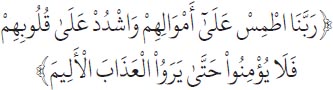
If a Muslim supplicates against a Muslim and says: ‘O Allah, snatch his faith away from him,’ he has disobeyed [Allah] by doing so. Does he become a disbeliever merely by uttering this? There are two opinions which our colleagues hold and which have been reported by al-Qāḍī Ḥusayn, one of the Imams of our colleagues in al-Fatāwā, the more authoritative of which is that he does not become a disbeliever. They cite as proof what Allah says when narrating the story of Mūsā: “Lord, deface the features of their wealth, and impart hardness to their hearts, so they shall not believe until they see the grievous chastisement.” [11].About this method of proof there are some views, even if we say that the Sharī‘ah of those before us is a Sharī‘ah for us.
DISBELIEVERS’ COERCING A MUSLIM TO SAY WORDS OF DISBELIEF
If disbelievers force a Muslim to utter a statement of disbelief and he utters it while his heart is content with faith, he does not become a disbeliever. This is supported by the text of the Qur’ān and the consensus of the Muslims. Is it better for him to utter it to save himself from being killed? There are five opinions about this.
The authentic view is that it is better to be patient and endure being killed than to utter a statement of disbelief. Proof of this from authentic hadiths and the actions of the Companions  are well-known.
are well-known.The second is that it is better to utter it to save oneself from being killed.
The third is that if there is some benefit for the Muslims in his survival, in that he hopes to cause harm to the enemy or to establish the laws of the Sharī‘ah, then it is better for him to utter it. If that is not the case, then to have patience and bear being killed is better.
The fourth is that if he is one of the ‘ulamā’ and the like, or is one of those on whom people model themselves, then it is better for him to have patience so that the masses may not be deceived.
The fifth is that it is compulsory for him to utter it on account of the Words of Allah “And throw not yourselves to destruction with your own hands.” [12].But this argument is very weak indeed.

A MUSLIM COERCING A DISBELIEVER TO ACCEPT ISLAM
If a Muslim forces a disbeliever to accept Islam and he utters the declaration of faith, then if he is at war with the Muslims his Islam will be valid because it is coercion with a right. If he is under the protection of the Muslim polity (dhimmī) he will not become a Muslim, because we are compelled to let him be; so one has no right to compel him. There is another [weak] opinion, that he becomes a Muslim because he has been commanded [to accept] the truth.
A DISBELIEVER’S UTTERING THE TWO SHAHĀDAHS WITHOUT COERCION
If a disbeliever utters the declaration of faith without any compulsion, and it is a quotation, like: “I heard Zayd say ‘There is no god but Allah and Muḥammad is the Messenger of Allah,’” he will not be declared a Muslim. If he says it after a Muslim has invited him [to embrace Islam] by saying: “Say: There is no god but Allah and Muḥammad is the Messenger of Allah” and then he utters it, he becomes a Muslim. If he says it of his own initiative, not as a quotation or in response to an invitation, then he becomes a Muslim, according to the well-known and correct position which is adhered to by the majority of our [Shāfi‘ī] colleagues. It is also said that he does not become a Muslim, because of the possibility of it being a [mere] quotation.
WHAT IS SAID ABOUT NICKNAMES FOR THE ONE WHO IS IN CHARGE OF THE MUSLIMS’ AFFAIRS
It is not befitting that the one who is in charge of the affairs of the Muslims be called ‘the Vicegerent of Allah’ (Khalīfat Allah), but rather he should be called ‘the Vicegerent’, ‘the Vicegerent of the Messenger of Allah ’ or ‘the Leader of the Believers.’
’ or ‘the Leader of the Believers.’We relate in Sharḥ as-Sunnah that Imam Abū Muḥammad al-Baghawī, may Allah have mercy on him, said: “It does not matter if the one who is in charge of the affairs of the Muslims is called ‘Leader of the Believers’ or ‘Khalīfah’—even if he acts contrary to the conduct of the just leaders—because he deals with the concerns of the believers and because the believers listen to him.” He said, “He is called the Khalīfah because he succeeds those who have been before him and he takes their place.” He also said: “None should be called the Vicegerent of Allah after Adam and Dāwūd, peace be upon them both. Allah says: ‘I will create a vicegerent on the earth.’ [13].Allah says: ‘Dāwūd, We have made you a vicegerent in the earth.’ From Abū Mulaykah it is reported that a man said to Abū Bakr : “O Khalīfah of Allah.” He said: “I am the Khalīfah of Muḥammad and I am happy with that.” A man said to ‘Umar ibn ‘Abd al-‘Azīz “O Khalīfah of Allah.” He said: “Woe to you, this is far-fetched! My mother named me ‘Umar. If you call me by that name, I will accept it. Then I grew up and I was given the nickname Abū Ḥafṣ. If you call me by that, I will accept it. Then you put me in charge of your affairs and you named me ‘Leader of the Believers’. It is enough for you to call me by that title.”
says: ‘I will create a vicegerent on the earth.’ [13].Allah says: ‘Dāwūd, We have made you a vicegerent in the earth.’ From Abū Mulaykah it is reported that a man said to Abū Bakr : “O Khalīfah of Allah.” He said: “I am the Khalīfah of Muḥammad and I am happy with that.” A man said to ‘Umar ibn ‘Abd al-‘Azīz “O Khalīfah of Allah.” He said: “Woe to you, this is far-fetched! My mother named me ‘Umar. If you call me by that name, I will accept it. Then I grew up and I was given the nickname Abū Ḥafṣ. If you call me by that, I will accept it. Then you put me in charge of your affairs and you named me ‘Leader of the Believers’. It is enough for you to call me by that title.”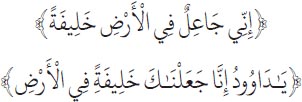
The Imam and most judicious of judges Abū al-Ḥasan al-Māwardī al-Baṣrī, the Shāfi‘ī faqīh, says in his book al-Aḥkām as-sulṭāniyyah: “The Imam is called the Khalīfah because he succeeds the Messenger of Allah in his Ummah.” He said: “It is permissible to say ‘the Khalīfah’ unqualifiedly, and it is permissible to say ‘Khalīfah of the Messenger of Allah.’” He said: “Opinions are divided about saying ‘Khalīfah of Allah’. Some hold that it is permissible because he is concerned for His rights among His Creation and because Allah says: ‘It is He Who has made you vicegerents on the earth.’ [14].The majority of the ‘ulamā’ avoid this, and accuse those who say it of sin.” These are the words of al-Māwardī.
in his Ummah.” He said: “It is permissible to say ‘the Khalīfah’ unqualifiedly, and it is permissible to say ‘Khalīfah of the Messenger of Allah.’” He said: “Opinions are divided about saying ‘Khalīfah of Allah’. Some hold that it is permissible because he is concerned for His rights among His Creation and because Allah says: ‘It is He Who has made you vicegerents on the earth.’ [14].The majority of the ‘ulamā’ avoid this, and accuse those who say it of sin.” These are the words of al-Māwardī.
I say that the first to be called ‘Leader of the Believers’ was ‘Umar ibn al-Khaṭṭāb . There is no difference of opinion about this among people of knowledge. The fantasy of the ignorant that it was Musaylimah is a manifest error and obnoxious ignorance, contrary to the consensus of the ‘ulamā’. Their books display their agreement that the first to be called ‘Leader of the Believers’ was ‘Umar ibn al-Khaṭṭāb .
. There is no difference of opinion about this among people of knowledge. The fantasy of the ignorant that it was Musaylimah is a manifest error and obnoxious ignorance, contrary to the consensus of the ‘ulamā’. Their books display their agreement that the first to be called ‘Leader of the Believers’ was ‘Umar ibn al-Khaṭṭāb .Imam Ḥāfiẓ Abū ‘Umar ibn ‘Abd al-Barr gives in his book al-Istī‘āb, a work about the names of the Companions , an account and explanation of ‘Umar being the first to be named ‘Leader of the Believers’, and the reason for it. He also states that Abū Bakr was called ‘the Khalīfah of Allah’s Messenger ’.
, an account and explanation of ‘Umar being the first to be named ‘Leader of the Believers’, and the reason for it. He also states that Abū Bakr was called ‘the Khalīfah of Allah’s Messenger ’.IT IS PROHIBITED TO CALL THE SULTAN AND OTHERS SHĀHĀN SHĀH (‘KING OF KINGS’)
It is strictly forbidden to call a leader, or any other human being, ‘Shāhan Shāh’ because it means ‘King of kings’, and no-one is called that but Allah .
.We relate in the Ṣaḥīḥs of al-Bukhārī and Muslim that Abū Hurayrah reported that the Messenger of Allah said: “The worst, most humiliating name in the sight of Allah, exalted is He, is for a man to call himself Malik al-Amlāk—‘King of kings’”. [15].We have mentioned this previously in the chapter on names. According to Sufyān ibn ‘Uyaynah, ‘King of kings’ is the meaning of [the Persian title] ‘Shāhān Shāh’” [normally written Shāhanshāh].
reported that the Messenger of Allah said: “The worst, most humiliating name in the sight of Allah, exalted is He, is for a man to call himself Malik al-Amlāk—‘King of kings’”. [15].We have mentioned this previously in the chapter on names. According to Sufyān ibn ‘Uyaynah, ‘King of kings’ is the meaning of [the Persian title] ‘Shāhān Shāh’” [normally written Shāhanshāh].ON THE WORD ‘MASTER’ (AS-SAYYID)
Know that the word ‘Master’ is used to refer to someone who is above his people and whose status is above theirs. It denotes a leader and a person of eminent merit, and is also used to refer to a mild-tempered person whose anger is not [easily] roused. It may also denote a noble, generous person, an owner, or a husband. There are many hadiths stating that a person of virtue and merit may be referred to as a ‘master’.
We relate in the Ṣaḥīḥs of al-Bukhārī and Muslim that Abū Bakrah narrated that the Messenger of Allah ascended the minbar with al-Ḥasan ibn ‘Alī and declared: “This son of mine is a leader, and perhaps Allah may reconcile two parties of the Muslims through him.” [16].
narrated that the Messenger of Allah ascended the minbar with al-Ḥasan ibn ‘Alī and declared: “This son of mine is a leader, and perhaps Allah may reconcile two parties of the Muslims through him.” [16].We relate in the Ṣaḥīḥs of al-Bukhārī and Muslim that Abū Sa‘īd al-Khudrī related that when Sa‘d ibn Mu‘ādh approached, the Messenger of Allah said to the Anṣār, “Stand up for your master” or “the best of you”. [17].Some of the narrations have: “your master” or “the best of you”, and in others it is “your master” without equivocation.
related that when Sa‘d ibn Mu‘ādh approached, the Messenger of Allah said to the Anṣār, “Stand up for your master” or “the best of you”. [17].Some of the narrations have: “your master” or “the best of you”, and in others it is “your master” without equivocation.We relate in the Ṣaḥīḥ of Muslim that Abū Hurayrah related that Sa‘d ibn ‘Ubādah asked: “Messenger of Allah, what do you think about a man who finds a man with his wife: should he kill him?. . .” The Messenger of Allah said: “Look at what your master is saying!” [18].
related that Sa‘d ibn ‘Ubādah asked: “Messenger of Allah, what do you think about a man who finds a man with his wife: should he kill him?. . .” The Messenger of Allah said: “Look at what your master is saying!” [18].As for [hadiths] which prohibit [the use of the word], there is one which we relate in the Sunan of Abū Dāwūd, with a ṣaḥīḥ isnād: Buraydah related that the Messenger of Allah said “Do not say ‘master’ (sayyid) about a hypocrite, for if he is a master you have angered your Lord .” [19].
related that the Messenger of Allah said “Do not say ‘master’ (sayyid) about a hypocrite, for if he is a master you have angered your Lord .” [19].I say: “The reconciliation of these hadiths is that there is no harm in saying ‘So-and-so is a master’, or ‘O my master’, etc., if the person who is addressed as a master is virtuous and good, either because of his knowledge or right action or because of some other trait. If he is a deviant or suspect in his religion, it is makrūh to call him ‘master’.” We have related the same from Imam Abū Sulaymān al-Khaṭṭābī in Ma‘ālim as-Sunan in reconciliation of these views.
WHAT A SLAVE SHOULD SAY TO HIS OWNER AND VICE-VERSA
It is makrūh for a slave to say to his owner ‘my Lord’ (Rabbī); rather, he should say ‘my master’ (Sayyidī)—or if he wishes he may say ‘my guardian’(Mawlāya). It is makrūh for an owner to say ‘my slave’ (‘Abdī) or ‘my slave girl’ (Amatī); he should say ‘my young man’ (Fatāya) or ‘my young woman’ (Fatātī) or ‘my boy’ (Ghulāmī).
We relate in the Ṣaḥīḥs of al-Bukhārī and Muslim that Abū Hurayrah narrated that the Messenger of Allah said: “None of you should say: ‘Feed your lord,’ or ‘Help your lord to do wuḍū’,’ or ‘Give your lord water to drink.’ He should say: ‘my master,’ or ‘my guardian.’ You should not say ‘my male slave’, or ‘my female slave,’ but ‘my young man’ (Fatāya), ‘my young woman’ (Fatātī), and ‘my boy’ (Ghulāmī).’” According to a report by Muslim, he said: “None of you should say ‘my lord’, but let him say ‘my master’ and ‘my guardian’.” And in a narration of his: “None of you should say ‘my male slave’, because all of you are slaves. And a slave should say not ‘my lord’ but ‘my master.’” [20].And in another narration of his: “None of you should say ‘my male slave’ and ‘my female slave’; all of you are slaves of Allah and all of your women are female slaves of Allah. Instead, should say ‘my boy’, and ‘my girl’ (jāriyatī), and ‘my young man’, and ‘my young woman’.”
narrated that the Messenger of Allah said: “None of you should say: ‘Feed your lord,’ or ‘Help your lord to do wuḍū’,’ or ‘Give your lord water to drink.’ He should say: ‘my master,’ or ‘my guardian.’ You should not say ‘my male slave’, or ‘my female slave,’ but ‘my young man’ (Fatāya), ‘my young woman’ (Fatātī), and ‘my boy’ (Ghulāmī).’” According to a report by Muslim, he said: “None of you should say ‘my lord’, but let him say ‘my master’ and ‘my guardian’.” And in a narration of his: “None of you should say ‘my male slave’, because all of you are slaves. And a slave should say not ‘my lord’ but ‘my master.’” [20].And in another narration of his: “None of you should say ‘my male slave’ and ‘my female slave’; all of you are slaves of Allah and all of your women are female slaves of Allah. Instead, should say ‘my boy’, and ‘my girl’ (jāriyatī), and ‘my young man’, and ‘my young woman’.”The ‘ulamā’ say that ‘the Lord (ar-Rabb)’ with alif and lām (the definite article) may not be used for anyone except Allah . But in a possessive construction (iḍāfah) it is permissible to say ‘lord of wealth,’ ‘lord of the house’ and so on.
. But in a possessive construction (iḍāfah) it is permissible to say ‘lord of wealth,’ ‘lord of the house’ and so on.Examples of this are the saying of the Prophet in the ṣaḥīḥ hadith concerning stray camels: “Leave it until its lord meets it,” [21].; the ṣaḥīḥ hadith: “Until it is important to the owner of the wealth who will accept his ṣadaqah;” [22].and the words of ‘Umar in the Ṣaḥīḥ: “The lord of the few camels and the few sheep and goats.” [23].
in the ṣaḥīḥ hadith concerning stray camels: “Leave it until its lord meets it,” [21].; the ṣaḥīḥ hadith: “Until it is important to the owner of the wealth who will accept his ṣadaqah;” [22].and the words of ‘Umar in the Ṣaḥīḥ: “The lord of the few camels and the few sheep and goats.” [23].There are also very many more well-known examples in hadiths.
As for the usage by those who convey the Sharī‘ah, it is a matter that is very well-known.
The ‘ulamā’ say that it is only disliked for a slave to say to his owner ‘my lord’ because the wording then implies that the person in question has some share in the lordship of Allah . As for the hadith “. . . until its lord meets it” and “The lord of the few camels. . .” and those others in the same sense, [the word Rabb] is only used there because they are not responsible beings, because they are like ‘the house’ and ‘wealth’. There is no doubt that using the term ‘lord of the house’ or lord of the wealth’ is not disapproved of.
. As for the hadith “. . . until its lord meets it” and “The lord of the few camels. . .” and those others in the same sense, [the word Rabb] is only used there because they are not responsible beings, because they are like ‘the house’ and ‘wealth’. There is no doubt that using the term ‘lord of the house’ or lord of the wealth’ is not disapproved of.[Should someone object to this ruling, citing] the words of Yūsuf : “Mention me when you are with your lord,” [24].there are two responses:
: “Mention me when you are with your lord,” [24].there are two responses: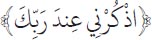
First, that he addressed him in a way he would recognise, and such usage is valid if it arises from necessity, just as Mūsā said to the Samaritan: “Look at your god,” [25].meaning “the one whom you have taken as a god”.
said to the Samaritan: “Look at your god,” [25].meaning “the one whom you have taken as a god”.
Second, that this is the Sharī‘ah of those who came before us [Muslims], and the Sharī‘ah of those who preceded us does not become a Sharī‘ah for us if our Sharī‘ah contradicts it. There is no difference of opinion about this. The people who are knowledgeable about principles only differ about the Sharī‘ah of those who came before us, if there is nothing in ours either in agreement with it or in contradiction to it, as to whether it becomes Sharī‘ah for us or not.
A MAN CALLING ANOTHER ‘MY GUARDIAN’ (MAWLĀY)
Imam Abū Ja‘far an-Naḥḥās says in his book Ṣinā‘at al-Kitāb: [26].“As for ‘the guardian’ (al-mawlā), we know of no difference of opinion among the ulamā’ that no one ought to call any other creature ‘my guardian’ (mawlāy).”
I say that we have seen in the previous section the permissibility of the usage ‘my guardian’ (mawlāy). There is no contradiction between that and this, because an-Naḥḥās was talking about ‘the guardian’ (al-mawlā) with alif and lām.
Similarly an-Naḥḥās said, “One may say ‘master’ (sayyid) about someone, provided he is not a deviant, but one may not say ‘the master’ (as-sayyid) about anyone but Allah .” [27].
.” [27].The more apparently correct position is that there is no harm in saying ‘the guardian’ (al-mawlā) and ‘the master’ (as-sayyid) with alif and lām, subject to the preceding precondition.
THE PROHIBITION OF CURSING THE WIND
The two hadiths that prohibit cursing the wind have been mentioned, and we have explained them in the chapter on what to say when the wind blows.
THE PROHIBITION OF CURSING FEVER
We relate in the Ṣaḥīḥ of Muslim that Jābir narrated that the Messenger of Allah came to Umm as-Sā’ib or Umm al-Musayyab, and asked: “What is wrong with you, Umm as-Sā’ib (or Umm al-Musayyab) that you tremble?” She replied: “Fever, may Allah not bless it.” He said: “Do not curse fever, for it removes the sins of the sons of Adam as a furnace removes impurity from iron.” [28].
narrated that the Messenger of Allah came to Umm as-Sā’ib or Umm al-Musayyab, and asked: “What is wrong with you, Umm as-Sā’ib (or Umm al-Musayyab) that you tremble?” She replied: “Fever, may Allah not bless it.” He said: “Do not curse fever, for it removes the sins of the sons of Adam as a furnace removes impurity from iron.” [28].I say that ‘tremble’ (tuzafzifīna) i.e. ‘move with a swift movement’, means ‘tremble, quiver, shake’ and is written with a ḍammah on the tā’ and with zāy repeated; it is also narrated with rā’ repeated (turafrifīna), but the zāy is better known. One of those who cite both is Ibn al-Athīr, and the author of al-Maṭāli‘ cites the zāy and rā’ along with qāf (turaqriqīna); but the accepted spelling is with fā’, whether it be with zāy or rā’.
THE PROHIBITION OF CURSING ROOSTERS
We relate in the Sunan of Abū Dāwūd, with a ṣaḥīḥ isnād, that Zayd ibn Khālid al-Juhanī reported that the Messenger of Allah said: “Do not curse the rooster, because it wakes people up for ṣalāh.” [29].
reported that the Messenger of Allah said: “Do not curse the rooster, because it wakes people up for ṣalāh.” [29].THE PROHIBITION OF CALLING THE SLOGANS OF THE DAYS BEFORE ISLAM AND USING THEIR WORDS AND EXPRESSIONS
We relate in the Ṣaḥīḥs of al-Bukhārī and Muslim that Ibn Mas‘ūd reported that the Messenger of Allah said: “He is not one of us who beats his cheeks, tears his clothes, and calls out the slogans of the days before Islam.” [30].In another narration it is: “. . .or tears . . . or calls out. . .” with ‘or’.
reported that the Messenger of Allah said: “He is not one of us who beats his cheeks, tears his clothes, and calls out the slogans of the days before Islam.” [30].In another narration it is: “. . .or tears . . . or calls out. . .” with ‘or’.ON THE DISAPPROVAL OF CALLING MUḤARRAM ‘ṢAFAR’
It is makrūh to call al-Muḥarram ‘Ṣafar’, because that was the practice of the days before Islam.
ON THE DISAPPROVAL OF SUPPLICATING FOR FORGIVENESS AND THE LIKE FOR SOMEONE WHO DIED AS A DISBELIEVER
It is ḥarām to pray for the forgiveness of a person who has died as a disbeliever. Allah says: “It is not fitting for the Prophet and those who believe to pray for forgiveness for pagans, even though they be relatives, once it is clear to them that they are destined for Hell.” [31].
says: “It is not fitting for the Prophet and those who believe to pray for forgiveness for pagans, even though they be relatives, once it is clear to them that they are destined for Hell.” [31].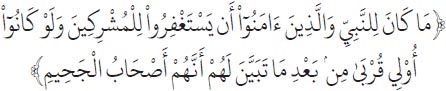
We have looked at the hadiths to the same effect, and the Muslims are in unanimous agreement about this.
ON THE PROHIBITION OF ABUSING A MUSLIM WITHOUT A VALID REASON IN SHARĪ‘AH THAT WOULD PERMIT IT
It is ḥarām to curse a Muslim without any reason that is applicable in Sharī‘ah.
We relate in the Ṣaḥīḥs of al-Bukhārī and Muslim that ‘Abdullāh ibn Mas‘ūd reported that the Messenger of Allah said: “To abuse a Muslim is deviation.” [32].
reported that the Messenger of Allah said: “To abuse a Muslim is deviation.” [32].We relate in the Ṣaḥīḥ of Muslim and the books of Abū Dāwūd and at-Tirmidhī that Abū Hurayrah reported that the Messenger of Allah said: “When two people abuse one another, what they say will fall on the one who started [the abuse], if the wronged party does not transgress.” [33].According to at-Tirmidhī, this is a ḥasan ṣaḥīḥ hadith.
reported that the Messenger of Allah said: “When two people abuse one another, what they say will fall on the one who started [the abuse], if the wronged party does not transgress.” [33].According to at-Tirmidhī, this is a ḥasan ṣaḥīḥ hadith.DEPLORABLE WORDS CUSTOMARILY USED IN DISPUTING
Some of the deplorable words commonly used when arguing are ‘you donkey,’ ‘you goat,’ ‘you dog’, etc. These are deplorable for two reasons: firstly it is a lie, and secondly it causes harm and pain. This is not the same as someone saying ‘you wrongdoer’ or suchlike, for that is excusable because of the needs of the argument, besides which in most cases it may be true since there are few people who do not wrong themselves and others.
THE DISAPPROVAL OF SAYING ‘THERE IS NO OTHER CREATURE WITH ME BUT ALLAH’
An-Naḥḥās said: “Some of the learned disapprove of people saying ‘There is no other creature with me but Allah,’ since ordinarily exceptions are connected, [34].and in this case it is impossible [since Allah is not a creature]. The meaning here can only be that the exception is disjoined [35].and therefore implies ‘[there is no creature with me] but Allah is with me’ which is derived from His words: “And He is with you”. [36].

One ought to say instead of that, “There is no one with me, but Allah is.”
is.”
Mā kāna ma‘ī aḥadun illa-llāhu subḥānahu wa ta‘ālā.
He said: “It is also disliked to say ‘Sit down upon the name of Allah;’ instead one should say: ‘Sit down, in the name of Allah.’”
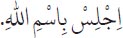
Ijlis bi-smi-llāh.
THE PROHIBITION OF A FASTING PERSON SAYING: ‘BY THE RIGHT OF THIS SEAL WHICH IS ON MY MOUTH!’
An-Naḥḥās cited some of the first generation [of Muslims as saying] that it is disapproved of for a person who is fasting to say: “by the right of this seal which is on my mouth!” He adduced as evidence for this that only the mouths of disbelievers are sealed; but there are various views about this argument. The only argument is rather that he has sworn an oath by something other than Allah . This is unlawful, as we will see shortly, if Allah wills; and so this is makrūh because of what we have mentioned and also because [by saying this, the person] unnecessarily discloses the fact that he is fasting.
. This is unlawful, as we will see shortly, if Allah wills; and so this is makrūh because of what we have mentioned and also because [by saying this, the person] unnecessarily discloses the fact that he is fasting.AVOIDING SAYING, AS SOME PEOPLE DO: ‘MAY ALLAH BLESS YOU IN YOUR EYE,’ AND ‘MAY HE BLESS YOUR MORNING’
We relate in the Sunan of Abū Dāwūd, from ‘Abd ar-Razzāq from Ma‘mar, from Qatādah or someone else, from ‘Imrān ibn al-Ḥuṣayn : “We used to say in the Jāhiliyyah: ‘May Allah bless you in your eye’ [37].or ‘. . .Bless your morning’. Then when Islam came, we were forbidden [to do] that.” ‘Abd ar-Razzāq reported: “Ma‘mar said: ‘It is disliked that a man say, “May Allah bless you in your eye”; but there is no harm in him saying, “May Allah bless your eye.”’” [38].
: “We used to say in the Jāhiliyyah: ‘May Allah bless you in your eye’ [37].or ‘. . .Bless your morning’. Then when Islam came, we were forbidden [to do] that.” ‘Abd ar-Razzāq reported: “Ma‘mar said: ‘It is disliked that a man say, “May Allah bless you in your eye”; but there is no harm in him saying, “May Allah bless your eye.”’” [38].I say that it is thus: Abū Dāwūd narrated it “from Qatādah or someone else”. About such hadiths scholars say that one cannot judge them to be authentic, because Qatādah is trustworthy but ‘someone else’ is unknown. It may therefore be understood as having been transmitted from someone unknown, and so a Sharī‘ah ruling cannot reliably be established on such a basis. However, the precautionary approach would entail avoiding this expression, since it is possible that it is authentically transmitted and because some of the ‘ulamā’ argue by means of [transmissions from] unknown people. And Allah knows best.
ON THE PROHIBITION OF TWO MEN TALKING CONFIDENTIALLY IF THERE IS A THIRD PERSON WITH THEM WHO WOULD BE LEFT BY HIMSELF
We relate in the Ṣaḥīḥs of al-Bukhārī and Muslim that Ibn Mas‘ūd narrated that the Messenger of Allah said: “If there are three of you then two should not talk confidentially, excluding the third, until they join the [rest of the] people, because that might sadden him.” [39].
narrated that the Messenger of Allah said: “If there are three of you then two should not talk confidentially, excluding the third, until they join the [rest of the] people, because that might sadden him.” [39].We relate in the same Ṣaḥīḥs that Ibn ‘Umar related that the Messenger of Allah said: “If there are three people, two should not talk confidentially to the exclusion of the third.” [40].
related that the Messenger of Allah said: “If there are three people, two should not talk confidentially to the exclusion of the third.” [40].We also relate this in the Sunan of Abū Dāwūd, who added: “Abū Ṣāliḥ—the narrator from Ibn ‘Umar—reported: ‘I asked Ibn ‘Umar: “What about four?” He said: “That will not harm you.”’” [41].
ON THE PROHIBITION OF A WOMAN INFORMING HER HUSBAND OR ANYONE ELSE OF THE BEAUTY OF ANOTHER WOMAN’S BODY UNLESS THERE IS SOME NEED ALLOWED BY THE SHARĪ‘AH, SUCH AS A DESIRE FOR HIM TO MARRY HER
We relate in the Ṣaḥīḥs of al-Bukhārī and Muslim that Ibn Mas‘ūd reported that the Messenger of Allah said: “A woman should not embrace another woman and then describe her to her husband as if he were looking at her.” [42].
reported that the Messenger of Allah said: “A woman should not embrace another woman and then describe her to her husband as if he were looking at her.” [42].ON THE DISAPPROVAL OF SAYING ‘WITH CLOSE UNION AND SONS’
It is makrūh to say to a person who gets married: ‘With close union and children.’ One should only say: ‘May Allah bless you,’ and ‘May Allah bestow blessings upon you’, as we have already mentioned in the chapter on marriage.

Bāraka-llāhu lak.
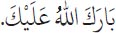
Bāraka-llāhu ‘alayk.
ON THE DISAPPROVAL OF SAYING TO AN ANGRY PERSON ‘REMEMBER ALLAH’ AND SUCHLIKE
An-Naḥḥās related that Abū Bakr Muḥammad ibn Abī Yaḥyā—who was one of the cultured ‘ulamā’ who were fuqahā’—said: “It is makrūh to tell anyone when they are angry ‘Remember Allah,’ because of the fear that his anger may incite him to disbelief. Likewise, one should not say ‘Invoke blessings upon the Prophet,’ for the same reason.”
STUDIOUSLY AVOIDING SWEARING AN OATH BY SAYING: ‘ALLAH KNOWS WHAT WAS THUS’ OR SUCHLIKE
Among the ugliest and most objectionable things that most people are in the habit of uttering when they want to swear an oath and they abstain from saying ‘By Allah’—because they dislike to break their oath, or out of veneration of Allah , or to protect oaths—is to say: ‘Allah knows it was not like that’, ‘It was certainly like that’, etc. These expressions are dangerous. If the one who utters them is certain that the matter was in fact so, there is no harm. If, however, he is in doubt about it, then it is the vilest of utterances because it leads to telling lies about Allah . He is saying that Allah knows something which he is not certain of. There is another fine point about it which is even uglier than this, which is that he is describing Allah as knowing the matter contrary to the way that it actually was. If that is the case then it is kufr, and so people must avoid this expression.
, or to protect oaths—is to say: ‘Allah knows it was not like that’, ‘It was certainly like that’, etc. These expressions are dangerous. If the one who utters them is certain that the matter was in fact so, there is no harm. If, however, he is in doubt about it, then it is the vilest of utterances because it leads to telling lies about Allah . He is saying that Allah knows something which he is not certain of. There is another fine point about it which is even uglier than this, which is that he is describing Allah as knowing the matter contrary to the way that it actually was. If that is the case then it is kufr, and so people must avoid this expression.DISAPPROVAL OF SAYING IN DU‘Ā’, ‘O ALLAH, FORGIVE ME IF YOU WISH’ OR ‘IF YOU WILL’
It is makrūh to say in du‘ā’, ‘O Allah, forgive me, if You wish’ or ‘if You will’. One should be positive in asking.
We relate in the Ṣaḥīḥs of al-Bukhārī and Muslim that Abū Hurayrah reported that the Messenger of Allah said: “None of you should say ‘O Allah, forgive me if You wish’, [or] ‘O Allah, have mercy on me if You wish.’ Instead he should be resolute in the request, for no one can compel Him.” [43].
reported that the Messenger of Allah said: “None of you should say ‘O Allah, forgive me if You wish’, [or] ‘O Allah, have mercy on me if You wish.’ Instead he should be resolute in the request, for no one can compel Him.” [43].One narration in Muslim reads: “But he should be absolutely resolute and have great desire, for nothing that Allah gives is too great for Him.” [44].
We relate in the same Ṣaḥīḥs that Anas related that the Messenger of Allah said: “When any one of you says a du‘ā’ he should be resolute in his request and not say ‘O Allah, if You wish then grant me’, for there is no one who can compel Him.” [45].
related that the Messenger of Allah said: “When any one of you says a du‘ā’ he should be resolute in his request and not say ‘O Allah, if You wish then grant me’, for there is no one who can compel Him.” [45].DISAPPROVAL OF SWEARING AN OATH BY ANYTHING OTHER THAN THE NAMES AND ATTRIBUTES OF ALLAH
It is makrūh to swear an oath by anything besides Allah and His attributes, whether by the Prophet , the Ka‘bah, the angels, the Trust, life, the Spirit and so on. The most improper of these is to swear by the Trust.
and His attributes, whether by the Prophet , the Ka‘bah, the angels, the Trust, life, the Spirit and so on. The most improper of these is to swear by the Trust.We relate in the Ṣaḥīḥs of al-Bukhārī and Muslim that Ibn ‘Umar narrated that the Messenger of Allah said: “Allah forbids you to make oaths by your parents, [46].so whoever would take an oath should swear by Allah or be silent.” [47].
narrated that the Messenger of Allah said: “Allah forbids you to make oaths by your parents, [46].so whoever would take an oath should swear by Allah or be silent.” [47].One narration in the Ṣaḥīḥ reads: “So whoever would swear an oath should only swear an oath by Allah or else he should be silent.” [48].
We relate many reports about the severe censure of swearing by the Trust, including the following.
We relate in the Sunan of Abū Dāwūd, with a ṣaḥīḥ isnād, that Buraydah reported that the Messenger of Allah said, “Whoever swears an oath by the Trust is not one of us.” [49].
reported that the Messenger of Allah said, “Whoever swears an oath by the Trust is not one of us.” [49].DISAPPROVAL OF SWEARING MANY OATHS IN BUYING, SELLING, ETC., EVEN IF THEY ARE TRUE
It is makrūh to swear oaths excessively in business transactions, etc., even if one is telling the truth.
We relate in the Ṣaḥīḥ of Muslim that Abū Qatādah reported that he heard the Messenger of Allah say: “Beware of excessive oaths in buying and selling, for it produces sales but then produces loss.” [50].
reported that he heard the Messenger of Allah say: “Beware of excessive oaths in buying and selling, for it produces sales but then produces loss.” [50].DISAPPROVAL OF CALLING A RAINBOW ‘THE BOW OF QUZAḤ’
We relate in the Ḥilyat al-awliyā’ of Abū Nu‘aym, from Ibn ‘Abbās , that the Prophet said: “Do not say ‘The bow of Quzaḥ’, because Quzaḥ is a shayṭān; say instead ‘The bow of Allah’, for it is an assurance of safety for the people of the earth.” [51].
, that the Prophet said: “Do not say ‘The bow of Quzaḥ’, because Quzaḥ is a shayṭān; say instead ‘The bow of Allah’, for it is an assurance of safety for the people of the earth.” [51].I say that Quzaḥ is written with a ḍammah on the qāf and a fatḥah on the zāy. According to al-Jawharī and others, it is not declined. The common people say ‘Qudaḥ’, with a dāl, which is incorrect.
THE DISAPPROVAL OF A MAN WHO IS AFFLICTED BY [COMMITTING] ACTS OF DISOBEDIENCE TELLING OTHERS ABOUT THEM UNLESS THERE IS SOME BENEFIT IN IT
It is makrūh for a person afflicted by some act of disobedience or the like to inform others about it. On the contrary, he ought to repent to Allah , abstain from it immediately, regret what he has done, and resolve never to return to the likes of it. These are the three conditions of repentance without which it will not be valid. If one informs his Shaykh or someone like him, in the hope that once he has informed him he will be able to teach him a way out from his act of disobedience, or something that will save him from falling into the like of it, or to show him why he commits it, or to pray for him, or suchlike, there is no harm in informing him; on the contrary, it is good. It is only makrūh if those beneficial conditions are not fulfilled.
, abstain from it immediately, regret what he has done, and resolve never to return to the likes of it. These are the three conditions of repentance without which it will not be valid. If one informs his Shaykh or someone like him, in the hope that once he has informed him he will be able to teach him a way out from his act of disobedience, or something that will save him from falling into the like of it, or to show him why he commits it, or to pray for him, or suchlike, there is no harm in informing him; on the contrary, it is good. It is only makrūh if those beneficial conditions are not fulfilled.We relate in the Ṣaḥīḥs of al-Bukhārī and Muslim that Abū Hurayrah related that he heard the Messenger of Allah say: “All of my Ummah are forgiven except those who [disobey Allah ] openly. An example of [disobeying] openly is that a man does a deed at night and then gets up in the morning, after Allah has concealed it for him, and he says: ‘O So-and-so, last night I did such-and-such and such-and-such.’ He has spent the night with his Lord, Who concealed it, and then he gets up and exposes that which Allah has concealed about him.” [52].
related that he heard the Messenger of Allah say: “All of my Ummah are forgiven except those who [disobey Allah ] openly. An example of [disobeying] openly is that a man does a deed at night and then gets up in the morning, after Allah has concealed it for him, and he says: ‘O So-and-so, last night I did such-and-such and such-and-such.’ He has spent the night with his Lord, Who concealed it, and then he gets up and exposes that which Allah has concealed about him.” [52].IT IS PROHIBITED FOR A MAN’S SLAVE OR SOMEONE LIKE THAT TO SPEAK ABOUT SOMETHING THAT WILL CAUSE HIM PROBLEMS
It is ḥarām for a person charged with responsibility (mukallaf) to speak to a man’s slave, wife, son or servant etc., about something that will degrade him in their sight, unless what they say involves enjoining good and forbidding evil. Allah says: “Help one another in righteousness and piety, but help not one another in sin and rancour.” [53].
says: “Help one another in righteousness and piety, but help not one another in sin and rancour.” [53].
Allah also said: “Not a word does he utter but there is a Vigilant Guardian with him.” [54].
also said: “Not a word does he utter but there is a Vigilant Guardian with him.” [54].
We relate in the books of Abū Dāwūd and an-Nasā’ī that Abū Hurayrah reported that the Messenger of Allah said: “Whoever causes a man’s wife or slave to be disaffected is not one of us.” [55].
reported that the Messenger of Allah said: “Whoever causes a man’s wife or slave to be disaffected is not one of us.” [55].I say that khabbaba (‘causes to be disaffected’), is written with a khā’ and then a bā’ which is repeated, and it means ‘ruined him and rendered him disaffected’, or ‘deceived him’.
WHAT OUGHT TO BE SAID ABOUT MONEY SPENT IN OBEDIENCE TO ALLAH
One ought to say about money that was spent in obedience to Allah, ‘I spent’ etc. For example: ‘I spent a thousand on my Ḥajj,’ ‘I spent two thousand on my military expedition’, and similarly ‘I spent on entertaining my guest’, or ‘on circumcising my boys’, or ‘on my marriage’, etc. One should not say, as many ordinary people do: ‘I was forced to pay (gharimtu) for my hospitality,’ ‘I lost (khasirtu) on my Ḥajj,’ or ‘I wasted (ḍayya‘tu) on my journey’, etc. The upshot is that ‘I spent’ and the like should be used for acts of obedience; ‘I lost’, ‘I was forced to pay’ and ‘I wasted’ should be used for acts of disobedience and undesirable acts, and should not be used for acts of obedience.
WHAT MANY PEOPLE SAY IN THE PRAYER BEHIND THE IMAM: ‘YOU ALONE WE WORSHIP AND FROM YOU ALONE WE SEEK HELP’
One of the things that are prohibited is that which many people say during the ṣalāh: when the imam says, ‘You alone we worship and from You alone we seek help,’ [56].and a person led in prayer says ‘You alone we worship and from You alone we seek help’. This is one of those things that one ought to give up and beware of, for the author of al-Bayān—one of our [Shāfi‘ī] colleagues—says, “This invalidates the prayer unless one intends by it recitation.” Although there are some other views about this, and apparently some people do not agree with him, one should still avoid it; for even if it does not invalidate the prayer, it is makrūh in that context. And Allah knows best.
WARNING AGAINST PEOPLE SAYING ABOUT TAXES ‘THIS IS THE SULTAN’S RIGHT’ AND SO ON.
Another thing that is strenuously forbidden and warned against is something which people and their likes say about the taxes exacted from those who buy and sell, etc. They say “This is the Sultan’s right” or “You must [pay] the Sultan’s right” and similar expressions terming them a ‘right’ or an ‘obligation’. This is one of the most deplorable things and ugliest innovations, so much so that one of the ‘ulamā’ has said: “Whoever calls this a ‘right’ is a disbeliever and has left the religion of Islam.” But the correct position is that he has not become a disbeliever unless he believes that [innovated tax] to be a right even though he knows that it is unjust. The correct position is that one should say that it is a ‘tax’ or ‘the Sultan’s imposition’ or another similar expression. And success is by Allah.
THE DISAPPROVAL OF ANYTHING BEING ASKED FOR “BY THE COUNTENANCE OF ALLAH ” OTHER THAN PARADISE
It is makrūh that anything other than Paradise should be asked for “by the Countenance of Allah ”.
”.We relate in the Sunan of Abū Dāwūd that Jābir related that the Messenger of Allah said, “Nothing should be asked for ‘by the Countenance of Allah’ except Paradise.” [57].
related that the Messenger of Allah said, “Nothing should be asked for ‘by the Countenance of Allah’ except Paradise.” [57].THE DISAPPROVAL OF REFUSING SOMEONE WHO ASKS BY ALLAH OR INTERCEDES THROUGH HIM
It is makrūh to refuse to give something to someone who asks by Allah and intercedes through Him.
and intercedes through Him.We relate in the Sunan of Abū Dāwūd and an-Nasā’ī, with isnāds of the two Ṣaḥīḥ books, that Ibn ‘Umar reported that the Messenger of Allah said: “If someone seeks refuge by Allah, give him refuge; if a person asks by Allah , give him; if a person invites you, respond; and if a person treats you well, repay and reward him. If you cannot find anything to reward him with, make du‘ā’ for him until you think that you have repaid him.” [58].
reported that the Messenger of Allah said: “If someone seeks refuge by Allah, give him refuge; if a person asks by Allah , give him; if a person invites you, respond; and if a person treats you well, repay and reward him. If you cannot find anything to reward him with, make du‘ā’ for him until you think that you have repaid him.” [58].ABOUT SAYING ‘MAY ALLAH PROLONG YOUR LIFE’
The best known position is that it is makrūh to say, “May Allah prolong your life”.
Abū Ja‘far an-Naḥḥās says in his book Ṣinā‘at al-kitāb, “Some of the ‘ulamā’ regard the saying ‘May Allah prolong your remaining’ as makrūh and some give a concessionary licence for it.”
Ismā‘īl ibn Isḥāq said, “The first to write ‘May Allah prolong your life’ were the heretics”.
It is narrated that Ḥammād ibn Salamah, may Allah have mercy on him, said that the way the [early] Muslims used to write [a letter] was thus: “From So-and-so to So-and-so. Then: peace be upon you. I praise to you Allah besides Whom there is no other god. And I ask that He bless Muḥammad and the family of Muḥammad.’ Then [later] heretics innovated this formula of writing that begins, ‘May Allah prolong your life’.
ON SAYING TO ANOTHER PERSON ‘MAY MY FATHER AND MOTHER BE YOUR RANSOM’ OR THE LIKE
The chosen and correct position is that it is not makrūh for a person to say to someone else ‘May my father and mother be your ransom’ or ‘May Allah make me your ransom’.
Well-known hadiths in the two Ṣaḥīḥs and elsewhere prove the permissibility of doing so, whether or not the parents are Muslims or disbelievers; but some of the ‘ulamā’ regard it as makrūh if they are Muslims.
An-Naḥḥās said, “And Mālik ibn Anas regarded ‘May Allah make me your ransom’ as being makrūh, but some [scholars] regarded it as permissible.”
Qāḍī ‘Iyāḍ said, “The majority of ‘ulamā’ regard it as permissible, whether the person who would be the ransom is a Muslim or a disbeliever.”
I say that innumerable instances confirming that it is permissible are narrated in ṣaḥīḥ hadiths, and I have drawn attention to a good number of them in the Ṣaḥīḥ of Muslim.
ARGUING, DISPUTATION AND LITIGATION
Imam Abū Ḥāmid al-Ghazālī says: “Mirā’ (arguing) means casting aspersions on someone else’s speech to show mistakes in it without any purpose other than to show contempt for the one who said it and to show your superiority over him.” He also says: “As for jidāl (disputation), it denotes arguing to do with showing the madhhabs and confirming them.” He adds: “As for khuṣūmah (litigation), it means contending in order to take in full some purpose, whether financial or otherwise. Sometimes it is initiated and sometimes it is raised as an objection, but arguing always means just raising an objection.” [59].These are the words of al-Ghazālī.
Know that disputation can be for the truth or for falsehood. Allah says: “Dispute with the People of the Book only in the kindest way.” [60].
says: “Dispute with the People of the Book only in the kindest way.” [60].
He also says: “And dispute with that which is best”. [61].
also says: “And dispute with that which is best”. [61].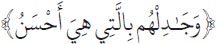
He also says: “No one disputes Allah’s Signs except those who disbelieve.” [62].
also says: “No one disputes Allah’s Signs except those who disbelieve.” [62].
If disputation is engaged in in order to arrive at the truth and to confirm it then it is praiseworthy. If it is done to repudiate the truth or it is mere disputation without knowledge then it is blameworthy. The texts that are narrated concerning its being permitted or being reproved reveal this position in detail. Mujādalah has the same meaning [as jidāl]. I have explained all of that at great length in Tahdhīb al-asmā’ wa-l-lughāt.
One of [the wise] said: “I have never seen anything that does away with the Dīn, diminishes manliness, wastes pleasure, or occupies the heart more completely than litigation.”
If you object that there is sometimes no avoiding litigation to obtain one’s rights, the answer is, as Imam al-Ghazālī replied: “Severe censure is only [applicable] to those who litigate falsely or without knowledge, such as someone who is entrusted by the judge and then deputises in litigation before knowing on which side the truth lies, and so litigates without knowledge.
“Included in the censure also is someone who seeks his right but does not confine himself to the measure of his need, and instead altercates and lies in order to cause harm and to gain power over his opponent. The same applies to someone who mixes hurtful words in his litigation for which there is no need in order for him to obtain his right, as is also the case for someone motivated simply by pure obstinate rejection in order to overcome his opponent and break him—and this too is reprehensible.
“As for a litigant who supports his arguments according to the way of the Sharī‘ah, without altercation and excess or extra obstinate persistence beyond what is necessary and without intending obstinate rejection or hurt, what he is doing is not unlawful; but it is more fitting that he abstain from it provided he can find a way to do so, since controlling one’s tongue in litigation to the extent of being [altogether] fair and just is impossible.
“Litigation makes the breast boil with rancour and stirs up anger, and when anger stirs the consequence is such malice between the two parties that each of them takes pleasure in causing hurt to the other and is grieved at what causes the other pleasure, and so each sets his tongue free to attack the other’s honour. Hence anyone who litigates exposes himself to these character defects. The least [danger] that lies in it is the heart’s being occupied to such an extent that it enters into his ṣalāh and his thoughts are busy with argumentation and litigation, so that his state is no longer correct.
“Litigation is the beginning of evil, as are disputation and arguing, so one ought not to open the door of litigation without some pressing need to do so from which there is no escape; and when doing so one must preserve one’s tongue and heart from all the ill effects of litigation.” [63].
We relate in the book of at-Tirmidhī that Ibn ‘Abbās reported that the Messenger of Allah said: “It is enough wrong action for you that you continuously litigate.” [64].
reported that the Messenger of Allah said: “It is enough wrong action for you that you continuously litigate.” [64].And it is narrated of ‘Alī that he said: “Litigation has dangers.”
that he said: “Litigation has dangers.”I say that quḥam, ‘dangers’, is written with a ḍammah on the qāf and a fatḥah on the ḥā’, and means ‘things that cause destruction’.
DISAPPROVAL OF SPEAKING IN GUTTURAL TONES BY SPEAKING AFFECTEDLY ETC.
It is makrūh to speak in guttural tones by speaking affectedly, or to exert oneself in speaking affectedly in rhymed prose and eloquent language, and in artificially constructed introductions as affectedly eloquent speakers habitually do, and in their elaborate speeches, because all of that is reprehensible affectation. The same applies to affected rhymed prose, as is also the case with seeking out petty details of case endings (i‘rāb) and barbarous usages when talking to ordinary people. Speakers should use words which their audience will understand clearly and easily.
We relate in the books of at-Tirmidhī and Abū Dāwūd that ‘Abdullāh ibn ‘Amr ibn al-‘Āṣ reported that the Messenger of Allah said: “Allah hates orators among men who chew [words] with their tongues as the cow chews the cud.” [65].At-Tirmidhī states that this is a ḥasan hadith.
reported that the Messenger of Allah said: “Allah hates orators among men who chew [words] with their tongues as the cow chews the cud.” [65].At-Tirmidhī states that this is a ḥasan hadith.We relate in the Ṣaḥīḥ of Muslim that ‘Abdullāh ibn Mas‘ūd related that the Prophet said: “May those who exaggerate be destroyed.” [66].He said it thrice. The learned say that mutanaṭṭi‘īn (‘those who exaggerate’) are those who go to great lengths over things.
related that the Prophet said: “May those who exaggerate be destroyed.” [66].He said it thrice. The learned say that mutanaṭṭi‘īn (‘those who exaggerate’) are those who go to great lengths over things.We relate in the book of at-Tirmidhī that Jābir reported that the Messenger of Allah said: “The dearest among you to me, and those [who shall be] closest to me on the Day of Judgment, are the best of you in character. And the most disliked of you, and the furthest from me on the Day of Judgment, are windbags, those who speak affectedly, and the mutafayhiqūn.” They said: “We know windbags and those who speak affectedly, but who are the mutafayhiqūn?” He said: “Those who are arrogant.” [67].At-Tirmidhī says that this is a ḥasan hadith, and adds that tharthār (a windbag) is someone who talks a great deal, while mutashaddiq (someone who speaks affectedly) is someone who behaves arrogantly towards people while talking and addresses them in an unseemly or indecent manner.”
reported that the Messenger of Allah said: “The dearest among you to me, and those [who shall be] closest to me on the Day of Judgment, are the best of you in character. And the most disliked of you, and the furthest from me on the Day of Judgment, are windbags, those who speak affectedly, and the mutafayhiqūn.” They said: “We know windbags and those who speak affectedly, but who are the mutafayhiqūn?” He said: “Those who are arrogant.” [67].At-Tirmidhī says that this is a ḥasan hadith, and adds that tharthār (a windbag) is someone who talks a great deal, while mutashaddiq (someone who speaks affectedly) is someone who behaves arrogantly towards people while talking and addresses them in an unseemly or indecent manner.”Know that this rebuke does not apply to those who make the wording of their sermons and discourses elegant, provided that there is no exaggeration and overstatement, because the objective here is to awaken the hearts to the obedience of Allah and beautiful words have an evident effect in this.
and beautiful words have an evident effect in this.DISAPPROVAL OF EVEN PERMISSIBLE SPEECH AFTER ṢALĀT AL-‘ISHĀ’
It is makrūh, after performing the ṣalāh of ‘Ishā’, to engage in conversation that is permissible at other times. By permissible talk I mean talk which one may equally well engage in or leave. Conversations that are ḥarām or makrūh at other times are even more ḥarām and deplorable at that time. Good conversation, like scholarly discussions, stories of the pious, and talk of good character and conversations with guests, is not makrūh but mustaḥabb. The authentic hadiths confirm this. Similarly, there is no harm in conversation with a valid excuse or prompted by events that occur. The hadiths concerning everything I have mentioned are very well-known, but I will allude to some of them in summary fashion and point out a good number of them.
We relate in the Ṣaḥīḥs of al-Bukhārī and Muslim that Abū Barazah related that the Messenger of Allah used to dislike sleeping before ‘Ishā’ and conversation after it. [68].
related that the Messenger of Allah used to dislike sleeping before ‘Ishā’ and conversation after it. [68].Numerous hadiths make concessions for conversation about the matters we have mentioned above, including the hadith of Ibn ‘Umar in the [same] two Ṣaḥīḥs that when the Messenger of Allah said the salām after performing the ṣalāh of ‘Ishā’ during the last part of his life, he said: “Do you see this night of yours? After one hundred years there will not remain anyone who is on the face of the earth today.” [69].
in the [same] two Ṣaḥīḥs that when the Messenger of Allah said the salām after performing the ṣalāh of ‘Ishā’ during the last part of his life, he said: “Do you see this night of yours? After one hundred years there will not remain anyone who is on the face of the earth today.” [69].Another example is the hadith of Abū Mūsā al-Ash‘arī , in the same two Ṣaḥīḥs, that the Messenger of Allah delayed the ṣalāh of ‘Ishā’ until the twilight had disappeared. Then the Messenger of Allah came out and led the Companions in ṣalāh. When he had completed his ṣalāh he said to those who were present: “Be at ease; I will teach you something. Rejoice in the good news that part of Allah’s favour upon you is that there are no people but you who are praying at this hour.” [70].
, in the same two Ṣaḥīḥs, that the Messenger of Allah delayed the ṣalāh of ‘Ishā’ until the twilight had disappeared. Then the Messenger of Allah came out and led the Companions in ṣalāh. When he had completed his ṣalāh he said to those who were present: “Be at ease; I will teach you something. Rejoice in the good news that part of Allah’s favour upon you is that there are no people but you who are praying at this hour.” [70].Another example is the hadith of Anas in the Ṣaḥīḥ of al-Bukhārī that [the Companions] waited for the Prophet and he came to them when almost half the night had passed. He led them in ṣalāh: that is, ‘Ishā’. He [Anas] said: “Then he addressed them saying, ‘[Other] people have performed ṣalāh and gone to sleep, but you have continued to be in ṣalāh for as long as you were waiting for ṣalāh.’” [71].
in the Ṣaḥīḥ of al-Bukhārī that [the Companions] waited for the Prophet and he came to them when almost half the night had passed. He led them in ṣalāh: that is, ‘Ishā’. He [Anas] said: “Then he addressed them saying, ‘[Other] people have performed ṣalāh and gone to sleep, but you have continued to be in ṣalāh for as long as you were waiting for ṣalāh.’” [71].Another proof is the hadith from ‘Abdullāh ibn ‘Abbās [72]. about him spending the night in the house of his maternal aunt Maymūnah . He said that the Prophet performed the ṣalāh of ‘Ishā’ and then went to his family and spoke to them and asked, “Has the little boy gone to sleep?”
about him spending the night in the house of his maternal aunt Maymūnah . He said that the Prophet performed the ṣalāh of ‘Ishā’ and then went to his family and spoke to them and asked, “Has the little boy gone to sleep?”Another proof is the hadith from ‘Abd ar-Raḥmān ibn Abī Bakr who reported the story [73].about [Abū Bakr’s] guests and him holding back from them until he had prayed ‘Ishā’. Then he came and spoke to them and spoke to his wife and his son, speaking to them repeatedly. This hadith is found in both Ṣaḥīḥs.
who reported the story [73].about [Abū Bakr’s] guests and him holding back from them until he had prayed ‘Ishā’. Then he came and spoke to them and spoke to his wife and his son, speaking to them repeatedly. This hadith is found in both Ṣaḥīḥs.There are many like these and they are innumerable, but in that which we relate there is more than enough.
THE RULING ON CALLING THE LATER ‘ISHĀ’ ‘AL-‘ATAMAH’, CALLING MAGHRIB ‘AL-‘ISHĀ’, AND CALLING ṢUBḤ ‘GHADĀH’
It is makrūh to call the later ‘Ishā’ al-‘Atamah because of the well-known ṣaḥīḥ hadiths on the subject. It is also makrūh to call Maghrib al-‘Ishā’.
We relate in the Ṣaḥīḥ of al-Bukhārī from ‘Abdullāh ibn Mughaffal al-Muzanī l—written with ghayn—that he reported that the Messenger of Allah said: “Do not let the desert Arabs overrule you with respect to the name of your prayer of Maghrib.” He said: “The desert Arabs say that it is ‘Ishā’.” [74].
said: “Do not let the desert Arabs overrule you with respect to the name of your prayer of Maghrib.” He said: “The desert Arabs say that it is ‘Ishā’.” [74].[If anyone objects that there are] hadiths about naming ‘Ishā’ al-‘Atamah, such as the hadith “If only [people] knew what is in aṣ-Ṣubḥ and al-‘Atamah, they would come to them even if it were crawling on their hands and knees,” the response is twofold.
First, their point is to make it clear that the prohibition is not such as to render this ḥarām, but for the sake of being careful.
Second, that it was feared that the people addressed thus might be unclear as to what he meant if he had called it ‘Ishā’ [since the desert Arabs used that term for Maghrib].
As for calling aṣ-Ṣubḥ Ghadāh, there is no disapproval of that according to the correct position, and there are very many ṣaḥīḥ hadiths employing the term al-Ghadāh. A group of our [Shāfi‘ī] colleagues say that this is disapproved of, but that is not the case. There is no harm in calling Maghrib and ‘Ishā’ ‘the two ‘Ishā’s’. There is no harm in calling ‘Ishā’ ‘the later ‘Ishā’’. Although it is narrated from al-Aṣma‘ī that he held that one should not say ‘the later ‘Ishā’’, that is an obvious mistake.
It is reliably transmitted in the Ṣaḥīḥ of Muslim that the Prophet said: “Any woman who has put on scent should not attend the later ‘Ishā’ together with us.” [75].
said: “Any woman who has put on scent should not attend the later ‘Ishā’ together with us.” [75].That is reliably established from the words of an innumerable group of Compan ions in the two Ṣaḥīḥs and elsewhere, and I have explained all that, together with its evidentiary proofs, in Tahdhīb al-asmā’ wa-l-lughāt. And all success is by Allah.
IT IS ḤARĀM TO DIVULGE A SECRET IF THERE IS HARM OR HURT IN DOING SO
It is forbidden to reveal secrets. The hadiths in this regard are many. It is ḥarām if it entails harm and hurt.
We relate in the Sunans of Abū Dāwūd and at-Tirmidhī that Jābir reported that the Messenger of Allah said: “If a man tells another man something and he turns away, it become a trust.” [76].According to at-Tirmidhī, this is a ḥasan hadith.
reported that the Messenger of Allah said: “If a man tells another man something and he turns away, it become a trust.” [76].According to at-Tirmidhī, this is a ḥasan hadith.ON THE DISAPPROVAL OF ASKING A MAN NEEDLESSLY ABOUT WHY HE HIT HIS WIFE
It is makrūh to ask a man why he struck his wife, except in the case of [strict] necessity.
We cited the authentic hadiths about keeping silent about things in which there is no benefit at the beginning of the chapter on safeguarding the tongue.
We mentioned this ṣaḥīḥ hadith: “Part of the goodness of a man’s Islam is that he disregard that which does not concern him.” [77].
We relate in the Sunan of Abū Dāwūd, an-Nasā’ī and Ibn Mājah that ‘Umar ibn al-Khaṭṭāb related that the Messenger of Allah said: “A man should not be asked why he beats his wife.” [78].
related that the Messenger of Allah said: “A man should not be asked why he beats his wife.” [78].WHAT IS RELATED ABOUT POETRY; WITH AN EXPLANATION OF THE RULING ON IT
With regard to poetry, we relate in the Musnad of Abū Ya‘lā al-Mawṣilī, with a ḥasan isnād, that ‘Ā’ishah narrated that the Messenger of Allah was asked about poetry and said, “It is speech, the good of which is good and the bad of which is bad.” [79].
narrated that the Messenger of Allah was asked about poetry and said, “It is speech, the good of which is good and the bad of which is bad.” [79].The ‘ulamā’ say that this means that poetry is like prose, but that to confine oneself to [expressing oneself] exclusively in verse is blameworthy. It is recorded in authentic hadiths that the Messenger of Allah listened to poetry and instructed Ḥassān ibn Thābit to satirise and disparage the disbelievers. It is reliably established that he said: “In some poetry there is wisdom.” [80].It is also recorded that he said: “For the innards of any of you to be filled with pus would be better for him than for them to be filled with poetry.” [81].And all of that is in accordance with what we have mentioned.
listened to poetry and instructed Ḥassān ibn Thābit to satirise and disparage the disbelievers. It is reliably established that he said: “In some poetry there is wisdom.” [80].It is also recorded that he said: “For the innards of any of you to be filled with pus would be better for him than for them to be filled with poetry.” [81].And all of that is in accordance with what we have mentioned.EMPLOYING ALLUSIONS FOR MATTERS WHICH ONE IS TOO SHY TO MENTION
Among the things that are forbidden are indecency and obscene language. The authentic hadiths about this are many and well-known. What it means is expressing things that are base in explicit words, even if they be accurate and the speaker truthful. This happens often with words referring to sexual intercourse. It is essential that allusions be used to express this in comely words whose implication is readily understood. This is mentioned in the Mighty Qur’ān and the noble and authentic Sunnahs. Allah says: “Approaching your wives on the nights of the fasts is permitted to you” [82]..
says: “Approaching your wives on the nights of the fasts is permitted to you” [82]..
Allah says: “And how could you take it when you have gone in unto one another?” [83].
says: “And how could you take it when you have gone in unto one another?” [83].
Allah also says: “And if you divorce them before touching them. . .” [84].
also says: “And if you divorce them before touching them. . .” [84].
According to the ‘ulamā’, one ought, in this and other expressions one is too shy to mention directly, to use allusions that can be understood. So intercourse with a woman could be referred to as ‘going to’, ‘visiting’, ‘living with’ or ‘falling upon’. One should not say openly ‘copulate’, ‘have sex’, and suchlike. Likewise, allusion should be made to urinating and defecating by saying ‘discharging one’s need’ or ‘going to the open spaces’. One should not say explicitly ‘excrement’, ‘urine’, and so on. Likewise, bodily defects like leprosy, halitosis, or body odours should be referred to in seemly words that can readily be understood. Other examples should be considered along with what we have mentioned.
Know that all this applies when there is no need to be explicit; but if there is a need to make something clear or to teach, or if one is afraid that the person one is addressing will understand the allusion [literally] or misunderstand its purport, then one has to speak directly so that correct understanding is achieved. That is how the hadiths which state such things explicitly must be interpreted, meaning [directness is permissible] in case of necessity as we mentioned, because achieving understanding in this respect is more important than merely being good-mannered. And all success is by Allah.
We relate in the book of at-Tirmidhī that ‘Abdullāh ibn Mas‘ūd narrated that the Messenger of Allah said: “A believer does not regularly defame or curse, nor is he vulgar or obscene”. [85].
narrated that the Messenger of Allah said: “A believer does not regularly defame or curse, nor is he vulgar or obscene”. [85].We relate in the books of at-Tirmidhī and Ibn Mājah that Anas related that the Messenger of Allah said: “Never does vulgarity enter into anything without blemishing it; and never does modesty enter into a thing without adorning it.” [86].
related that the Messenger of Allah said: “Never does vulgarity enter into anything without blemishing it; and never does modesty enter into a thing without adorning it.” [86].THE PROHIBITION OF REBUFFING ONE’S FATHER OR MOTHER ETC.
It is extremely ḥarām to rebuff or turn away from one’s mother or father. Allah says: “And your Lord has decreed that you worship none but Him, and that you be good to [your] parents. Whether one or both of them attain old age in your life, say not to them a word of contempt, nor repel them, but address them in terms of honour. And from compassion lower to them the wing of humility, and say: “Lord, bestow on them Your Mercy even as they cherished me in childhood.” [87].
says: “And your Lord has decreed that you worship none but Him, and that you be good to [your] parents. Whether one or both of them attain old age in your life, say not to them a word of contempt, nor repel them, but address them in terms of honour. And from compassion lower to them the wing of humility, and say: “Lord, bestow on them Your Mercy even as they cherished me in childhood.” [87].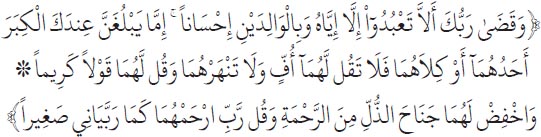
We relate in the Ṣaḥīḥs of al-Bukhārī and Muslim that ‘Abdullāh ibn ‘Amr ibn al-‘Āṣ reported that the Messenger of Allah said, “It is a major sin for a man to curse his parents.” [Those present] asked: “Messenger of Allah, does a man curse his parents?” He replied, “He may curse a man’s father and so the man curses his father [in return]; he may curse a man’s mother so he curses his mother [in return].” [88].
reported that the Messenger of Allah said, “It is a major sin for a man to curse his parents.” [Those present] asked: “Messenger of Allah, does a man curse his parents?” He replied, “He may curse a man’s father and so the man curses his father [in return]; he may curse a man’s mother so he curses his mother [in return].” [88].We relate in the Sunans of Abū Dāwūd and at-Tirmidhī that Ibn ‘Umar reported: “I had a wife and I loved her, but [my father] ‘Umar disliked her. He told me: ‘Divorce her.’ I refused, and ‘Umar went to the Prophet and told him about this. The Prophet said: ‘Divorce her.’” [89].At-Tirmidhī states that this is a ḥasan ṣaḥīḥ hadith.
reported: “I had a wife and I loved her, but [my father] ‘Umar disliked her. He told me: ‘Divorce her.’ I refused, and ‘Umar went to the Prophet and told him about this. The Prophet said: ‘Divorce her.’” [89].At-Tirmidhī states that this is a ḥasan ṣaḥīḥ hadith.References
[1] Al-Bukhārī (6179) and Muslim (2251).
[2] Abū Dāwūd (4979).
[3] Karm comes from a root connoting generosity and nobility.
[4] Al-Bukhārī (6183) and Muslim (2246).
[5] Muslim (2248).
[6] Muslim (2623).
[7] Abū Dāwūd (4983) and al-Muwaṭṭa’ (2/984).
[8] Abū Dāwūd (4980).
[9] Al-Bukhārī (6103) and Muslim (60).
[10] Al-Bukhārī (6045) and Muslim (61).
[11] Qur’ān 10:88.
[12] Qur’ān 2:195.
[13] Qur’ān 2:26.
[14] Qur’ān 35:39.
[15] Al-Bukhārī (6205) and Muslim (2143).
[16] Al-Bukhārī (3746), Abū Dāwūd (4662), and an-Nasā’ī (251).
[17] Al-Bukhārī (4121) and Muslim (1768).
[18] Muslim (1498), with a slight variation in the wording.
[19] Abū Dāwūd (4977).
[20] Al-Bukhārī (2552), Muslim (2249), and Abū Dāwūd (4975).
[21] Al-Bukhārī (91) and Muslim (5:1722).
[22] Al-Bukhārī (1412) and Muslim (61:157) on zakāh, in the chapter encouraging giving ṣadaqah before a time comes when no-one can be found to accept it.
[23] Al-Bukhārī (3059).
[24] Qur’ān 12:42.
[25] Qur’ān 20:97.
[26] p. 169.
[27] ibid.
[28] Muslim (4575).
[29] Abū Dāwūd (5101).
[30] Al-Bukhārī (1297) and Muslim (103).
[31] Qur’ān 9:113.
[32] Al-Bukhārī (7076) and Muslim (64).
[33] Muslim (2587), Abū Dāwūd (4894), and at-Tirmidhī (1982).
[34] The particle illā when connected to the preceding statement means ‘but’ or ‘except’.
[35] When the particle illā is unconnected, such as when it begins a sentence, it means ‘however’.
[36] Qur’ān 57:4.
[37] Meaning, “May Allah give rest by means of you to the eye of those whom you love”, or “May He give your eye rest in those whom you love”. ‘Awn al-Ma‘būd sharḥ Abī Dāwūd.
[38] Abū Dāwūd (5227).
[39] Al-Bukhārī (6290), Muslim (2184), Abū Dāwūd (4851), and at-Tirmidhī (2827).
[40] Al-Bukhārī (6288), Muslim (2183), al-Muwaṭṭa’ (2/988), and Abū Dāwūd (4852).
[41] Abū Dāwūd (4852).
[42] Al-Bukhārī (5240), Abū Dāwūd (2150), and at-Tirmidhī (2793).
[43] Al-Bukhārī (6339), Muslim (2679), al-Muwaṭṭa’ (1/213), Abū Dāwūd (1483), at-Tirmidhī (3492), and an-Nasā’ī in ‘Amal al-yawm wa al-laylah (582).
[44] Muslim (8:2679).
[45] Al-Bukhārī (6338) and Muslim (3678).
[46] Grandparents and ancestors are included in ābā (‘ fathers’) .
[47] Al-Bukhārī (6646), Muslim (1646), Abū Dāwūd (3250), at-Tirmidhī (1534), and an-Nasā’ī (7/4–5).
[48] Al-Iḥsān bi-tartīb Ṣaḥīḥ Ibn Ḥibbān (4359).
[49] Abū Dāwūd (3253) and al-Futūḥāt (7/114). Al-Mundhirī states that the chain of this hadith is ṣaḥīḥ, whereas as-Sakhāwī grades it as ḥasan.
[50] Muslim (1607) and an-Nasā’ī (7/247).
[51] Ḥilyat al-awliyā ’ (2:309).
[52] Al-Bukhārī (6069) and Muslim (2990).
[53] Qur’ān 5:2.
[54] Qur’ān 50:18.
[55] Abū Dāwūd (2175) and al-Futūḥāt (7/118). The narrators of the chain of a similar narration in aṭ-Ṭabarānī’s al-Awsaṭ are trustworthy.
[56] Qur’ān 1:5.
[57] Abū Dāwūd (1671). As-Sakhāwī comments that this hadith is gharīb.
[58] Abū Dāwūd (1672), an-Nasā’ī (5/82), and al-Futūḥāt (7/119). As-Sakhāwī grades it as ḥasan.
[59] Iḥyā ’ ‘ulūm ad-dīn 3:118.
[60] Qur’ān 29:46.
[61] Qur’ān 16:125.
[62] Qur’ān 40:4.
[63] Iḥyā ’ ‘ulūm ad-dīn (3:119).
[64] At-Tirmidhī (1994).
[65] Abū Dāwūd (5005) and at-Tirmidhī (2857).
[66] Muslim (2670).
[67] At-Tirmidhī (2019).
[68] Al-Bukhārī (568), Muslim (647), Abū Dāwūd (398), and at-Tirmidhī (168).
[69] Al-Bukhārī (564), Muslim (2537), Abū Dāwūd (4348), and at-Tirmidhī (2252).
[70] Al-Bukhārī (567), Muslim (641).
[71] Al-Bukhārī (572), Muslim (640) and an-Nasā’ī (1/268).
[72] Al-Bukhārī (117) and Muslim (763).
[73] Al-Bukhārī (602) and Muslim (2058).
[74] Al-Bukhārī (563).
[75] Muslim (444).
[76] Abū Dāwūd (4868) and at-Tirmidhī (1960). Ibn ‘Allān comments that this hadith is ḥasan on the strength of other hadiths (li-ghayrihi).
[77] Al-Muwaṭṭa’ (2/903), at-Tirmidhī (2318), and Ibn Mājah (3976).
[78] Abū Dāwūd (2147) and al-Futūḥāt (7/140). Ibn Ḥajar states that this hadith is ṣaḥīḥ, in Tanbīh al-akhyār.
[79] Abū Ya‘lā (4760).
[80] Al-Bukhārī (6145) and Abū Dāwūd (5010).
[81] Al-Bukhārī (6155), Muslim (2257), Abū Dāwūd (5009) and at-Tirmidhī (2855).
[82] Qur’ān 2:187.
[83] Qur’ān 4:21.
[84] Qur’ān 2:237.
[85] At-Tirmidhī (1978).
[86] At-Tirmidhī (1975) and Ibn Mājah (4185).
[87] Qur’ān 17:23–24.
[88] Al-Bukhārī (5973), Muslim (90), Abū Dāwūd (5141), and at-Tirmidhī (1903).
[89] Abū Dāwūd (1583) and at-Tirmidhī (1189).