
ALLAH  SAYS: “Truly in the creation of the heavens and the earth and the alternation of night and day there are signs for men of understanding: those who remember Allah standing, sitting, and lying on their sides.” [1].
SAYS: “Truly in the creation of the heavens and the earth and the alternation of night and day there are signs for men of understanding: those who remember Allah standing, sitting, and lying on their sides.” [1].
We relate in the Ṣaḥīḥ of al-Bukhārī from Ḥudhayfah ibn al-Yamān  and Abū Dharr , who reported that when the Messenger of Allah
  went to bed he would say: “In Your Name, Allah, do I live and die.” [2].We also relate it from the Ṣaḥīḥ of Muslim, from al-Barā’ ibn ‘Āzib’s narration .
and Abū Dharr , who reported that when the Messenger of Allah went to bed he would say: “In Your Name, Allah, do I live and die.” [2].We also relate it from the Ṣaḥīḥ of Muslim, from al-Barā’ ibn ‘Āzib’s narration .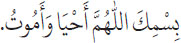
Bismika-llāhumma aḥyā wa amūt.
And we relate from the Ṣaḥīḥs of al-Bukhārī and Muslim from ‘Alī who said that the Messenger of Allah told him and Fāṭimah: “When you retire to bed or go to sleep, say Allah is greater thirty-three times, Glory be to Allah thirty-three times, and Praise be to Allah thirty-three times.” According to another report he said: “And make tasbīḥ thirty-four times” and in another “And make takbīr thirty-four times.” ‘Alī said: “I have never missed it since the time I heard it from the Messenger of Allah .” “Not even on the night before the battle of Ṣiffīn?” he was asked. “Not even on the night of Ṣiffīn,” he replied. [3].
who said that the Messenger of Allah told him and Fāṭimah: “When you retire to bed or go to sleep, say Allah is greater thirty-three times, Glory be to Allah thirty-three times, and Praise be to Allah thirty-three times.” According to another report he said: “And make tasbīḥ thirty-four times” and in another “And make takbīr thirty-four times.” ‘Alī said: “I have never missed it since the time I heard it from the Messenger of Allah .” “Not even on the night before the battle of Ṣiffīn?” he was asked. “Not even on the night of Ṣiffīn,” he replied. [3].
Subḥāna-llāh, al-ḥamdu li-llāh, Allāhu akbar.
And we relate from the Ṣaḥīḥs of al-Bukhārī and Muslim, from Abū Hurayrah, who reported that the Messenger of Allah said: “When any of you retires to bed, he should dust his bed off with the corner of his trousers, because he does not know what came [to it] after him. Then he should say: In Your name, my Lord, I lay down my side and by You I raise it again. If You take my soul, then have mercy on it; and if You release it, protect it by that with which You protect Your righteous slaves.” [4].
who reported that the Messenger of Allah said: “When any of you retires to bed, he should dust his bed off with the corner of his trousers, because he does not know what came [to it] after him. Then he should say: In Your name, my Lord, I lay down my side and by You I raise it again. If You take my soul, then have mercy on it; and if You release it, protect it by that with which You protect Your righteous slaves.” [4].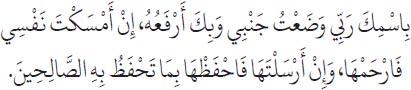
Bismika Rabbī waḍa‘tu jambī wa bika arfa‘uh, in amsakta nafsī fa-rḥamhā, wa in arsaltahā fa-ḥfaẓhā bimā taḥfaẓu bihi-ṣ-ṣāliḥīn.
And we relate from the two Ṣaḥīḥs, from ‘Ā’ishah  that when the Messenger of Allah went to bed he blew onto his hands, recited al-Mu‘awwidhāt, and passed them over his body. [5].
that when the Messenger of Allah went to bed he blew onto his hands, recited al-Mu‘awwidhāt, and passed them over his body. [5].And we relate from the two Ṣaḥīḥs, from ‘Ā’ishah , who also reported that every night when the Messenger of Allah went to bed, he put his palms together, blew onto them, and recited over them “Say: He is Allah, One”, “Say: I seek protection in the Lord of the dawn” [6].and “Say: I seek protection in the Lord of men”. Then he passed them over whatever parts of his body he was able to, beginning with his head, his face, and the front part of his body. He did this thrice. [7].The linguists say that the meaning of an-nafth is ‘a light puff of breath without spittle’ (nafkh laṭīf bi-lā rīq).
, who also reported that every night when the Messenger of Allah went to bed, he put his palms together, blew onto them, and recited over them “Say: He is Allah, One”, “Say: I seek protection in the Lord of the dawn” [6].and “Say: I seek protection in the Lord of men”. Then he passed them over whatever parts of his body he was able to, beginning with his head, his face, and the front part of his body. He did this thrice. [7].The linguists say that the meaning of an-nafth is ‘a light puff of breath without spittle’ (nafkh laṭīf bi-lā rīq).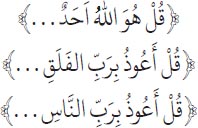
Qul Huwa-llāhu Aḥad. . .
Qul a‘ūdhu bi-Rabbi-l-falaq. . .
Qul a‘ūdhu bi-Rabbi-n-nās. . .
Qul a‘ūdhu bi-Rabbi-l-falaq. . .
Qul a‘ūdhu bi-Rabbi-n-nās. . .
We relate in the two Ṣaḥīḥs from Abū Mas‘ūd al-Anṣārī al-Badrī, whose other name was ‘Uqbah ibn ‘Amr , who reported that the Messenger of Allah said: “Whoever recites two verses from Sūrat al-Baqarah at night, they will suffice for him.” [8].The ‘ulamā’ differ about the meaning of “they will suffice for him”. Some say it means [they will protect him] from calamities and misfortune on that night. Others say it will suffice for him in place of the prayer at night (Tahajjud). I say that both are possible.
, who reported that the Messenger of Allah said: “Whoever recites two verses from Sūrat al-Baqarah at night, they will suffice for him.” [8].The ‘ulamā’ differ about the meaning of “they will suffice for him”. Some say it means [they will protect him] from calamities and misfortune on that night. Others say it will suffice for him in place of the prayer at night (Tahajjud). I say that both are possible.We relate in the two Ṣaḥīḥs, from al-Barā’ ibn ‘Āzib who reported that Allah’s Messenger told him: “When you go to bed, perform ablution as you would for ṣalāh, then lie down on your right side and recite: O Allah, I submit my soul to You, and I entrust my destiny to You. I retreat unto You for protection, with hope in You and fear of You. There is no refuge and no safety from You but with You. I affirm my faith in Your Book, which You revealed, and Your Messenger, whom You sent. If you pass away that night, you will die in the true religion. Make these the last words that you say.” [9].This is the wording of one of al-Bukhārī’s versions, whereas the rest of the narration is Muslim’s version, which is very similar.
who reported that Allah’s Messenger told him: “When you go to bed, perform ablution as you would for ṣalāh, then lie down on your right side and recite: O Allah, I submit my soul to You, and I entrust my destiny to You. I retreat unto You for protection, with hope in You and fear of You. There is no refuge and no safety from You but with You. I affirm my faith in Your Book, which You revealed, and Your Messenger, whom You sent. If you pass away that night, you will die in the true religion. Make these the last words that you say.” [9].This is the wording of one of al-Bukhārī’s versions, whereas the rest of the narration is Muslim’s version, which is very similar.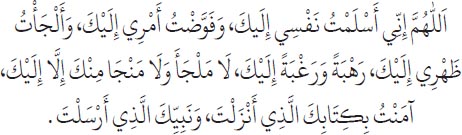
Allāhumma innī aslamtu nafsī ilayk, wa fawwaḍtu amrī ilayk, wa alja’tu ẓahrī ilayk, raghbatan wa rahbatan ilayk, lā malja’a wa lā manjā minka illā ilayk, āmantu bi-Kitābika-lladhī anzalt, wa Nabiyyika-lladhī arsalt.
We relate in the Ṣaḥīḥ of al-Bukhārī that Abū Hurayrah said: “The Messenger of Allah appointed me to look after the charity given for Ramaḍān. A person came to me and started to pick and take from the food.” He recounted the rest of the hadith and at the end he said: “When you go to bed, recite the Verse of the Throne (Āyat al-Kursī), [which begins] Allāhu lā ilāha illā Hūwa al-Ḥayyu-l-Qayyūm. It will continue to be a God-given protection for you, and Shayṭān will not come near to you until the morning.” The Messenger of Allah said: “[That person] told the truth even though he is a liar. That was Shayṭān.” [10].Al-Bukhārī narrated this hadith in his Ṣaḥīḥ, saying: “‘Uthmān ibn al-Haytham said that ‘Awf related to us from Muḥammad ibn Sīrīn from Abū Hurayrah”. This is a continuous (muttaṣil) chain. ‘Uthmān ibn al-Haytham was one of the teachers of al-Bukhārī from whom he related in his Ṣaḥīḥ.
said: “The Messenger of Allah appointed me to look after the charity given for Ramaḍān. A person came to me and started to pick and take from the food.” He recounted the rest of the hadith and at the end he said: “When you go to bed, recite the Verse of the Throne (Āyat al-Kursī), [which begins] Allāhu lā ilāha illā Hūwa al-Ḥayyu-l-Qayyūm. It will continue to be a God-given protection for you, and Shayṭān will not come near to you until the morning.” The Messenger of Allah said: “[That person] told the truth even though he is a liar. That was Shayṭān.” [10].Al-Bukhārī narrated this hadith in his Ṣaḥīḥ, saying: “‘Uthmān ibn al-Haytham said that ‘Awf related to us from Muḥammad ibn Sīrīn from Abū Hurayrah”. This is a continuous (muttaṣil) chain. ‘Uthmān ibn al-Haytham was one of the teachers of al-Bukhārī from whom he related in his Ṣaḥīḥ.[However] Abū ‘Abdullāh al-Ḥumaydī said in his al-Jam‘ bayn aṣ-Ṣaḥīḥayn that al-Bukhārī narrated this hadith with its isnād in shortened form (ta‘līq). That is not acceptable. The correct and preferred position of scholars and researchers (muḥaqqiqūn) is that the statement of al-Bukhārī and others that ‘So-and-so said’ is taken to imply his having heard directly from him as well as there being continuity in the chain of transmission if [the narrator] was not someone who concealed gaps in his chains of transmission (mudallis) and he had encountered him. This is one of those. Where a narration’s isnād is in abridged (mu‘allaq) form, this term denotes an isnād in which al-Bukhārī omits to mention his teacher or more [narrators between him and the narrator cited] by saying, regarding hadiths such as this: “‘Awf said”, “Muḥammad ibn Sīrīn said”, and “Abū Hurayrah said”. [11].And Allah knows best.
We relate in the Sunan of Abū Dāwūd that Ḥafṣah , the Mother of the Believers, reported that when the Messenger of Allah was about to lie down he put his right hand under his cheek, then said: “O Allah, save me from Your punishment on the day that You resurrect Your slaves.” He said this thrice. [12].At-Tirmidhī narrated this from Ḥudhayfah from the Prophet , and described this hadith as ḥasan ṣaḥīḥ. He also narrated a version from al-Barā’ ibn ‘Āzib which did not mention “thrice”.
, the Mother of the Believers, reported that when the Messenger of Allah was about to lie down he put his right hand under his cheek, then said: “O Allah, save me from Your punishment on the day that You resurrect Your slaves.” He said this thrice. [12].At-Tirmidhī narrated this from Ḥudhayfah from the Prophet , and described this hadith as ḥasan ṣaḥīḥ. He also narrated a version from al-Barā’ ibn ‘Āzib which did not mention “thrice”.
Allāhumma qīnī ‘adhābaka yawma tab‘athu ‘ibādak.
We relate in the Ṣaḥīḥ of Muslim, the Sunans of Abū Dāwūd, at-Tirmidhī, an-Nasā’ī and Ibn Mājah from Abū Hurayrah who reported that when the Messenger of Allah retired to his bed he said: “O Allah, Lord of the heavens and the earth and the Lord of the Mighty Throne, our Lord and the Lord of all things, You Who split the seed and the grain, You Who revealed the Torah, the Gospels and the Qur’ān, I seek Your protection from the evil of every thing that You hold by the forelock. You are the First and there is none before You; You are the Last and there is none after You. You are the Manifest and there is none above You. You are the Hidden and there is none below You. Settle our debts for us and free us from poverty.” [13].Abū Dāwūd’s version reads: “Settle my debts and enrich us from poverty.”
who reported that when the Messenger of Allah retired to his bed he said: “O Allah, Lord of the heavens and the earth and the Lord of the Mighty Throne, our Lord and the Lord of all things, You Who split the seed and the grain, You Who revealed the Torah, the Gospels and the Qur’ān, I seek Your protection from the evil of every thing that You hold by the forelock. You are the First and there is none before You; You are the Last and there is none after You. You are the Manifest and there is none above You. You are the Hidden and there is none below You. Settle our debts for us and free us from poverty.” [13].Abū Dāwūd’s version reads: “Settle my debts and enrich us from poverty.”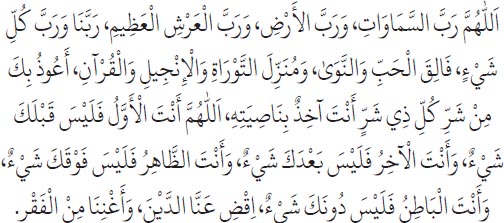
Allāhumma Rabba-s-samāwāt, wa Rabba-l-arḍ, wa Rabba-l-‘Arshi-l-‘aẓīm, Rabbanā wa Rabba kulli shay’, fāliqa-l-ḥabbi wa-n-nawā, wa munazzila-t-Tawrāti wa-l-Injīli wa-l-Qur’ān, a‘ūdhu bika min sharri kulli dhī sharrin Anta ākhidhun bi-nāṣiyatih, Allāhumma Anta-l-Awwalu fa-laysa qablaka shay’, wa Anta-l-Ākhiru fa-laysa ba‘daka shay’, wa Anta-ẓ-Ẓāhiru fa-laysa fawqaka shay’, wa Anta-l-Bāṭinu fa-laysa dūnaka shay’, iqḍi ‘annā-d-dayn, wa aghninā min al-faqr.
We relate with a ṣaḥīḥ isnād from the Sunans of Abū Dāwūd and an-Nasā’ī from ‘Alī , who narrated that the Messenger of Allah used to say when it was time to go to bed: “O Allah, I seek protection by Your Noble Countenance and by Your Perfect Words from the evil of all that You hold by the forelock. O Allah, it is You Who remove debt and sin. O Allah, Your army is never defeated and Your promise is never broken. The power of the mighty does not avail them against You. Glory be to You, Allah, and to You belongs all praise.” [14].
, who narrated that the Messenger of Allah used to say when it was time to go to bed: “O Allah, I seek protection by Your Noble Countenance and by Your Perfect Words from the evil of all that You hold by the forelock. O Allah, it is You Who remove debt and sin. O Allah, Your army is never defeated and Your promise is never broken. The power of the mighty does not avail them against You. Glory be to You, Allah, and to You belongs all praise.” [14].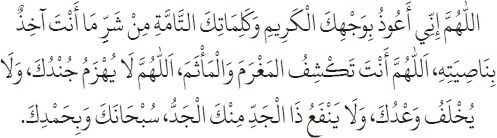
Allāhumma innī a‘ūdhu bi-wajhika-l-karīmi wa kalimātika-t-tāmmati min sharri mā Anta ākhidhun bi-nāṣiyatih. Allāhumma Anta takshifu-l-maghrama wa ’l-ma’tham. Allāhumma lā yuhzamu junduk, wa lā yukhlafu wa‘duk, wa lā yanfa‘u dha-l-jaddi minka-l-jadd, subḥānaka wa bi-ḥamdik.
We relate in the Ṣaḥīḥ of Muslim and the Sunans of Abū Dāwūd and at-Tirmidhī from Anas who reported that when the Messenger of Allah went to bed he said: “Praise be to Allah, Who has fed us, given us to drink, sufficed for us and given us shelter. How many there are who have no one to take care of them and give them shelter!” [15].According to at-Tirmidhī, this hadith is ḥasan ṣaḥīḥ.
who reported that when the Messenger of Allah went to bed he said: “Praise be to Allah, Who has fed us, given us to drink, sufficed for us and given us shelter. How many there are who have no one to take care of them and give them shelter!” [15].According to at-Tirmidhī, this hadith is ḥasan ṣaḥīḥ.
Al-ḥamdu li-llāhi-lladhī aṭ‘amanā wa saqānā, wa kafānā wa āwānā, fa-kam mīm-man lā kāfiya lahu wa lā mu’wī.
And we relate with a ḥasan isnād from the Sunan of Abū Dāwūd from Abū al-Azhārī, better known as Abū Zuhayr al-Anmārī , who reported that when the Messenger of Allah went to bed at night he used to say: “In the name of Allah do I lay down my side. O Allah, forgive me my sins, ward off from me my shayṭān, settle for me my debts, and enter me into the Loftiest Assembly.” The word an-nādiyyu has a fatḥah on the letter nūn, kasrah on the letter dāl, and shaddah on the letter yā. We relate in the Imam Abū Sulaymān Ḥamd ibn Muḥammad ibn Ibrāhīm ibn al-Khaṭṭāb al-Khaṭṭābī (Allah have mercy on him) in his commentary on this hadith, who said that the word an-nādiyyu means ‘a gathering of people in a place’. This is similar to the word an-nadī, its plural being andiyah. He also said: “What is meant by the words an-nādiyyu-l-a‘lā is ‘the gathering of the angels’, ‘the highest assembly of the angels’. [16].
, who reported that when the Messenger of Allah went to bed at night he used to say: “In the name of Allah do I lay down my side. O Allah, forgive me my sins, ward off from me my shayṭān, settle for me my debts, and enter me into the Loftiest Assembly.” The word an-nādiyyu has a fatḥah on the letter nūn, kasrah on the letter dāl, and shaddah on the letter yā. We relate in the Imam Abū Sulaymān Ḥamd ibn Muḥammad ibn Ibrāhīm ibn al-Khaṭṭāb al-Khaṭṭābī (Allah have mercy on him) in his commentary on this hadith, who said that the word an-nādiyyu means ‘a gathering of people in a place’. This is similar to the word an-nadī, its plural being andiyah. He also said: “What is meant by the words an-nādiyyu-l-a‘lā is ‘the gathering of the angels’, ‘the highest assembly of the angels’. [16].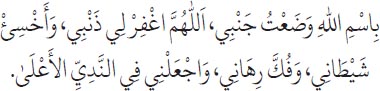
Bismi-llāhi waḍa‘tu jambī, Allāhumma-ghfir lī dhambī, wa akhsi’ shayṭānī, wa fukka rihānī, wa-j‘alnī fī-n-Nadiyyi-l-A‘lā.
And we relate from the Sunans of Abū Dāwūd and at-Tirmidhī from Nawfal al-Ashjā‘ī who reported that the Messenger of Allah told him: “Recite Qul Yā ayyuha-l-kāfirūn (‘Say: O you who reject faith’ [17].), then sleep after you have completed it, for it will absolve you of idolatry.” [18].
who reported that the Messenger of Allah told him: “Recite Qul Yā ayyuha-l-kāfirūn (‘Say: O you who reject faith’ [17].), then sleep after you have completed it, for it will absolve you of idolatry.” [18].And in the Musnad of Abū Ya‘lā al-Mawṣilī from Ibn ‘Abbās who narrated that the Messenger of Allah said: “Shall I not show you words that will save you from assigning partners to Allah? Recite Qul Yā ayyuha-l-kāfirūn (‘Say: O you who reject faith’) when you go to sleep.”
who narrated that the Messenger of Allah said: “Shall I not show you words that will save you from assigning partners to Allah? Recite Qul Yā ayyuha-l-kāfirūn (‘Say: O you who reject faith’) when you go to sleep.”And we relate from the Sunans of Abū Dāwūd and at-Tirmidhī, from ‘Irbād ibn Sāriyah , that the Messenger of Allah used to recite those chapters that begin with the glorification of Allah before he lay down. [19].At-Tirmidhī considered this hadith ḥasan.
, that the Messenger of Allah used to recite those chapters that begin with the glorification of Allah before he lay down. [19].At-Tirmidhī considered this hadith ḥasan.And we relate from ‘Ā’ishah who said that the Messenger of Allah did not sleep until he had recited the chapters Banī Isrā’īl and az-Zumar. [20].According to at-Tirmidhī this hadith is ḥasan.
who said that the Messenger of Allah did not sleep until he had recited the chapters Banī Isrā’īl and az-Zumar. [20].According to at-Tirmidhī this hadith is ḥasan.We relate in the Sunan of Abū Dāwūd with a ṣaḥīḥ isnād that Ibn ‘Umar  reported that the Messenger of Allah used to say when he went to bed: “Praise be to Allah Who has protected me, given me refuge, fed me and given me to drink; Who has been gracious to me and showered favours on me; Who has provided for me and has been most generous. Praise be to Allah in all conditions. O Allah, Lord of all things and Sovereign and God of all things, I seek Your protection from Hell-Fire.” [21].
reported that the Messenger of Allah used to say when he went to bed: “Praise be to Allah Who has protected me, given me refuge, fed me and given me to drink; Who has been gracious to me and showered favours on me; Who has provided for me and has been most generous. Praise be to Allah in all conditions. O Allah, Lord of all things and Sovereign and God of all things, I seek Your protection from Hell-Fire.” [21].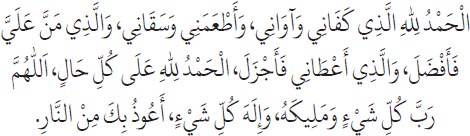
Al-ḥamdu li-llāhi-lladhī kafānī wa āwānī, wa aṭ‘amanī wa saqanī, wa-lladhī manna ‘alayya fa-afḍal, wa-lladhī a‘ṭānī fa-ajzal, al-ḥamdu li-llāhi ‘alā kulli ḥāl. Allāhumma Rabba kulli shay’in wa Mālikah, wa Ilāha kulli shay’, aūdhu bika mina-n-Nār.
And we relate from the book of at-Tirmidhī that Abū Sa‘īd al-Khudrī reported that the Messenger of Allah said: “If a person, when going to bed, says: I seek forgiveness of Allah, besides Whom there is no god, the Living, the Self-Subsisting, and I repent to Him, three times, Allah will forgive his sins even if they be as abundant as the foam of the sea, even if they be equal in number to the stars, even if they be as much as the sands of ‘Ālij, [22].even if they be equal in number to the days of the world.” [23].
reported that the Messenger of Allah said: “If a person, when going to bed, says: I seek forgiveness of Allah, besides Whom there is no god, the Living, the Self-Subsisting, and I repent to Him, three times, Allah will forgive his sins even if they be as abundant as the foam of the sea, even if they be equal in number to the stars, even if they be as much as the sands of ‘Ālij, [22].even if they be equal in number to the days of the world.” [23].
Astaghfiru-llāha-lladhī lā ilāha illā Huwa-l-Ḥayyu-l-Qayyūmu wa atūbu ilayh.
We relate in the Sunans of Abū Dāwūd and others, with a ṣaḥīḥ isnād, that it is reported that a man from the Companions of the Messenger narrated: “I was sitting with the Messenger of Allah when a man from his Companions came and said: ‘Messenger of Allah, I was bitten last night and I could not sleep until morning.’ He asked: ‘By what?’ ‘A scorpion,’ the man replied. He said: ‘If you had said in the evening: I seek protection in the perfect words of Allah from the evil of that He created, nothing would have harmed you, if Allah willed.’” [24].
narrated: “I was sitting with the Messenger of Allah when a man from his Companions came and said: ‘Messenger of Allah, I was bitten last night and I could not sleep until morning.’ He asked: ‘By what?’ ‘A scorpion,’ the man replied. He said: ‘If you had said in the evening: I seek protection in the perfect words of Allah from the evil of that He created, nothing would have harmed you, if Allah willed.’” [24].
A‘ūdhu bi-kalimāti-llāhi-t-tāmmāti min sharri mā khalaq.
We also relate from the Sunans of Abū Dāwūd and others and from Abū Hurayrah . We have already narrated the hadith of Muslim in the chapter on what to say in the morning and evening.
. We have already narrated the hadith of Muslim in the chapter on what to say in the morning and evening.We relate in the book of Ibn as-Sunnī, on the authority of Anas , that the Messenger of Allah advised a man to recite Sūrat al-Ḥashr when he went to bed, and that he added: “If you die, you will die a martyr” or “As one of the people of Paradise.” [25].
, that the Messenger of Allah advised a man to recite Sūrat al-Ḥashr when he went to bed, and that he added: “If you die, you will die a martyr” or “As one of the people of Paradise.” [25].We relate in the Ṣaḥīḥ of Muslim that Ibn ‘Umar instructed a man to say when he went to bed: “O Allah, You created my soul and You will cause it to die; its death and its life are for You. If You keep it alive then protect it, and if You cause it to die then forgive it. O Allah, I ask You for good health and well-being.” Ibn ‘Umar said: “I heard it from the Messenger of Allah .” [26].
instructed a man to say when he went to bed: “O Allah, You created my soul and You will cause it to die; its death and its life are for You. If You keep it alive then protect it, and if You cause it to die then forgive it. O Allah, I ask You for good health and well-being.” Ibn ‘Umar said: “I heard it from the Messenger of Allah .” [26].
Allāhumma khalaqta nafsī wa Anta tawaffāhā, laka mamātuhā wa maḥyāhā, in aḥyaytahā fa-ḥfaẓhā, wa in amattahā fa-ghfir lāhā, Allāhumma as’aluka-l-‘āfiyah.
And we relate from the Sunans of Abū Dāwūd, at-Tirmidhī and others, with ṣaḥīḥ isnāds from the hadith of Abū Hurayrah , as we previously mentioned in the chapter on What to Say in the Morning and Evening (51) in which he told a story about Abū Bakr aṣ-Ṣiddīq . The Prophet said: “Say: O Allah, Creator of the heavens and the earth, Knower of the Unseen and the Seen, Lord and Sovereign of all things, I bear witness that there is no god but You. I seek Your protection from the evil of my ego and the evil and polytheism of Shayṭān.” He said: “Say this when you get up in the morning and in the evening and when you go to bed.”237
, as we previously mentioned in the chapter on What to Say in the Morning and Evening (51) in which he told a story about Abū Bakr aṣ-Ṣiddīq . The Prophet said: “Say: O Allah, Creator of the heavens and the earth, Knower of the Unseen and the Seen, Lord and Sovereign of all things, I bear witness that there is no god but You. I seek Your protection from the evil of my ego and the evil and polytheism of Shayṭān.” He said: “Say this when you get up in the morning and in the evening and when you go to bed.”237
Allāhumma Fāṭira-s-samāwāti wa-l-arḍ, ‘Ālima-l-ghaybi wa-sh-shahādah, Rabba kulli shay’in wa Malīkah, ashhadu an lā ilāha illā Ant. A‘ūdhu bika min sharri nafsī wa min sharri-sh-Shayṭāni wa shirkih.
We relate in the books of at-Tirmidhī and Ibn as-Sunnī from Shaddād ibn Aws , who narrated that the Messenger of Allah said: “No Muslim goes to bed and then recites one chapter of the Book of Allah without Allah appointing an angel who does not allow anything harmful to come near him until he wakes up.” [27].The isnād of this hadith is weak. The meaning of the word habba is ‘to be attentive’ or ‘to stand up’.
, who narrated that the Messenger of Allah said: “No Muslim goes to bed and then recites one chapter of the Book of Allah without Allah appointing an angel who does not allow anything harmful to come near him until he wakes up.” [27].The isnād of this hadith is weak. The meaning of the word habba is ‘to be attentive’ or ‘to stand up’.We relate in the book of Ibn as-Sunnī from Jābir , who narrated that the Messenger of Allah said: “When a man goes to bed, an angel and a demon race one another [towards him]. The angel says: ‘O Allah, make him end well.’ The demon says: ‘May he end badly.’ If the man remembers Allah before he sleeps, the angel spends the night protecting him.” [28].
, who narrated that the Messenger of Allah said: “When a man goes to bed, an angel and a demon race one another [towards him]. The angel says: ‘O Allah, make him end well.’ The demon says: ‘May he end badly.’ If the man remembers Allah before he sleeps, the angel spends the night protecting him.” [28].We also relate, in [the same source], from ‘Amr ibn al-‘Āṣ that when the Messenger of Allah lay down to sleep he used to say: “O Allah, in Your name, my Lord, do I lay down my side, so forgive me my sins.” [29].
that when the Messenger of Allah lay down to sleep he used to say: “O Allah, in Your name, my Lord, do I lay down my side, so forgive me my sins.” [29].
Allāhumma bismika Rabbī waḍa‘tu jambī, fā-ghfir lī dhambī.
We also relate, in [the same source], from Abū Umāmah who reported: “I heard the Prophet say: ‘Whoever goes to bed in a state of ablution and remembers Allah until slumber overtakes him will not move at any time in the night asking Allah for good in this world and the Hereafter without Him granting it to him.’” [30].
who reported: “I heard the Prophet say: ‘Whoever goes to bed in a state of ablution and remembers Allah until slumber overtakes him will not move at any time in the night asking Allah for good in this world and the Hereafter without Him granting it to him.’” [30].And we narrate from ‘Ā’ishah who reported that when the Messenger of Allah went to bed he said: “O Allah, let me enjoy my hearing and my sight and make them inherit from me. Help me against my enemy and show me how to avenge myself against him. O Allah, I seek Your protection from crippling debt, and from hunger, for it is the most evil companion.” [31].
who reported that when the Messenger of Allah went to bed he said: “O Allah, let me enjoy my hearing and my sight and make them inherit from me. Help me against my enemy and show me how to avenge myself against him. O Allah, I seek Your protection from crippling debt, and from hunger, for it is the most evil companion.” [31].
Allāhumma amti‘nī bi-sam‘ī wa baṣarī, wa-j‘alhumā’l-wāritha minnī, wa-nṣurnī ‘alā ‘aduwwī, wa arinī minhu tha’rī, Allāhumma innī a‘ūdhu bika min ghalabati-d-dayn, wa mina-l-jū‘, fa-innahu bi’sa-ḍ-ḍajī‘.
The ‘ulamā’ say that “make my hearing and my sight inherit from me” means that they should remain sound and healthy until one dies. Some say that it means that they should have endurance and strength in old age when the limbs and senses become weak, in other words, “Make them the inheritors of the strength of the other limbs that endure after them.” It is said that the meaning of sam‘ is ‘retaining what one hears and acting by it’ and the meaning of baṣar is ‘considering the moral of what one sees’. The wording ‘and make it my heir’ is also recorded, so that the pronoun [it] refers back to ‘let me enjoy’, which is the reason he made it singular.
We relate in the same source from ‘Ā’ishah that she said, “The Messenger of Allah —since I began accompanying him—never slept until he had sought protection from cowardice and laziness, boredom and miserliness, the evil of old age and from seeing a displeasing aspect of family and wealth, from punishment in the grave, and from Shayṭān and his idolatry.” [32].
that she said, “The Messenger of Allah —since I began accompanying him—never slept until he had sought protection from cowardice and laziness, boredom and miserliness, the evil of old age and from seeing a displeasing aspect of family and wealth, from punishment in the grave, and from Shayṭān and his idolatry.” [32].It is reported that when ‘Ā’ishah was about to go to sleep she said: “O Allah, I ask You for a pious dream, true and not false, beneficial and not harmful.” When she said that, it was known that she was not to be spoken to until the morning or until she woke up at night. [33].
was about to go to sleep she said: “O Allah, I ask You for a pious dream, true and not false, beneficial and not harmful.” When she said that, it was known that she was not to be spoken to until the morning or until she woke up at night. [33].
Allāhumma innī as’aluka ru’yā ṣāliḥah, ṣādiqatan ghayra kādhibah, nāfi‘atan ghayra ḍārrah.
The Imam and Ḥāfiẓ Abū Bakr ibn Abū Dāwūd narrated with his isnād from ‘Alī who said: “I have not known any intelligent person who went to sleep before reciting the last three verses of Sūrat al-Baqarah.” [34].The isnād is ṣaḥīḥ according to the conditions of al-Bukhārī and Muslim.
who said: “I have not known any intelligent person who went to sleep before reciting the last three verses of Sūrat al-Baqarah.” [34].The isnād is ṣaḥīḥ according to the conditions of al-Bukhārī and Muslim.And he also related from ‘Alī that he said: “I have never known an intelligent person who entered into Islam and then went to sleep before reciting the Verse of the Throne.” [35].
that he said: “I have never known an intelligent person who entered into Islam and then went to sleep before reciting the Verse of the Throne.” [35].Ibrāhīm an-Nakha‘ī said: “They used to teach them to recite the Mu‘awwidhatayn (Sūrahs 113 and 114) before going to bed.” According to another report he said: “They used to love reciting the chapters Qul Huwa-llāhu Aḥad (al-Ikhlāṣ) and al-Mu‘awwidhatayn thrice every night.” [36].The isnād is ṣaḥīḥ according to the conditions of Muslim.
The hadiths and narrations on this subject are numerous. What we have mentioned is sufficient for those who have been given the ability to practice it. We have not mentioned any more than this in order not to bore the student. And Allah knows best. It is most appropriate that one should practice all that has been mentioned in this chapter. If one is unable to do so, then one should shorten it to what is most important, if one can.
References
[1] Qur’ān 3:190–191.
[2] Al-Bukhārī (6324).
[3] Al-Bukhārī (6318), Muslim (2727), and Abū Dāwūd (2988).
[4] Al-Bukhārī (6320), Muslim (2714), Abū Dāwūd (5050), and at-Tirmidhī (3398).
[5] Al-Bukhārī (6319), Muslim (2192), al-Muwaṭṭa’ (2/942), Abū Dāwūd (3902), and at-Tirmidhī (3399).
[6] Qur’ān 114.
[7] Al-Bukhārī (5017) and Muslim (2192).
[8] Al-Bukhārī (5009), Muslim (808), Abū Dāwūd (1397), and at-Tirmidhī (2884).
[9] Al-Bukhārī (6313), Muslim (2710), Abū Dāwūd (5046), and at-Tirmidhī (3391).
[10] Al-Bukhārī (2311). Ibn Ḥajar states in Fatḥ al-Bārī (4/489) that this contains the merit of Āyat al-kursī and the last verses of Sūrat al-Baqarah, and that the jinn eat from the food upon which the name of Allah has not been mentioned.
[11] None of whom al-Bukhārī met.
[12] Abū Dāwūd (5040), at-Tirmidhī (3395), and Ibn Mājah (2873). Ibn Ḥajar grades it as ḥasan.
[13] Muslim (2713), Abū Dāwūd (5051), at-Tirmidhī (3397), and Ibn Mājah (2873).
[14] Abū Dāwūd (5052). Ibn Ḥajar states that this hadith is ḥasan.
[15] Muslim (2715), at-Tirmidhī (3396), and Abū Dāwūd (5053).
[16] Abū Dāwūd (5054).
[17] Qur’ān 109:1.
[18] At-Tirmidhī (3400), Abū Dāwūd (5055), and al-Futūḥāt (3/156). Ibn Ḥajar states that this hadith is ḥasan ; however, there is a significant difference of opinion regarding its chain, due to the inclusion of Abū Isḥāq aṣ-Ṣābi‘ī.
[19] At-Tirmidhī (4003), who describes it as ḥasan gharīb, Abū Dāwūd (5057), and Natā ’ ij al-afkār (196). Ibn Ḥajar grades it as ḥasan.
[20] At-Tirmidhī (3402) and al-Futūḥāt (3/158). Ibn Ḥajar grades it as ḥasan.
[21] Abū Dāwūd (5058) and al-Futūḥāt (3/158). Ibn Ḥajar states that this hadith is ḥasan. Further research is needed to ascertain whether it is ṣaḥīḥ.
[22] ‘Alīj is the name of a place where there is a lot of sand.
[23] At-Tirmidhī (3394), who states that it is ḥasan gharīb, al-Futūḥāt (3/160), and Natā ’ ij al-afkār (196). Ibn Ḥajar states that this hadith is gharīb ; al-Waṣṣāfī and his shaykh are both weak, but something similar is reported by ‘Iṣām ibn Qudāmah from ‘Aṭiyyah.
[24] Abū Dāwūd (3898).
[25] Ibn as-Sunnī (723) and al-Futūḥāt (3/161). Ibn Ḥajar states that this is a gharīb hadith; its chain is very weak because it includes Yazīd ibn Ābān ar-Raqashī, who narrated the hadith from Anas.
[26] Muslim (2712).
[27] At-Tirmidhī (3404), Ibn as-Sunnī (751), and al-Futūḥāt (3/163). According to Ibn Ḥajar this hadith is ḥasan because it is narrated through other chains which corroborate each other.
[28] Ibn as-Sunnī (750) and al-Futūḥāt (3/164). Ibn Ḥajar mentions that those who report this hadith are: an-Nasā’ī, al-Ḥākim in al-Mustadrak, Ibn Ḥibbān, and Abū Ya‘lā. He also states that he is surprised that an-Nawawī referenced only Ibn as-Sunnī, when this hadith is present in those well-known books.
[29] Ibn as-Sunnī (719), with a slight change in wording, and al-Futūḥāt (3/164). Ibn Ḥajar references it from aṭ-Ṭabarānī and graded it as ḥasan.
[30] Ibn as-Sunnī (724) and al-Futūḥāt (3/165). Ibn Ḥajar states that this hadith was reported by Ibn as-Sunnī from Ismā‘īl ibn ‘Ayyāsh, whose narrations from the Ḥijāzī narrators are weak, and this is one of them. His sheikhs ‘Abdullāh ibn ‘Abd ar-Raḥmān al-Makkī and Shahr ibn Ḥawshab have been criticised.
[31] Ibn as-Sunnī (739) and Natā ’ ij al-afkār (199). Ibn Ḥajar states that this hadith was reported by Ibn as-Sunnī from Abū ’l-Miqdām Hishām ibn Ziyād, who narrated it from Hishām ibn ‘Urwah, who narrated it from his father, who narrated it from her. There is consensus about the weakness of Abū ’l-Miqdām’s transmission.
[32] Ibn as-Sunnī (741). Ibn Ḥajar mentions that there are supporting narrations for different parts of this hadith.
[33] Ibn as-Sunnī (748) and al-Futūḥāt (3/170). Ibn Ḥajar states that it was reported by Ibn as-Sunnī via two chains, and is a mawqūf narration with a ṣaḥīḥ chain.
[34] Al-Futūḥāt (3/170) and Natā ’ ij al-afkār (200). Ibn Ḥajar states that this hadith was reported by Abū Bakr ‘Abdullāh ibn Abī Dāwūd Sulaymān ibn Ash‘ath in the book Sharī‘at al-qārī via two chains, the first of them being ṣaḥīḥ as an-Nawawī mentions.
[35] Ibn Ḥajar states that this was reported by Ibn Abī Dāwūd, and its chain is ḥasan.
[36] Al-Futūḥāt (3/172). The report from an-Nakha‘ī is reported by Ibn Abī Dāwūd via two chains, both of which are ṣaḥīḥ.