
WE RELATE FROM the Ṣaḥīḥ of al-Bukhārī that Jābir ibn ‘Abdullāh  reported: “The Messenger of Allah
  used to teach us how to seek guidance in all our affairs, just as he would teach us a sūrah from the Qur’ān. He said: ‘When any one of you intends to do anything then he should perform two rak‘ahs of supererogatory ṣalāh. Then he should say: O Allah, I seek guidance from You through Your knowledge; I seek strength through Your omnipotence; and I implore You through Your immense grace. For You have power and I have no power, You know and I do not know, and You are the Knower of all unseen things. O Allah, if You know that this matter is good for me in my religion, my livelihood and my ultimate destiny (or he said: my immediate concern and its final outcome) then decree it for me, make it easy for me and bless me in it. But if You know that this matter is bad for me in my religion, my livelihood and my ultimate destiny (or he said: my immediate concern and its final outcome) then turn it away from me and turn me away from it and decree good for me wherever it may be, then make me pleased with it. Then you should mention your need.’” [1].
reported: “The Messenger of Allah used to teach us how to seek guidance in all our affairs, just as he would teach us a sūrah from the Qur’ān. He said: ‘When any one of you intends to do anything then he should perform two rak‘ahs of supererogatory ṣalāh. Then he should say: O Allah, I seek guidance from You through Your knowledge; I seek strength through Your omnipotence; and I implore You through Your immense grace. For You have power and I have no power, You know and I do not know, and You are the Knower of all unseen things. O Allah, if You know that this matter is good for me in my religion, my livelihood and my ultimate destiny (or he said: my immediate concern and its final outcome) then decree it for me, make it easy for me and bless me in it. But if You know that this matter is bad for me in my religion, my livelihood and my ultimate destiny (or he said: my immediate concern and its final outcome) then turn it away from me and turn me away from it and decree good for me wherever it may be, then make me pleased with it. Then you should mention your need.’” [1].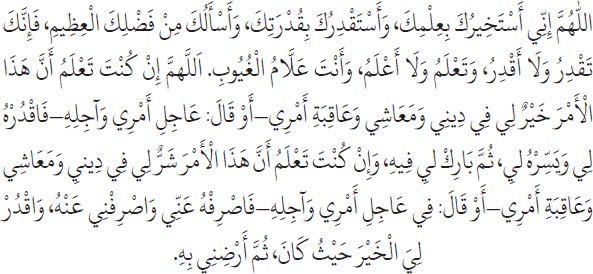
Allāhumma innī astakhīruka bi-‘ilmik, wa astaqdiruka bi-qudratik, wa as’aluka min faḍlika-l-‘aẓīm, fa-innaka taqdiru wa lā aqdir, wa ta‘lamu wa la a‘lam, wa Anta ‘Allāmu-l-ghuyūb. Allāhumma in kunta ta‘lamu anna hādha-l-amra khayrun lī fī dīnī wa ma‘āshī wa ‘āqibati amrī—or: ‘ājili amrī wa ājilihi—fa-qdurhu lī wa yassirhu lī, thumma bārik lī fīh, wa in kunta ta‘lamu anna hādha-l-amra sharrun lī fī dīnī wa ma‘āshī wa ‘āqibati amrī—or: fī ‘ājili amrī wa ājilihi—fa-ṣrifhu ‘annī wa-ṣrifnī ‘anhu wa-qdur lī-l-khayra ḥaythu kān, thumma arḍinī bīh.
According to the ‘ulamā’, it is mustaḥabb to perform istikhārah with ṣalāh and the above-mentioned du‘ā’. The ṣalāh should be two rak‘ahs of supererogatory ṣalāh. What is commonly accepted is that it can be done with two rak‘ahs of regular Sunnah ṣalāh, or with the ṣalāh of greeting the mosque or other nawāfil.
One should recite Qul Yā ayyuha-l-kāfirūn (“Say: O you who reject faith”) in the first rak‘ah and Qul Huwa-llāhu Aḥad (“Say: He is Allah, One”) in the second. If it is difficult for one to perform ṣalāh, one may do the istikhārah with du‘ā’. It is mustaḥabb to begin the du‘ā’ with the praise of Allah and blessings and salutations on the Messenger of Allah . Istikhārah is mustaḥabb in all affairs, as has been explained in an authentic hadith. Once a person has performed istikhārah, he should go towards that to which his heart inclines. And Allah knows best.
. Istikhārah is mustaḥabb in all affairs, as has been explained in an authentic hadith. Once a person has performed istikhārah, he should go towards that to which his heart inclines. And Allah knows best.We relate in the book of at-Tirmidhī, with a weak isnād which at-Tirmidhī, as well as others, considered weak, that Abū Bakr reported that when the Prophet wanted something he would say: “O Allah, choose for me and decide for me.” [2].
reported that when the Prophet wanted something he would say: “O Allah, choose for me and decide for me.” [2].
Allāhumma khir lī wa-khtar lī.
We relate in the book of Ibn as-Sunnī from Anas who reported that the Messenger of Allah said: “Anas, when you intend to do something, seek the guidance of your Lord seven times. Then look at what comes first to your heart, for the good is in it.” [3].This hadith’s isnād is irregular: it contains some individuals who are not known to me.
who reported that the Messenger of Allah said: “Anas, when you intend to do something, seek the guidance of your Lord seven times. Then look at what comes first to your heart, for the good is in it.” [3].This hadith’s isnād is irregular: it contains some individuals who are not known to me.References
[1] Al-Bukhārī (6382), Abū Dāwūd (1538), at-Tirmidhī (480), and an-Nasā’ī (6/80–81) in al-Mujtabā and (498) in ‘Amal al-yawm wa al-laylah.
[2] At-Tirmidhī (3511). Ibn Ḥajar states that this hadith is gharīb, as stated by at-Tirmidhī and al-Bazzār. Zanfal is the only person to have reported it.
[3] Ibn as-Sunnī (603) and al-Futūḥāt (3/357). The chain of narrators contains the narrator Ibrāhīm ibn al-Bara’, who is known to have narrated false reports.