
WE RELATE FROM the Ṣaḥīḥs of al-Bukhārī and Muslim that Ibn ‘Abbās  reported that the Messenger of Allah
  used to say in times of difficulty: “There is no god but Allah, the Tremendous, the Clement. There is no god but Allah, Lord of the Mighty Throne. There is no god but Allah, Lord of the heavens and the earth and Lord of the Noble Throne.” [1].And in a narration of Muslim there is, “When the Prophet was distressed by some concern . . . he would say that.” His words ‘ḥazabahu amrun’ mean ‘when an important matter arose’ or ‘when he was afflicted by distress’.
reported that the Messenger of Allah used to say in times of difficulty: “There is no god but Allah, the Tremendous, the Clement. There is no god but Allah, Lord of the Mighty Throne. There is no god but Allah, Lord of the heavens and the earth and Lord of the Noble Throne.” [1].And in a narration of Muslim there is, “When the Prophet was distressed by some concern . . . he would say that.” His words ‘ḥazabahu amrun’ mean ‘when an important matter arose’ or ‘when he was afflicted by distress’.
Lā ilāha illa-llāhu-l-‘Aẓīmu-l-Ḥalīm, lā ilāha illa-llāhu Rabbu-l-‘Arshi-l-‘aẓīm, lā ilāha illa-llāhu, Rabbu-s-samāwāti wa Rabbu-l-arḍi Rabbu-l-‘Arshi-l-karīm.
We relate in the book of at-Tirmidhī from Anas , who reported that when something was difficult for him the Prophet used to say: “O Living and Everlasting, I seek help through Your Mercy.” [2].According to al-Ḥākim, this hadith has a ṣaḥīḥ isnād.
, who reported that when something was difficult for him the Prophet used to say: “O Living and Everlasting, I seek help through Your Mercy.” [2].According to al-Ḥākim, this hadith has a ṣaḥīḥ isnād.
Yā Ḥayyu yā Qayyūmu bi-raḥmatika astaghīth.
We relate from Abū Hurayrah , who reported that when the Messenger of Allah was worried about something he would raise his head towards the sky and say: “Glory be to Allah the Tremendous.” [3].And when exerting himself in making du‘ā’ he would say: “O Living, O Eternally Self-Sustaining”.
, who reported that when the Messenger of Allah was worried about something he would raise his head towards the sky and say: “Glory be to Allah the Tremendous.” [3].And when exerting himself in making du‘ā’ he would say: “O Living, O Eternally Self-Sustaining”.
Subḥāna-llāhi-l-‘Aẓīm. Yā Ḥayyu yā Qayyūm.
We relate from the Ṣaḥīḥs of al-Bukhārī and Muslim that Anas said that the most frequent du‘ā’ of the Messenger was: “O Allah, our Lord, grant us good in this world and good in the Hereafter and spare us the punishment of Hell-Fire.” [4].
said that the most frequent du‘ā’ of the Messenger was: “O Allah, our Lord, grant us good in this world and good in the Hereafter and spare us the punishment of Hell-Fire.” [4].
Allāhumma Rabbanā ātinā fī-d-dunyā ḥasanatan wa fi-l-ākhirati ḥasanatan wa qinā ‘adhāba-n-Nār.
Muslim added in one narration that he said, “And when Anas wanted to supplicate with a single da‘wah. . . he would supplicate with it. If he wanted to supplicate with a du‘ā’ he would include that in his supplication.”
We relate in the books of an-Nasā’ī and Ibn as-Sunnī, from ‘Abdullāh ibn Ja‘far who reported that ‘Alī said: “The Messenger of Allah taught me these words and told me to say them whenever a problem or calamity befell me: There is no god but Allah, the Noble, the Tremendous; Glory be to Him. Blessed is Allah, Lord of the Tremendous Throne. Praise be to Allah, Lord of the Worlds.” ‘Abdullāh ibn Ja‘far used to say this and then blow it over the feverishly sick (maw‘ūk). He also used to teach it to his daughters who were married to people not of their kindred (mughtaribah). [5].
said: “The Messenger of Allah taught me these words and told me to say them whenever a problem or calamity befell me: There is no god but Allah, the Noble, the Tremendous; Glory be to Him. Blessed is Allah, Lord of the Tremendous Throne. Praise be to Allah, Lord of the Worlds.” ‘Abdullāh ibn Ja‘far used to say this and then blow it over the feverishly sick (maw‘ūk). He also used to teach it to his daughters who were married to people not of their kindred (mughtaribah). [5].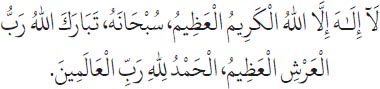
Lā ilāha illa-llāhu-l-Karīmu-l-‘Aẓīm, subḥānah, tabāraka-llāhu Rabbu-l-‘Arshi-l-‘Aẓīm, al-ḥamdu li-llāhi Rabbi-l-‘ālamīn.
A maw‘ūk is a person with a fever. Some say it is a person who is struggling with a severe fever. Women who are mughtaribah are those who are married off to non-relatives.
We relate in the Sunan of Abū Dāwūd that Abū Bakrah reported that the Mes senger of Allah said: “The du‘ā’ for people in difficulty to say is: O Allah, I hope for Your Mercy, so do not entrust me to myself for the blink of an eye. Put all my affairs right for me. There is no god but You.” [6].
reported that the Mes senger of Allah said: “The du‘ā’ for people in difficulty to say is: O Allah, I hope for Your Mercy, so do not entrust me to myself for the blink of an eye. Put all my affairs right for me. There is no god but You.” [6].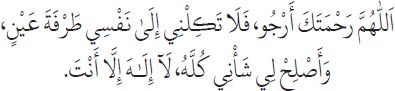
Allāhumma raḥmataka arjū, fa-lā takilnī ilā nafsī ṭarfata ‘ayn, wa aṣliḥ lī sha’nī kullah, lā ilāha illā Ant.
We relate in the Sunans of Abū Dāwūd and Ibn Mājah, from Asmā’ bint ‘Umays  , who narrated that the Messenger of Allah said to her: “Shall I not teach you words for you to say in times of distress?” or “when in distress?” Allah, Allah is my Lord, I do not assign anything as a partner to Him.” [7].
, who narrated that the Messenger of Allah said to her: “Shall I not teach you words for you to say in times of distress?” or “when in distress?” Allah, Allah is my Lord, I do not assign anything as a partner to Him.” [7].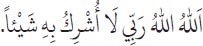
Allāhu Allāhu Rabbī lā ushriku bihi shay’ā.
We relate in the book of Ibn as-Sunnī from Abū Qatādah who reported that the Messenger of Allah said: “Whoever recites the Verse of the Throne and the last verse of the Chapter of the Cow (Sūrat al-Baqarah) when in distress, Allah  will help him.” [8].
who reported that the Messenger of Allah said: “Whoever recites the Verse of the Throne and the last verse of the Chapter of the Cow (Sūrat al-Baqarah) when in distress, Allah will help him.” [8].We relate in Ibn as-Sunnī from Sa‘d ibn Abī Waqqāṣ, who reported that he heard the Messenger of Allah say: “I will teach you something to say which no person in distress says without it being removed from him. It is what my brother Yūnus  said: ‘So he cried through the depths of darkness, “There is no god but You. Glory to You; indeed, I have been one of those who do wrong.”’” [9].
say: “I will teach you something to say which no person in distress says without it being removed from him. It is what my brother Yūnus said: ‘So he cried through the depths of darkness, “There is no god but You. Glory to You; indeed, I have been one of those who do wrong.”’” [9].
Fa-nādā fi-ẓ-ẓulumāti al-Lā ilāha illā Anta subḥānaka innī kuntu mina-ẓ-ẓālimīn.
At-Tirmidhī related it thus from Sa‘d, and said: “Sa‘d reported that the Messenger of Allah said: ‘The supplication of Dhū an-Nūn when he supplicated to his Lord while in the belly of the fish was: There is no god but You. Glory to You; indeed, I have been one of those who do wrong. [10].No Muslim man ever supplicates with it without Allah answering him.’”
reported that the Messenger of Allah said: ‘The supplication of Dhū an-Nūn when he supplicated to his Lord while in the belly of the fish was: There is no god but You. Glory to You; indeed, I have been one of those who do wrong. [10].No Muslim man ever supplicates with it without Allah answering him.’”
Lā ilāha illā Anta subḥānaka innī kuntu mina-ẓ-ẓālimīn.
References
[1] Al-Bukhārī (6345), Muslim (2730), at-Tirmidhī (3431), and an-Nasā’ī (652).
[2] At-Tirmidhī (3522).
[3] At-Tirmidhī (3432), who states that this hadith is gharīb.
[4] Al-Bukhārī (6389) and Muslim (2690).
[5] An-Nasā’ī (630), Ibn as-Sunnī (343), and al-Futūḥāt (4/7). Ibn Ḥajar grades this hadith as ṣaḥīḥ.
[6] Abū Dāwūd (5090) and an-Nasā’ī (651).
[7] Abū Dāwūd (345).
[8] Ibn as-Sunnī (346) and al-Futūḥāt (4/11). There is a break in the chain of this hadith and it contains narrators who are unknown.
[9] Qur’ān 21:87.
[10] At-Tirmidhī (3500) and al-Ḥākim in al-Mustadrak (1/505), who grades it as ṣaḥīḥ, and adh-Dhahabī agrees.