
IT IS MUSTAḤABB to say: ‘In the name of Allah,’ to remember Allah  a great deal and to call out greetings, whether or not there is a human in the house because of the words of Allah : “If you enter a house then greet one another, a greeting from Allah, blessed and pure.” [1].
a great deal and to call out greetings, whether or not there is a human in the house because of the words of Allah : “If you enter a house then greet one another, a greeting from Allah, blessed and pure.” [1].
We relate in the book of at-Tirmidhī that Anas  said: “The Messenger of Allah
  told me: “O my son, when you come to your family, greet them, for it will be a blessing on you and on the members of your family.” [2].At-Tirmidhī described this hadith as ḥasan ṣaḥīḥ.
said: “The Messenger of Allah told me: “O my son, when you come to your family, greet them, for it will be a blessing on you and on the members of your family.” [2].At-Tirmidhī described this hadith as ḥasan ṣaḥīḥ.We relate in the Sunan of Abū Dāwūd that Abū Mālik al-Ash‘arī , whose name was al-Ḥārith—but some say ‘Ubayd, some say Ka‘b and some say ‘Amr—reported that the Messenger of Allah said: “When a man enters his house he should say: O Allah, I ask You for the best entrance and the best exit. In the name of Allah do we enter and in the name of Allah do we leave, and in Allah our Lord do we trust. Then he should greet his family.” [3].Abū Dāwūd did not consider this hadith weak.
, whose name was al-Ḥārith—but some say ‘Ubayd, some say Ka‘b and some say ‘Amr—reported that the Messenger of Allah said: “When a man enters his house he should say: O Allah, I ask You for the best entrance and the best exit. In the name of Allah do we enter and in the name of Allah do we leave, and in Allah our Lord do we trust. Then he should greet his family.” [3].Abū Dāwūd did not consider this hadith weak.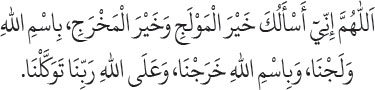
Allāhumma innī as’aluka khayra-l-mawlaj, wa khayra-l-makhraj, bismi-llāhi walajnā wa bismi-llāhi kharajnā, wa ‘ala-llāhi Rabbinā tawakkalnā.
We relate in Abū Umāmah al-Baḥilī , whose name was Ṣuday ibn ‘Ajlān , that the Messenger of Allah said: “Three people are under the protection of Allah : a man who goes out striving for the Cause of Allah will be the responsibility of Allah and under His protection until he passes away and He enters him into Paradise, or He brings him back with whatever reward and booty he may attain; a man who goes out to the mosque will be the responsibility of Allah and under His protection until he passes away and He enters him into Paradise, or He brings him back with whatever reward and booty he may attain; and a man who enters his house with a greeting will be under the protection of Allah .” [4].This hadith is ḥasan and was narrated by Abū Dāwūd, with a ḥasan isnād, as well as by others.
, whose name was Ṣuday ibn ‘Ajlān , that the Messenger of Allah said: “Three people are under the protection of Allah : a man who goes out striving for the Cause of Allah will be the responsibility of Allah and under His protection until he passes away and He enters him into Paradise, or He brings him back with whatever reward and booty he may attain; a man who goes out to the mosque will be the responsibility of Allah and under His protection until he passes away and He enters him into Paradise, or He brings him back with whatever reward and booty he may attain; and a man who enters his house with a greeting will be under the protection of Allah .” [4].This hadith is ḥasan and was narrated by Abū Dāwūd, with a ḥasan isnād, as well as by others.The meaning of ‘protected by Allah’ is to have ‘protection’ or be the owner of protection. ‘Protection’ means stewardship over something. For example, one says ‘dates and milk’, meaning somebody who has dates and milk. So, its meaning is that he is under the stewardship of Allah Most High. And how abundant this gift is! O Allah, grant us provision of it!
We relate that Jābir ibn ‘Abdullāh reported that he heard the Messenger of Allah say: “If a man enters his home and remembers Allah when entering and eating, Shayṭān says: ‘There is no bed and no supper for you [with me].’ If he enters and does not remember Allah on entering, Shayṭān says: ‘You have found lodgings [with me].’ If he does not remember Allah when he eats he says: ‘You have found lodgings and supper [with me].’” [5].Muslim narrated this in his Ṣaḥīḥ.
reported that he heard the Messenger of Allah say: “If a man enters his home and remembers Allah when entering and eating, Shayṭān says: ‘There is no bed and no supper for you [with me].’ If he enters and does not remember Allah on entering, Shayṭān says: ‘You have found lodgings [with me].’ If he does not remember Allah when he eats he says: ‘You have found lodgings and supper [with me].’” [5].Muslim narrated this in his Ṣaḥīḥ.We relate in the book of Ibn as-Sunnī from ‘Abdullāh ibn ‘Amr ibn al-‘Āṣ  that when the Messenger of Allah returned to his house during the day he would say: “Praise be to Allah, Who has sufficed me and given me refuge; all praise is due to Allah, Who has fed me and quenched my thirst; all praise is due to Allah, Who has favoured me. I ask You to protect me from Hell-Fire.” [6].The isnād of this hadith is weak.
that when the Messenger of Allah returned to his house during the day he would say: “Praise be to Allah, Who has sufficed me and given me refuge; all praise is due to Allah, Who has fed me and quenched my thirst; all praise is due to Allah, Who has favoured me. I ask You to protect me from Hell-Fire.” [6].The isnād of this hadith is weak.
Al-ḥamdu li-llāhi-lladhī kafānī wa āwānī, wa-l-ḥamdu li-llāhi-lladhī aṭ‘amanī wa saqānī, wa-l-ḥamdu li-llāhi-lladhī manna ‘alayy, as’aluka an tujīranī mina-n-nār.
We relate from Mālik who reports in his Muwaṭṭā’ that it had reached him that it is mustaḥabb, upon entering an uninhabited house, to say: “Peace be upon us and upon the righteous servants of Allah.”

As-salāmu ‘alaynā wa ‘alā ‘ibādi-llāhi-ṣ-ṣāliḥīn.
References
[1] Qur’ān 24:61.
[2] At-Tirmidhī (2699). In some editions of at-Tirmidhī it is stated that this hadith is ḥasan ṣaḥīḥ gharīb. Ibn Ḥajar collated numerous chains of transmission for the hadith , which strengthen it.
[3] Abū Dāwūd (5096).
[4] Abū Dāwūd (2494).
[5] Muslim (2018), Abū Dāwūd (3765), and an-Nasā’ī (178) in ‘Amal al-yawm wa al-laylah.
[6] Ibn as-Sunnī (157), with a slight change in the wording. Ibn Ḥajar mentioned supporting narrations for it, which raise it to the level of ḥasan.