
Remembrance 11 from Chapter 51
What to say in the morning and the evening
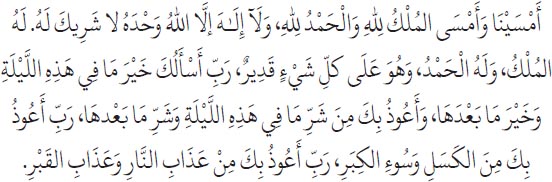
Amsaynā wa amsā-l-mulku li-llāhi wa-l-ḥamdu li-llāh, wa lā ilāha illa-llāhu waḥdahu lā sharīka lah, lahu-l-mulk, wa lahu-l-ḥamd, wa Huwa ‘alā kulli shay’in Qadīr. As’aluka khayra mā fī hādhihi-l-laylati wa khayra mā ba‘dahā, wa a‘ūdhu bika min sharri mā fī hādhihi-l-laylati wa sharri mā ba‘dahā. Rabbi a‘ūdhu bika min al-kasali wa sū’i-l-kibar. Rabbi a‘ūdhu bika min ‘adhābi-n-Nāri wa ‘adhābi-l-qabr.
And we relate from the Ṣaḥīḥ of Muslim from ‘Abdullāh ibn Mas‘ūd  who reported that when it became evening the Messenger of Allah
  used to say: “We have seen evening come and the Kingdom belongs to Allah this evening. Praise be to Allah. There is no god but Allah alone without partner.” The narrator said: I believe he said: “His is the kingdom and His is the praise, and He has power over all things. O my Lord, I ask You for the good that is in this night and the good that comes after it. O my Lord, I ask Your protection from the evil that is in this night and the evil that comes after it. I seek Your protection from laziness, senility and the harm of old age. [Lord] I seek Your protection from punishment in Hell-Fire and punishment in the grave.” When he got up in the morning he also said: “We have seen morning come, and the Kingdom belongs to Allah this morning.” [12].