
Remembrance 19 from Chapter 51
What to say in the morning and the evening
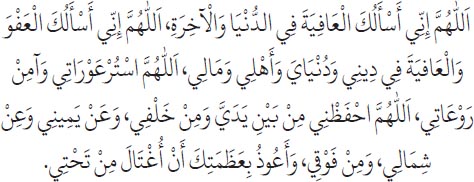
Allāhumma innī as’aluka-l-‘āfiyata fi-d-dunyā wa-l-ākhirah, Allāhumma innī as’aluka-l-‘afwa-l-‘āfiyata fī dīnī wa dunyāya wa ahlī wa mālī, Allāhumma-stur ‘awrātī wa āmin raw‘ātī, Allāhumma-ḥfaẓnī min bayni yadayya wa min khalfī, wa ‘an yamīnī wa ‘an shimālī, wa min fawqī, wa a‘ūdhu bi-‘aẓamatika an ughtāla min taḥtī.
And we relate with ṣaḥīḥ isnāds from the Sunans of Abū Dāwūd, an-Nasā’ī and Ibn Mājah from Ibn ‘Umar  , who said that the Prophet never failed to say these words when he got up in the morning or in the evening: “O Allah, I ask You for well-being in this world and in the Hereafter. O Allah, I ask You for forgiveness and well-being in my religion, my worldly life, and my family and wealth. O Allah, hide my faults and grant me security from my fears. O Allah, protect me from what is in front of me and from what is behind me, and from what is to my right and my left and above me. I seek Your protection in Your Vastness from being misled from below me.” [20].According to al-Wakī‘, this last phrase refers to ‘shame’ (al-khasf). According to al-Ḥākim Abū ‘Abdullāh, this is a hadith with a ṣaḥīḥ isnād.
 , which is not the case.